Band 5.5 IELTS Writing Task 1 Model Answer
Overall Band Score: 5.5 · Cambridge IELTS 21 · 2026-11-23
IELTS Writing Task 1 question
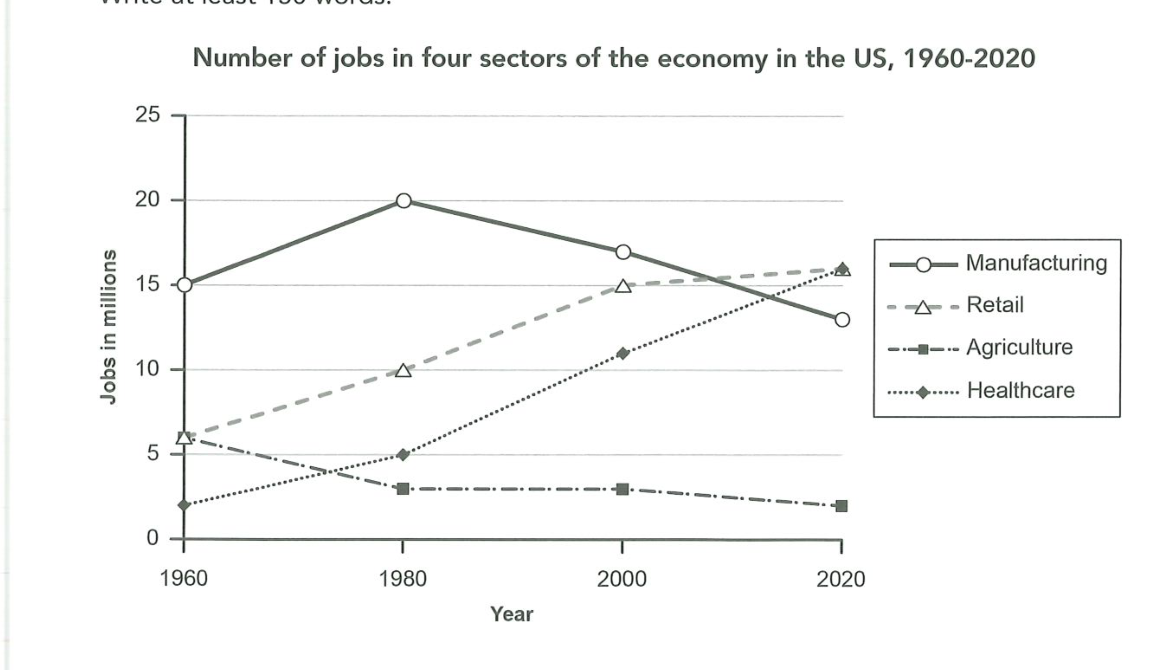
The graph below gives information about the number of jobs in four sectors of the economy in the US between 1960 and 2020.
Summarise the information by selecting and reporting the main features, and make comparisons where relevant.
Number of jobs in four sectors of the economy in the US, 1960-2020
Student answer (Band 5.5)
The graph illustrates the number of job in four different sectors manufacturing, retail, agriculture and healthcare in the [redacted phone], the number is given in millions.
First of all, the manufacturing industry was leading in 1960,at 15 millions jobs and the number rose to 20 million in 1980, which was the highest among others. After that it show decline till 2020 and reach at 15 million. The number of jobs in retail industry was at 7 million and the was gradually increasing till 2020 and reached at 16 billion employment, which had the highest number of employees compare to three others in 2020. Agriculture field was at same as retail with 7 million jobs but it shows a decline trend and it remained least in 2020 at only 3 million respectively. Similarly the healthcare sector was at 4 million, the number was increasing gradually and surpassed manufacturing and agriculture industry and reached at 16 billion jobs in 2020.
In conclusion, in 1960, manufacturing industry leading in number of jobs and health care was at last but in 2020, retail and healthcare industry was at same number of employees and agriculture field was at least number of jobs.
AI examiner evaluation
| Criterion | Band |
|---|---|
| Task Achievement / Task Response | 5.5 |
| Coherence and Cohesion | 6.0 |
| Lexical Resource | 5.5 |
| Grammatical Range and Accuracy | 5.0 |
| Overall | 5.5 |
Task Achievement / Task Response: Band 5.5
You identify the main sectors and report several important patterns: manufacturing peaks in 1980 before declining, agriculture falls, and healthcare and retail rise to joint-highest employment by 2020. However, some figures are inaccurate: manufacturing ends at about 13 million, not 15; retail begins at 6 million, not 7; and healthcare starts at 2 million, not 4. The repeated use of “billion” for 2020 values is also inconsistent with the graph’s unit of millions. Your overview is present, but the conclusion says retail and healthcare are equal without clearly summarising the major changes across the period. More accurate figures and a concise overview of the contrasting trends would make the report more complete.
Coherence and Cohesion: Band 6.0
The response has a clear overall arrangement: an introduction, a paragraph describing the sector trends, and a concluding comparison. Sequencing expressions such as “First of all,” “After that,” and “Similarly” help the reader follow the timeline. However, most details are crowded into one long body paragraph, and the links between sectors are sometimes unclear—for example, “the was gradually increasing” does not clearly identify the subject. The conclusion largely repeats information already given rather than adding a crisp overview. Grouping the rising sectors together and the declining sectors together, with clearer sentence boundaries and references, would improve progression and make the comparisons easier to follow.
Lexical Resource: Band 5.5
You use relevant vocabulary for describing trends, including “rose,” “decline,” “gradually increasing,” and “surpassed,” so the main patterns are generally understandable. However, several word choices and collocations are inaccurate or repetitive: “number of job,” “leading,” “decline trend,” and “at least number of jobs” do not express the intended ideas naturally. “16 billion employment” and “16 billion jobs” also misuse the unit and the noun phrase, which can confuse the reader about the data. Aim for precise, conventional expressions such as “number of jobs,” “peaked at,” “fell to,” and “the lowest figure.” A wider range of accurate trend language would make the report clearer and more fluent.
Grammatical Range and Accuracy: Band 5.0
You attempt both simple and more extended sentences, including clauses linked with “which” and “and,” and the overall meaning can usually be followed. However, errors in sentence structure and grammatical forms are frequent enough to make some sentences awkward. For example, “the number rose … which was the highest” has an unclear reference, while “the was gradually increasing” lacks a clear subject. There are also problems with articles, agreement, and plurals in phrases such as “the number of job” and “manufacturing industry leading.” Punctuation is inconsistent, particularly the missing space after “1960,” and some sentences run together. Practise accurate sentence patterns for comparing figures and describing changes over time.
See this exact question answered at other band scores. The same prompt compared across bands.
Browse more IELTS Writing model answers or get your own writing scored by the same AI examiner.