Band 5.5 IELTS Writing Task 1 Model Answer
Overall Band Score: 5.5 · Cambridge IELTS 21 · 2026-11-23
IELTS Writing Task 1 question
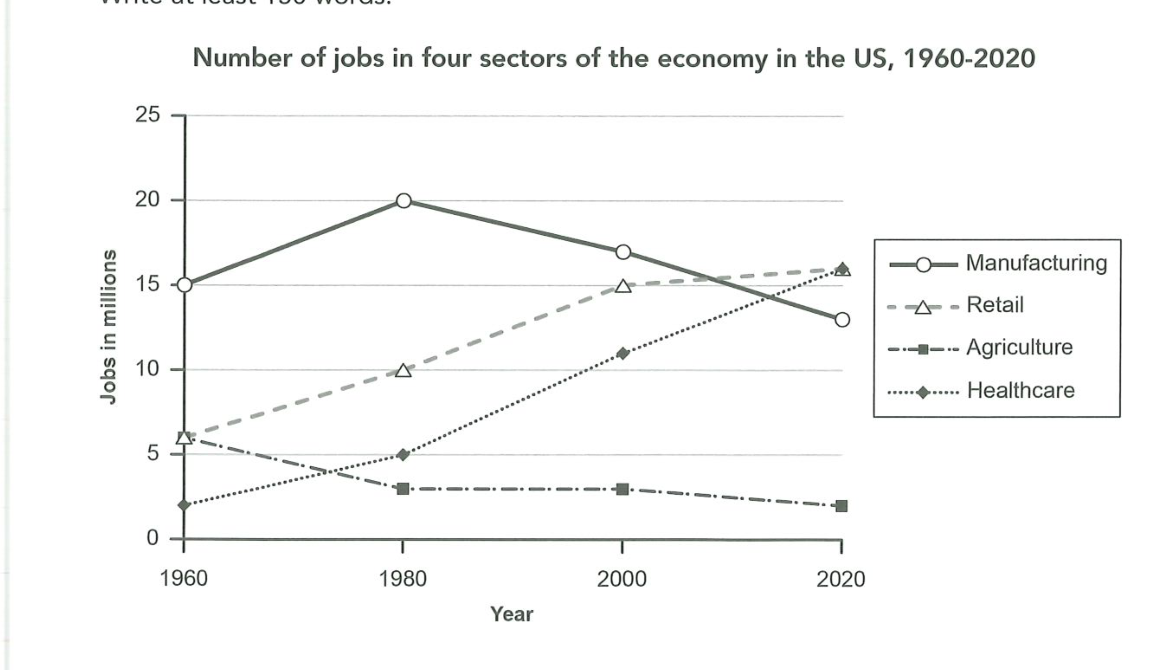
The graph below gives information about the number of jobs in four sectors of the economy in the US between 1960 and 2020.
Summarise the information by selecting and reporting the main features, and make comparisons where relevant.
Number of jobs in four sectors of the economy in the US, 1960-2020
Student answer (Band 5.5)
In the line graph gives the information about the number of jobs in four different sector of the economy in the US between 1960 and 2020 year.
Overall,in US manufacturing leads highest job sector during 1960 to 1980, while Agriculture is lest job sector is used by people as compared to two other sectors.
Firstly, during 1960 ,Manufacturing sectors has good lead for people who doing this job around 15 millions after that in 1980 a more growth seen in this sector and reach upto 20 millions , then in 2020 a sectors was fall upto 13 millions.Retail has wrost leading sector in 1960 around 5 millions after that a minimal increase seen in Retail sector and there is no going back around 10 million, during 2000 15 million and , in 2020 increase upto 16 millions.
Secondly,in 1960 Agriculture sector contributing economy in US was less around 5 million after that a sudden fall seen in agriculture, in 1980 around 1 millionand after that a constant fall seen till 2020 around 1 million. Healthcare sector has increase from begining in 1960 around 1 million after that a constant increase seen in econmy till 2020 around 15 million.
AI examiner evaluation
| Criterion | Band |
|---|---|
| Task Achievement / Task Response | 6.0 |
| Coherence and Cohesion | 5.5 |
| Lexical Resource | 5.0 |
| Grammatical Range and Accuracy | 5.0 |
| Overall | 5.5 |
Task Achievement / Task Response: Band 6.0
You cover all four sectors and identify the main broad patterns: manufacturing rises to a peak before declining, while retail and healthcare grow and agriculture remains the smallest sector. You also include several relevant figures, such as manufacturing reaching 20 million in 1980 and retail reaching 16 million in 2020. However, some details are inaccurate: agriculture falls to about 3 million by 1980 and stays near that level until 2000, rather than dropping to 1 million; it then ends at about 2 million. Healthcare rises to about 16 million, not 15 million. The overview also says manufacturing leads from 1960 to 1980, but does not clearly summarise the later convergence of retail and healthcare. More precise reporting of these trends would strengthen the response.
Coherence and Cohesion: Band 5.5
The response has a recognisable structure: an introduction, an overview, and two body paragraphs. Grouping manufacturing with retail and agriculture with healthcare gives the reader a basic route through the data, and sequencing figures by year helps show change. However, progression is sometimes difficult to follow because several trends are packed into long, loosely connected sentences. Phrases such as “after that” recur, while “there is no going back” does not clearly explain the retail trend. The overview is also brief and does not prepare the reader for the later comparison between retail and healthcare. Use clearer topic sentences and more precise links, such as “By contrast” or “Meanwhile,” to make comparisons easier to track.
Lexical Resource: Band 5.0
You use some relevant chart vocabulary, including “increase,” “fall,” “constant,” and “sector,” so the main trends can generally be understood. However, the range and control of word choice are limited, and several expressions are unnatural or unclear: “good lead,” “wrost leading sector,” and “there is no going back” do not accurately describe the data in an academic report. There are also spelling and word-form errors, including “begining” and “econmy.” Choose standard trend language and collocations, such as “rose steadily,” “declined,” “remained stable,” and “had the fewest jobs.” This would make the description more precise and reduce the effort required to interpret some sentences.
Grammatical Range and Accuracy: Band 5.0
You attempt both simple and more extended sentences, and the reader can usually identify the sectors and their broad trends. However, sentence structures are often faulty, particularly when clauses are joined: “In the line graph gives the information…” lacks a grammatical subject, and “after that a sudden fall seen” omits the verb form needed for a complete clause. There are also recurring problems with articles, plurals, and agreement, as in “four different sector” and “Manufacturing sectors has.” Commas are frequently placed awkwardly, and some sentences run on. Practise forming complete subject–verb clauses and checking agreement and punctuation; for example, “The number of manufacturing jobs rose to 20 million in 1980, then fell to 13 million by 2020.”
See this exact question answered at other band scores. The same prompt compared across bands.
Browse more IELTS Writing model answers or get your own writing scored by the same AI examiner.