Band 6.5 IELTS Writing Task 1 Model Answer
Overall Band Score: 6.5 · Cambridge IELTS 21 · 2026-11-23
IELTS Writing Task 1 question
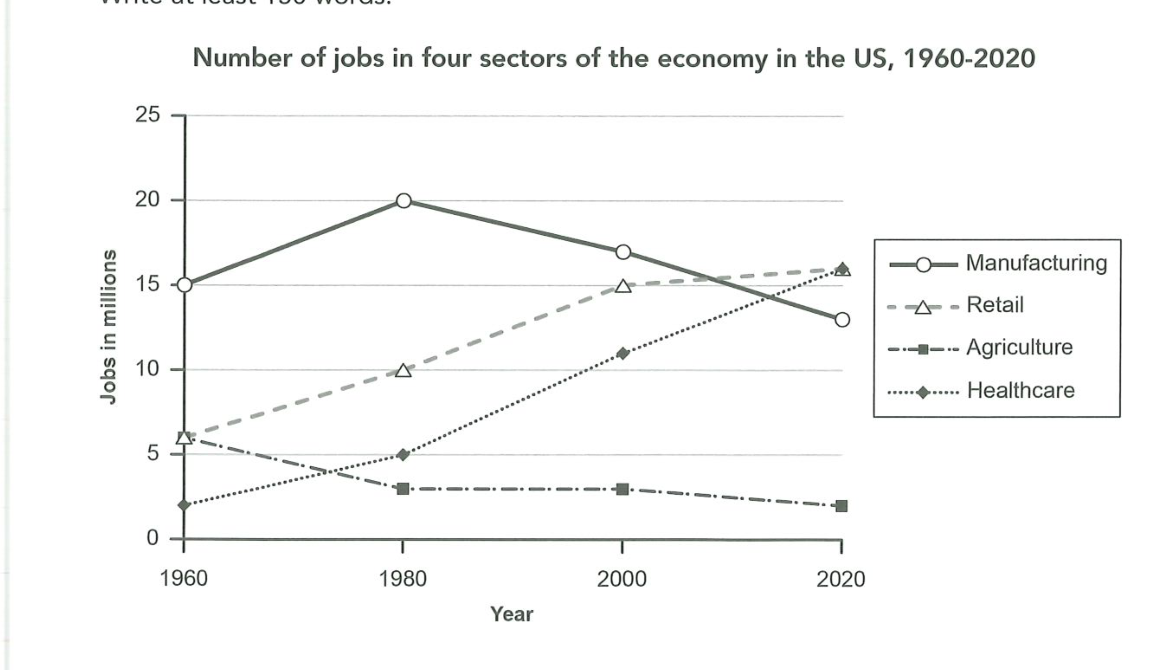
The graph below gives information about the number of jobs in four sectors of the economy in the US between 1960 and 2020.
Summarise the information by selecting and reporting the main features, and make comparisons where relevant.
Number of jobs in four sectors of the economy in the US, 1960-2020
Student answer (Band 6.5)
The following line graph provides information regarding the number of jobs in four sectors of the economoy in the US from 1960 to 2020 ,where the jobs are in millions.
Overall the graph shows and upward trend for retail and healthcare ,whereas it shows downward trend for manufacturing and agriculture .
From the graph it is seen that , at the beginning number of jobs in retail were just over 5 million and over the years it grew and in 2020 it was just over 15 million. Similar growth was also seen for healthcare , which started around 3 million and after 60 years , it was almost similar to retail numbers.
On the other side , Agriculture jobs were always out of trend since the beginning . It started just over 5 millions but the numbers decreased through out the the years and finished at around 3 millions . Jobs in manufacture showed a little peak at 1980 with 20 million job , starting from 15 but since then the numbers gradually decreased and finished way below 15 millions.
AI examiner evaluation
| Criterion | Band |
|---|---|
| Task Achievement / Task Response | 6.5 |
| Coherence and Cohesion | 7.0 |
| Lexical Resource | 6.0 |
| Grammatical Range and Accuracy | 5.5 |
| Overall | 6.5 |
Task Achievement / Task Response: Band 6.5
You identify the main contrast: retail and healthcare rise, while manufacturing and agriculture decline overall. The overview is relevant, and the account includes useful starting and ending comparisons. Several figures and trends are also accurately reported, such as manufacturing peaking at 20 million in 1980 and then falling. However, some details are imprecise: healthcare begins at about 2 million, not around 3 million, and agriculture ends at about 2 million rather than 3 million. The overview also misses that retail and healthcare both reach about 16 million by 2020, jointly matching the highest level. This covers the task, but some features are less fully and precisely reported than others; adding the key intermediate values would make the summary more complete.
Coherence and Cohesion: Band 7.0
The response has a clear overall progression, moving from an introduction and overview to rising sectors and then declining sectors. Paragraphing helps distinguish the main trends, and linking phrases such as “Overall,” “Similar growth,” and “On the other side” guide the reader through the comparisons. The organisation is generally easy to follow, although some transitions are slightly mechanical and the final paragraph combines agriculture and manufacturing without clearly separating their different patterns. For example, agriculture falls and then levels off before declining again, whereas manufacturing rises to a peak and then falls. Grouping the sectors is effective, but clearer internal sequencing and more precise links between the trends would make cohesion more flexible and the comparisons easier to track.
Lexical Resource: Band 6.0
You use an adequate range of vocabulary for describing trends, including “upward trend,” “decreased,” “gradually decreased,” and “finished.” These choices make the main information understandable. There are, however, some spelling and word-choice problems, including “economoy,” “manufacture” for the sector, and “out of trend,” which is not a natural way to describe agriculture’s pattern. Phrases such as “a little peak” and “way below 15 millions” are also informal or imprecise for an academic report. Aim for accurate collocations and a more neutral register, such as “peaked at,” “declined to,” and “remained the smallest sector.” This would improve precision without requiring unnecessarily complex vocabulary.
Grammatical Range and Accuracy: Band 5.5
You attempt both simple and complex sentences, including clauses linked with “whereas,” “which,” and “since then,” and the overall meaning is usually clear. Some grammatical errors remain, particularly with articles, plurals, and sentence punctuation. For example, “shows and upward trend” needs “an,” while “5 millions” and “20 million job” require correct plural forms. The sentence beginning “On the other side” also has awkward punctuation and spacing, and “at the beginning number of jobs” is missing an article or possessive construction. These errors do not generally prevent understanding, but they reduce accuracy. Check articles and singular/plural agreement, and use full stops to separate long sentences.
See this exact question answered at other band scores. The same prompt compared across bands.
Browse more IELTS Writing model answers or get your own writing scored by the same AI examiner.