Band 5.5 IELTS Writing Task 1 Model Answer
Overall Band Score: 5.5 · Cambridge IELTS 21 · 2026-11-23
IELTS Writing Task 1 question
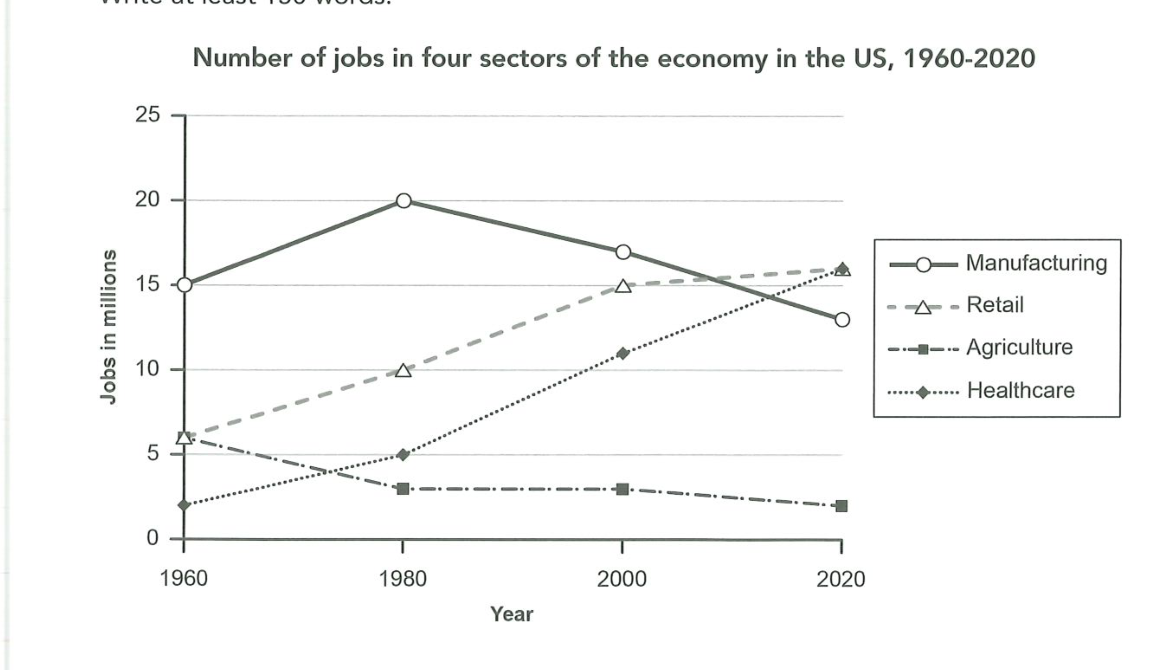
The graph below gives information about the number of jobs in four sectors of the economy in the US between 1960 and 2020.
Summarise the information by selecting and reporting the main features, and make comparisons where relevant.
Number of jobs in four sectors of the economy in the US, 1960-2020
Student answer (Band 5.5)
This line graph illustrates about the number of jobs in four sectors in the economy in the US between 1960 and 2020.
Overall, all the sector of job is thriving however the manufacturing dramatically standout during 1980 while the others start with humble biggening.
In 1960 Manufacturing has the highest rate which 15 percent and still increasing during 1980 with 20 percent number of jobs and then after that in 2000 you will notice base on the chart that it is decreasing around 18 percent and more fewer in 2020 and has a estimated 13 percent.
On the other hand Retail starts with estimated 6 percent during 1960 and dramatically increase in 1980 with 10 percent number of jobs and in 2000 it become higher with a 15 percent and become stable in 2020 with an estimated 16 percent.
In comparison Agriculture start with estimated 6 percent and more decreasing during 1960 and 2000 with an estimated rates of 3 percent and in 2020 it is fewer around 2 percent which has the lowest rate among the others.
And lastly the Healthcare, In 1960 it has estimated 2 percent of number of jobs and then in increase during 1980 with 5 percent rate and got higher in 200 with 11 percentage of rates and get more increase and stable in 2020 which has an estimated 16 percentage of rates.
AI examiner evaluation
| Criterion | Band |
|---|---|
| Task Achievement / Task Response | 6.0 |
| Coherence and Cohesion | 6.0 |
| Lexical Resource | 5.0 |
| Grammatical Range and Accuracy | 5.0 |
| Overall | 5.5 |
Task Achievement / Task Response: Band 6.0
You cover all four sectors and report the main broad patterns: manufacturing peaks in 1980 and then declines, retail and healthcare rise, and agriculture falls to the lowest level. The figures are generally close to the chart, although the vertical axis is jobs in millions, not percentages; describing values as “15 percent” or “20 percent” misstates the units. The overview is also unclear when it says “all the sector of job is thriving,” since agriculture declines throughout. Some details need more precise reporting: manufacturing is about 17 million in 2000, and healthcare reaches about 16 million in 2020, tying with retail. State these key comparisons clearly and distinguish rising from falling sectors.
Coherence and Cohesion: Band 6.0
The response has a recognisable structure: an introduction, an overview, and separate paragraphs describing the sectors. This makes the information broadly easy to follow, and transitions such as “On the other hand,” “In comparison,” and “And lastly” help signal changes in focus. However, the overview does not clearly summarise the main contrasts, and the body reads as a sequence of sector-by-sector descriptions rather than a comparison of related trends. Some linking is mechanical, while phrases such as “and then after that” and repeated “and” make sentences less smooth. Grouping manufacturing with agriculture as declining or contrasting them with the two rising sectors would create clearer progression and more effective comparisons.
Lexical Resource: Band 5.0
You use relevant task vocabulary, including “increasing,” “decreasing,” “highest,” and “lowest,” and the sector names are consistently clear. However, several word choices and collocations are inaccurate or awkward, which limits precision: “thriving” does not describe every sector, “humble biggening” is unsuitable and misspelled, and “more fewer” is not a natural comparison. Repetition of “estimated” and “number of jobs” also makes the account less varied. Use standard trend language and accurate units, such as “rose to 20 million jobs” or “declined to around 13 million.” This would make the description more concise and natural while preserving your clear focus on the data.
Grammatical Range and Accuracy: Band 5.0
You attempt both simple and longer sentences, and the reader can generally understand the sequence of changes. However, some errors in sentence structure, agreement, articles, and verb forms reduce accuracy. For example, “all the sector of job is thriving” has agreement problems, while “Manufacturing has the highest rate which 15 percent” is missing a grammatical link. In “in 200 it become higher,” the year is incomplete and the verb form is incorrect. Capitalisation and punctuation are also inconsistent, as in “And lastly the Healthcare, In 1960…” Practise building complete comparison sentences with a clear subject and verb, and check tense consistency when describing past data. More accurate sentence patterns would make your range easier to follow.
See this exact question answered at other band scores. The same prompt compared across bands.
Browse more IELTS Writing model answers or get your own writing scored by the same AI examiner.