Band 6.5 IELTS Writing Task 1 Model Answer
Overall Band Score: 6.5 · Cambridge IELTS 21 · 2026-11-23
IELTS Writing Task 1 question
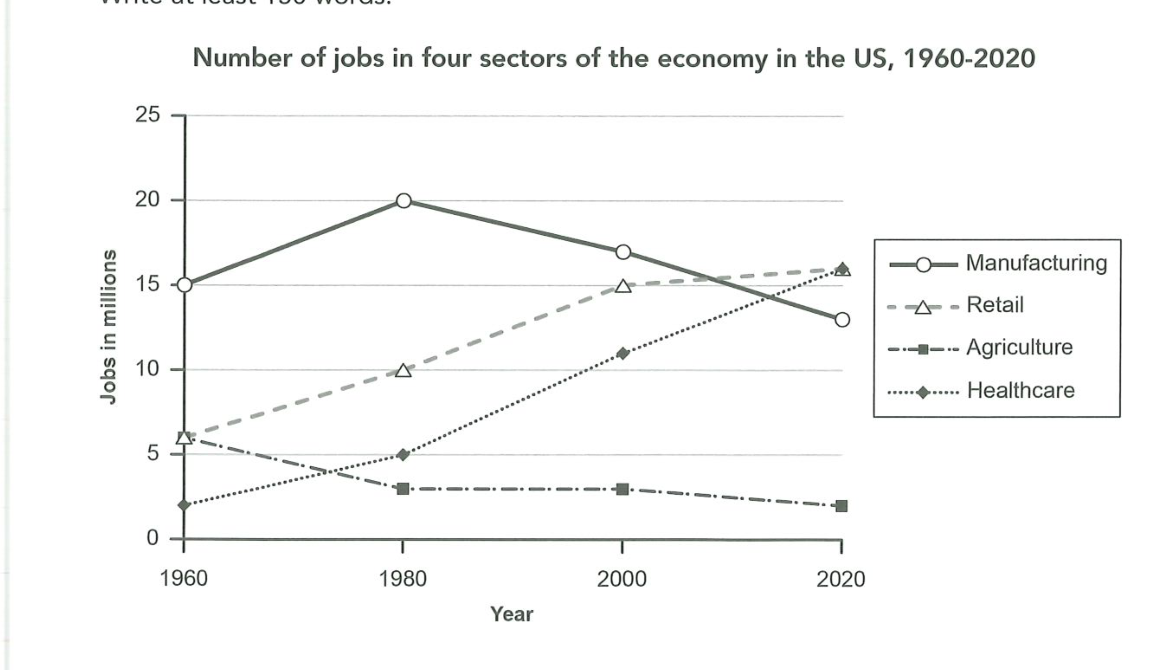
The graph below gives information about the number of jobs in four sectors of the economy in the US between 1960 and 2020.
Summarise the information by selecting and reporting the main features, and make comparisons where relevant.
Number of jobs in four sectors of the economy in the US, 1960-2020
Student answer (Band 6.5)
The given graph illustrates the number of jobs in four main sectors of the economy in the period between 1960 an 2020. The four sectors witnessed drastric changes across the years.
To begin with the manufacturing sector had the biggest number in 1960, which was 15 million jobs and kept increasing and reached 20 million jobs in year 1980. After that the number of jobs in that sector kept decreasing and reached about 13 or14 million jobs in 2020.
The retail and the agriculture sectors started with the same number of jobs in 1960, which was more than 5 million jobs. But the main difference was in the growth of each sector. On one hand agriculture sector job market noticebly declined and the number of jobs kept steadily decreasing and reached about 1 million jobs in the year 2020, on the other hand the retail secor number of jobs increased and by the year 2020 there were more than 15 million jobs available.
Finally the last sector which is healthcare it started in 1960 with the least number of opportunities but the growth didn't stop since then and reached more than 15 million jobs in 202.
Overall each sector had its own ups and downs across the given years. Some sectors declined and others didn't.
AI examiner evaluation
| Criterion | Band |
|---|---|
| Task Achievement / Task Response | 6.0 |
| Coherence and Cohesion | 7.0 |
| Lexical Resource | 6.0 |
| Grammatical Range and Accuracy | 6.0 |
| Overall | 6.5 |
Task Achievement / Task Response: Band 6.0
You identify the main movements in all four sectors and include several relevant figures: manufacturing rises from 15 million to 20 million before falling, while retail and healthcare grow and agriculture declines. However, some details are inaccurate or imprecise: agriculture is about 2 million in 2020, not 1 million, and healthcare reaches about 16 million, rather than simply “more than 15” (also, “202” appears to be a typo for 2020). The overview is too general: “each sector had its own ups and downs” does not clearly summarise the key contrasts. State that manufacturing peaks and then declines, agriculture falls, and retail and healthcare rise, with the latter two ending at roughly the same level. This would make the main features clearer and more fully developed.
Coherence and Cohesion: Band 7.0
The response is organised into a short introduction, separate paragraphs covering the sectors, and a concluding overview. Sequencing phrases such as “To begin with,” “After that,” and “Finally” help the reader follow the account, and the comparison between retail and agriculture gives the middle paragraph a clear focus. Some linking is mechanical, however, particularly “On one hand … on the other hand,” and the final overview repeats the idea of change without drawing the trends together. The long sentence comparing retail and agriculture also carries several ideas at once. Use clearer sentence boundaries and connect the sectors by shared patterns—for example, grouping the two rising sectors—while keeping the overall progression.
Lexical Resource: Band 6.0
You use an adequate range of vocabulary for describing trends, including “increasing,” “decreasing,” “declined,” and “growth,” and the meaning is generally clear. There are also attempts at more descriptive phrasing, such as “the least number of opportunities,” although “jobs” or “employment” would be more precise for this graph. Several spelling and word-choice errors reduce accuracy: “drastric,” “noticebly,” and “secor,” while “the growth didn’t stop” is informal and imprecise for an academic summary. Aim for accurate trend vocabulary and natural collocations, and proofread spellings. More precise choices would help distinguish a peak, a steady decline, and a rise without relying repeatedly on “number of jobs.”
Grammatical Range and Accuracy: Band 6.0
You attempt a mix of simple and complex sentences, including a time clause in “After that the number of jobs … kept decreasing” and a contrast structure for retail and agriculture. Most relationships remain understandable, but some grammatical errors persist. The opening has “between 1960 an 2020,” and several sentences need commas after introductory phrases, such as “To begin with” and “After that.” The sentence beginning “The retail and the agriculture sectors started…” shifts into a long, loosely joined construction, making its structure harder to control. There are also missing or inconsistent articles in phrases such as “agriculture sector.” Use full stops to separate trend descriptions, check articles and conjunctions, and vary sentence forms while maintaining accurate punctuation.
See this exact question answered at other band scores. The same prompt compared across bands.
Browse more IELTS Writing model answers or get your own writing scored by the same AI examiner.