Band 6.0 IELTS Writing Task 1 Model Answer
Overall Band Score: 6.0 · Cambridge IELTS 21 · 2026-11-23
IELTS Writing Task 1 question
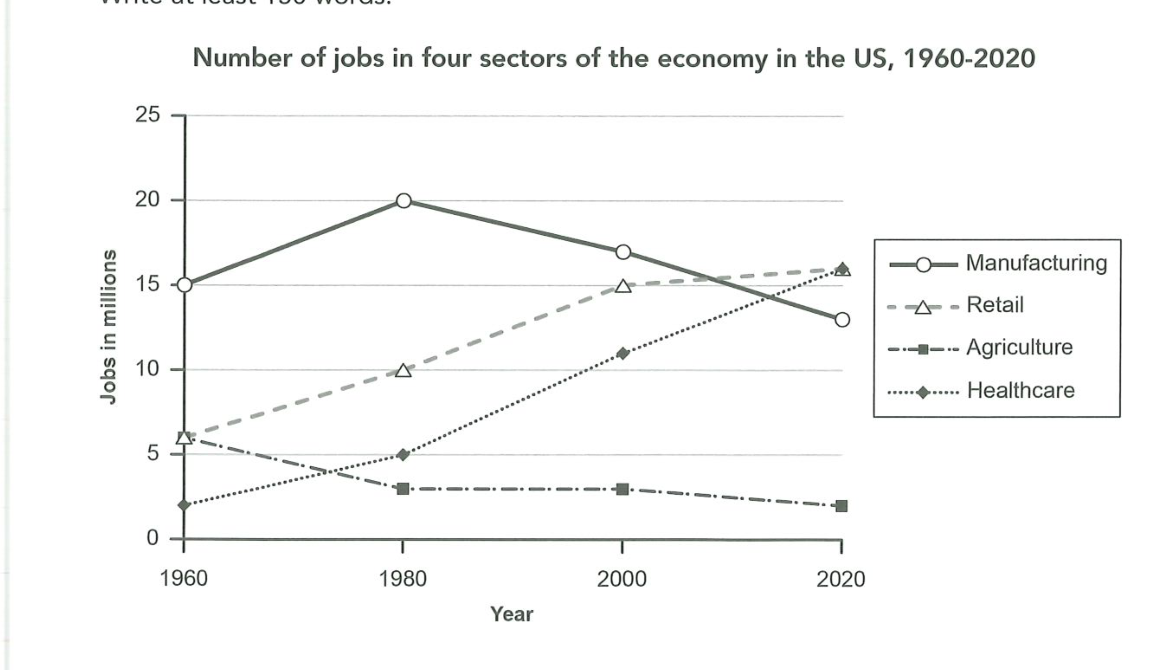
The graph below gives information about the number of jobs in four sectors of the economy in the US between 1960 and 2020.
Summarise the information by selecting and reporting the main features, and make comparisons where relevant.
Number of jobs in four sectors of the economy in the US, 1960-2020
Student answer (Band 6.0)
The given line graph compares the number of jobs of four different sectors contributing to the economy of the US from1960 to 2020.
Overall, Retail and Healthcare sectors were rapidly rising whereas Agriculture sector showed a gradual fall. A notable feature is that, the Manufacturing sector which was leading the economic sector in the beginning had a slight fall by the end of the period.
Regarding to the increasing trend, Healthcare sector which had provided minimum jobs in the beginning that is around 3 millions job had maximum growth by the end. In 1980, health sector had provided 5 millions job, in 2020 it became the sector providing maximim jobs, i.e around 16 millions job. A similar pattern is showed by Retail sector, it provided around 6 millions job in 1960, which later increased to 15 millions in 2000. The growth continued and in 2020 it met Healthcare sector by providing around 16 millions job.
In Contrast, Manufacturing sector which had provided 15 millions job in 1960 had rapid growth up to 1980. It had provided 20 millions job in 1980, but decreased rapidly after 1980 and by the end of period it had provided around 13 millions jobs. Agricultural sector showed gradual declination throughout the period. In 1960, it provided around 6 millions jobs, which declined to around 3 millions by 2020.
AI examiner evaluation
| Criterion | Band |
|---|---|
| Task Achievement / Task Response | 7.0 |
| Coherence and Cohesion | 6.5 |
| Lexical Resource | 5.5 |
| Grammatical Range and Accuracy | 5.5 |
| Overall | 6.0 |
Task Achievement / Task Response: Band 7.0
The response selects the main trends and supports them with relevant figures: manufacturing peaks at 20 million in 1980 before falling to about 13 million, while retail and healthcare rise to around 16 million by 2020. The overview also identifies agriculture’s decline and manufacturing’s change from the leading sector. These features give the report a clear, relevant account of the graph. There are a few inaccuracies or imprecisions: healthcare starts at about 2 million, not 3 million, and agriculture falls to about 2 million in 2020 rather than 3 million. Also, saying healthcare and retail both provide the maximum in 2020 overlooks that they are tied. More precise reporting of these details would strengthen an otherwise well-selected summary.
Coherence and Cohesion: Band 6.5
The response is organised into an introduction, an overview, and two body paragraphs that group the rising sectors and the declining sectors. This gives the reader a clear route through the information, and phrases such as “In Contrast” help signal a shift in focus. The main progression is logical, but some linking and referencing are awkward or repetitive: “Regarding to the increasing trend” is an unnatural transition, and “which later increased” could be made clearer by naming the sector again. The overview also repeats some points developed in the body. To make the organisation more fluent, use concise transitions and ensure each paragraph adds detail without restating the same trend.
Lexical Resource: Band 5.5
The response uses a relevant range of graph vocabulary, including “rapidly rising,” “gradual fall,” “declined,” and “provided,” so the main trends are generally understandable. However, several word choices and collocations are inaccurate or unnatural, such as “jobs of four different sectors,” “Regarding to,” “met Healthcare sector,” and “gradual declination.” Repetition of “provided” and “sector” also limits flexibility. Spelling errors such as “maximim” further reduce control. Aim for standard reporting expressions such as “the number of jobs in,” “increased to,” “matched,” and “a gradual decline.” More accurate collocations and a wider range of precise verbs would make the description clearer and more natural.
Grammatical Range and Accuracy: Band 5.5
The response attempts a mixture of simple and complex sentences, including relative clauses such as “which later increased to 15 millions in 2000” and contrastive structures describing manufacturing’s rise and fall. However, errors occur across sentence patterns and sometimes make the phrasing awkward. Examples include “from1960” (missing spacing), “that is around 3 millions job,” “In 1980, health sector had provided,” and “Agricultural sector showed gradual declination throughout the period.” Articles, plural forms, and tense choices need more consistent control; for example, use “about 2 million jobs” and “the healthcare sector provided.” Punctuation is also uneven, particularly the comma after “A notable feature is that.” Review sentence boundaries and check agreement, articles, and number forms to improve accuracy.
See this exact question answered at other band scores. The same prompt compared across bands.
Browse more IELTS Writing model answers or get your own writing scored by the same AI examiner.