Band 4.5 IELTS Writing Task 1 Model Answer
Overall Band Score: 4.5 · Cambridge IELTS 21 · 2026-11-23
IELTS Writing Task 1 question
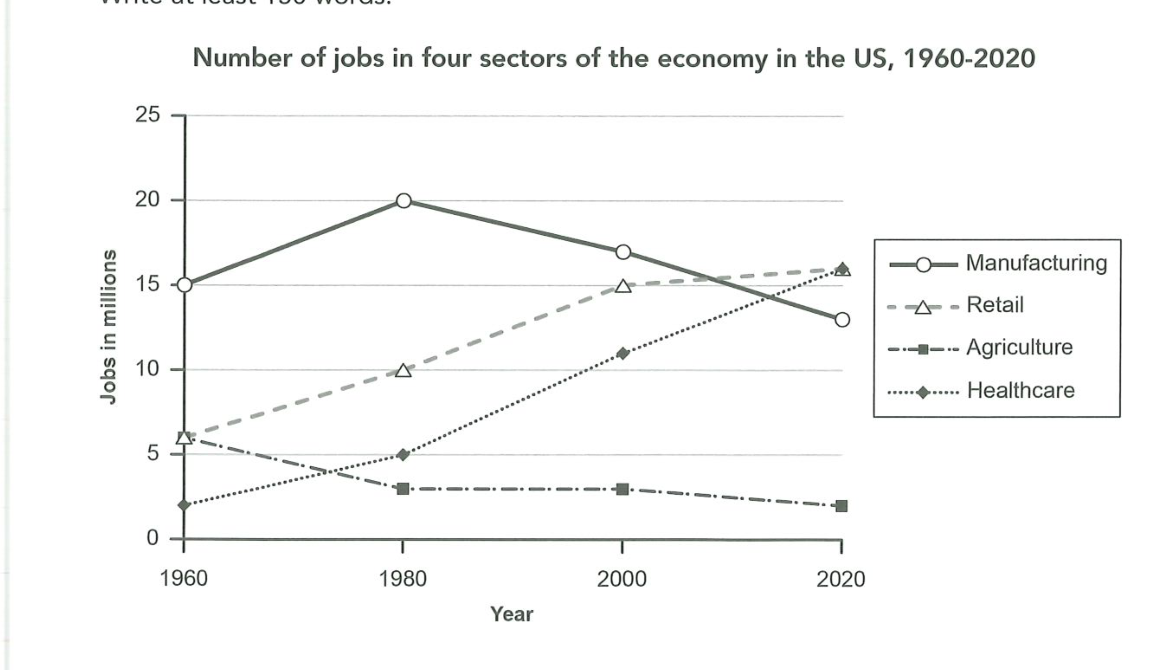
The graph below gives information about the number of jobs in four sectors of the economy in the US between 1960 and 2020.
Summarise the information by selecting and reporting the main features, and make comparisons where relevant.
Number of jobs in four sectors of the economy in the US, 1960-2020
Student answer (Band 4.5)
the graph below represnt number of jobs in four sectors of the economy in US from 1960 to 2020
the graph shows 4 features we have manufacting its all what humaine make
retail its buy thigs to other contries with good prices then we have agricultes
and healthcare
first of all how we can see that the most popular features is manufacturing
US its very famous on this domain by introduce many thing like clothes cars extrs we notic in this graph in 1980 the level its so higher becaus in this period the people discoverd many thing for example clothes many companys like louise vitton prada exct knows a big succed and we have also cars and many thing but in 2000 TO 2020 its sems so diffrents
then we have Retail we notic that between 1960 and 2020 there is a big diffrents she rose so much
then we have agriculture her also she rosee so much US ts famous in producing rice corn coton after 1980 people around the world consumat a lot of this things since that US in the most pawerfull contry in the world we fond thet other contries counsum from her
finally we have helthcare the moste weaker features in this graph its descrased a lot in 2020
AI examiner evaluation
| Criterion | Band |
|---|---|
| Task Achievement / Task Response | 3.5 |
| Coherence and Cohesion | 4.5 |
| Lexical Resource | 4.5 |
| Grammatical Range and Accuracy | 4.5 |
| Overall | 4.5 |
Task Achievement / Task Response: Band 3.5
The response identifies all four sectors and attempts to describe changes over time, but it does not accurately summarise the graph’s main features. Several key trends are reversed: agriculture fell from about 6 million jobs to 2 million, rather than rising, and healthcare increased from about 2 million to 16 million, rather than decreasing. Manufacturing peaked around 1980 and then declined, while retail rose steadily; these comparisons are not clearly or accurately reported. The discussion also adds unsupported explanations about fashion brands, exports and US production instead of focusing on the plotted data. To improve, give a concise overview of the contrasting trends and support it with accurate figures from the graph.
Coherence and Cohesion: Band 4.5
There is a basic sequence, with an opening followed by discussion of the sectors and transitions such as “first of all,” “then,” and “finally.” This gives the reader some sense of progression. However, the response is not organised into clear paragraphs, and the ideas within sections often move away from the graph into explanations about companies, products and other countries. Repeated “then we have” phrasing also makes the linking mechanical, while unclear references such as “she” and “her” make it difficult to follow which sector is being discussed. Grouping the trends into paragraphs—for example, rising sectors and declining sectors—and using clear references would make the report easier to follow.
Lexical Resource: Band 4.5
The response uses some task-related vocabulary, including “manufacturing,” “retail,” “agriculture,” “healthcare,” “level,” and “rose,” so the general subject is recognisable. However, vocabulary is often repetitive or imprecise: “features” is used for economic sectors, and “popular” does not accurately describe the number of jobs. Numerous spelling errors, including “manufacting,” “agricultes,” and “descrased,” make the writing harder to read. Some expressions are also unnatural, such as “the most weaker features” and “a big succed.” Use precise terms for graph trends and employment, and check spelling and collocations. For example, describe a sector’s job total as “employment” or “the number of jobs,” rather than calling it a feature.
Grammatical Range and Accuracy: Band 4.5
The response attempts both simple statements and longer sentences, including clauses introduced by “because” and “since,” but control is inconsistent. Errors in verb forms and sentence construction appear throughout, as in “the level its so higher,” “she rose so much,” and “its descrased a lot.” Articles, agreement and sentence boundaries are also problematic; for instance, “the most popular features is manufacturing” does not maintain agreement, and several ideas run together without clear punctuation. These patterns sometimes obscure the intended meaning. Build accurate short sentences first, using past-tense verbs for the historical data, then add longer comparisons with correctly formed clauses and punctuation.
See this exact question answered at other band scores. The same prompt compared across bands.
Browse more IELTS Writing model answers or get your own writing scored by the same AI examiner.