Band 5.5 IELTS Writing Task 1 Model Answer
Overall Band Score: 5.5 · Cambridge IELTS 21 · 2026-11-24
IELTS Writing Task 1 question
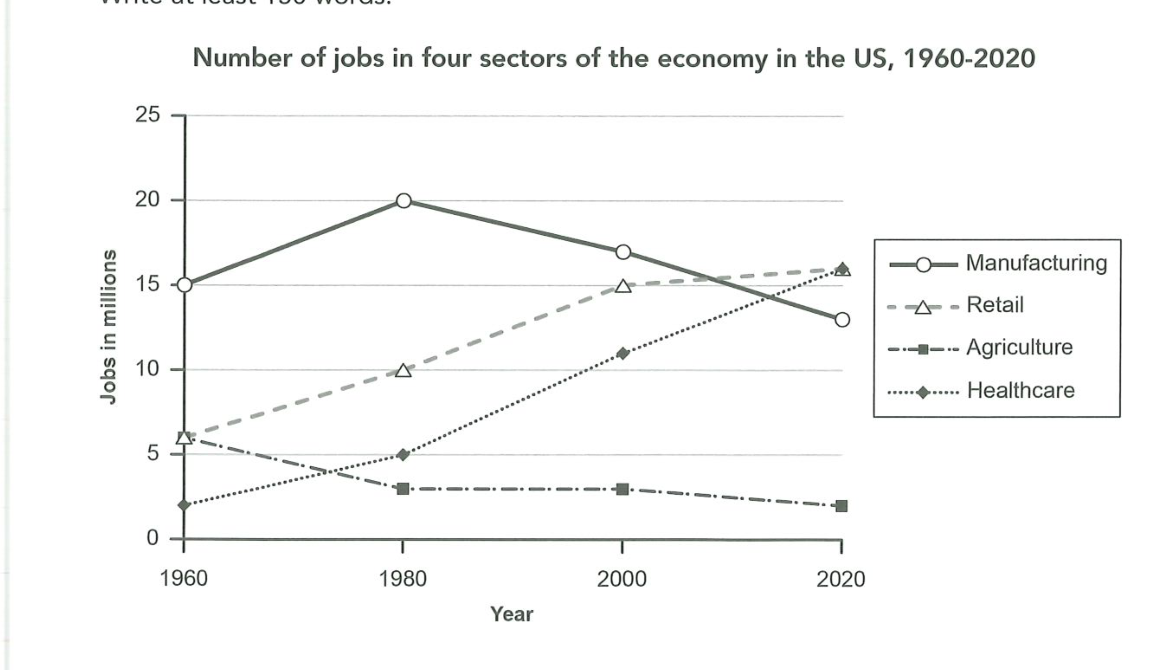
The graph below gives information about the number of jobs in four sectors of the economy in the US between 1960 and 2020.
Summarise the information by selecting and reporting the main features, and make comparisons where relevant.
Number of jobs in four sectors of the economy in the US, 1960-2020
Student answer (Band 5.5)
The line chart illustrate the changes in the number of job in the four sectors in the economy in the US between 1960 and 2020.
Overall, Manufacturing sector varied and slight declined from initial job counts. whereas Retail and Healthcare initially started at the lowest and surpass the manufacturing. Agriculture gradually decline.
In 1960, Manufacturing had the highest jobs across all sector with 15 million jobs, while Healthcare had the lowest jobs with around 2 million jobs. Agriculture and retails had around 6 million jobs. Manufacturing peaked at 20 million jobs in 1980 and than it gradually decline over the period and made the lowest of 13 million in 2020. Agriculture gradually fall from 6 million to 4 million in 1980.
Healthcare had drastically increased from 2 million to 5 million and at the end it peaked with the Retail with 16 million jobs. Retail had drastically rose and it was in trend.Agriculture made a low of 2 million jobs.
AI examiner evaluation
| Criterion | Band |
|---|---|
| Task Achievement / Task Response | 6.0 |
| Coherence and Cohesion | 5.0 |
| Lexical Resource | 5.5 |
| Grammatical Range and Accuracy | 5.0 |
| Overall | 5.5 |
Task Achievement / Task Response: Band 6.0
You identify the main overall patterns: manufacturing reaches a high point before declining, agriculture falls, and healthcare and retail rise. You also give several relevant figures, including manufacturing’s 15 million jobs in 1960 and 20 million in 1980, and healthcare’s rise from 2 million. However, some key comparisons are unclear or incomplete. Retail’s steady increase to 16 million is not described with intermediate figures, and the overview’s claim that retail and healthcare “surpass the manufacturing” is imprecise: by 2020 both are above manufacturing, but healthcare only reaches the same level as retail. There is also a factual error: agriculture falls to about 3 million in 1980, not 4 million. A clearer overview and more accurate, balanced reporting of the four trends would strengthen the response.
Coherence and Cohesion: Band 5.0
The response has a recognisable structure, with an introduction, an overview and paragraphs reporting details, so the reader can identify the broad subject and some trends. However, progression within the details is uneven: manufacturing and agriculture are discussed together, then healthcare and retail, but the retail account is left vague and the final agriculture figure is added abruptly. Linking is limited, and phrases such as “whereas” after a full stop and “and it was in trend” do not create clear relationships between ideas. The overview also combines several trends in a sentence that is difficult to follow. Grouping the rising sectors together and the declining sectors together, then using clear comparisons and references, would make the organisation more coherent.
Lexical Resource: Band 5.5
You use relevant chart vocabulary, including “peaked,” “gradually decline,” “increased,” and “million jobs,” which helps communicate the main movements. There is some variety in how trends are described, but word choice and collocation are often inaccurate or repetitive. For example, “made the lowest” and “made a low” are not natural ways to describe a figure, while “it was in trend” does not clearly convey a trend. “Drastically” is also too strong for the steady increases shown. Errors such as “job” for “jobs” and “retails” for “retail” affect precision. Aim for accurate chart collocations such as “fell to,” “rose steadily,” and “remained stable,” and use them consistently.
Grammatical Range and Accuracy: Band 5.0
You attempt both simple and more complex sentences, including comparisons with “while” and a time clause beginning “and at the end.” The main meaning is generally recoverable, but errors in agreement, tense, articles and sentence boundaries are noticeable. For example, “The line chart illustrate” needs subject–verb agreement, and “the number of job” needs a plural noun. In “Agriculture gradually decline,” the verb form is incorrect; “than” is also used where “then” is intended. The overview sentence beginning “whereas” is not properly attached to the preceding sentence, and punctuation around “it was in trend” is unclear. Check agreement and past-tense forms, and build complete sentences with clear punctuation.
See this exact question answered at other band scores. The same prompt compared across bands.
Browse more IELTS Writing model answers or get your own writing scored by the same AI examiner.