Band 5.5 IELTS Writing Task 1 Model Answer
Overall Band Score: 5.5 · Cambridge IELTS 21 · 2026-11-24
IELTS Writing Task 1 question
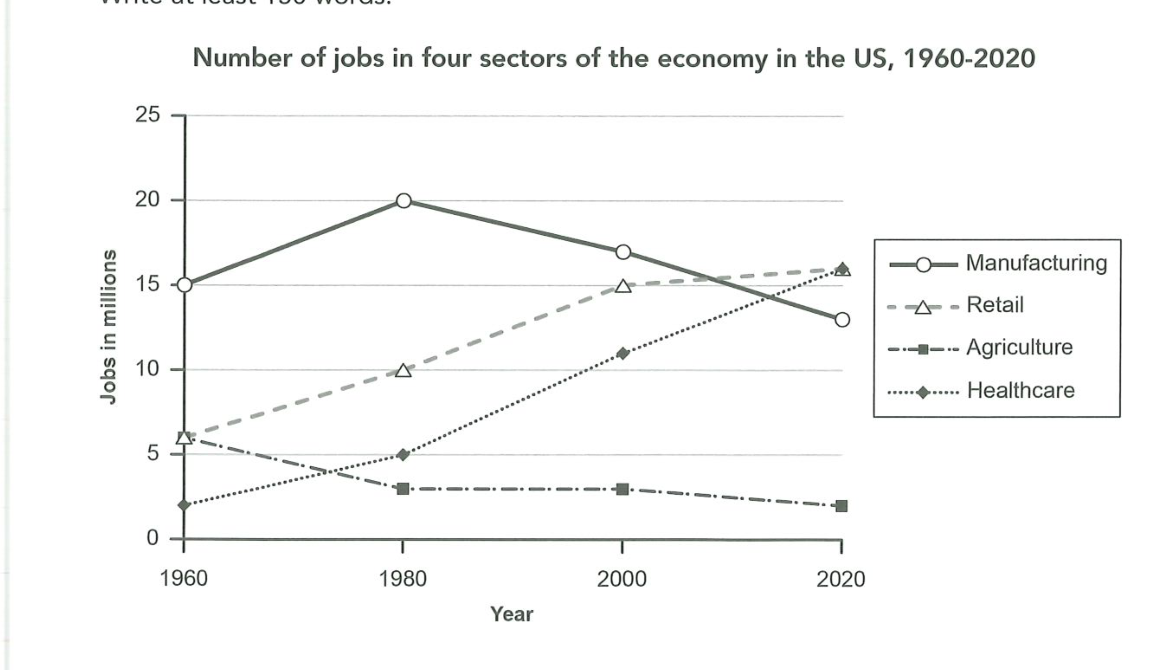
The graph below gives information about the number of jobs in four sectors of the economy in the US between 1960 and 2020.
Summarise the information by selecting and reporting the main features, and make comparisons where relevant.
Number of jobs in four sectors of the economy in the US, 1960-2020
Student answer (Band 5.5)
This is a line graph demonstrating number of jobs in four different sectors of economy in the US between 1960 and 2020.
Overall Manufacturing was the highest economy jobs from 1960 to 1980 then had a fallout from 2000 to 2020, healthcare had the lowest economy jobs in 1960 but has risen significally throughout the years,retail has risen till 2000 then had a small change in rise in 2020, agriculture has a rise in 1960 later on it dropped out throughout the years.
Firstly, In1960 Manufacturing had 15 million jobs,1980 the number of jobds had risen up to 20 million from 2000 to 2020 the number of manufacturing jobs had fallen to approximately 12 million, the number of retail jobs have risen throughout the years having over 5 million jobs in 1960 to over 15 million jobs.
Agriculture had over 5 million employment jobs in 1960 but has significally dropped in the following years up to approximately 3 million jobs, Healthcare has risen throughout the years having approximately 3 million jobs in 1960 to over 15 million employment jobs in 2020.
AI examiner evaluation
| Criterion | Band |
|---|---|
| Task Achievement / Task Response | 6.0 |
| Coherence and Cohesion | 5.5 |
| Lexical Resource | 5.0 |
| Grammatical Range and Accuracy | 5.0 |
| Overall | 5.5 |
Task Achievement / Task Response: Band 6.0
You identify the main overall patterns: manufacturing peaks in 1980 and then declines, while healthcare and retail rise and agriculture falls. Several figures are also reported accurately, including manufacturing at 15 million in 1960 and 20 million in 1980. However, some details are incomplete or imprecise. The graph shows manufacturing at 17 million in 2000 and 13 million in 2020, rather than a single fall “from 2000 to 2020” to approximately 12 million. Retail reaches 16 million in 2020, and healthcare rises from 2 to 16 million, but these endpoints are not stated precisely. The overview also says agriculture had a rise in 1960, although the figure is level with retail at about 6 million. More precise comparisons and coverage of the intermediate values would strengthen the report.
Coherence and Cohesion: Band 5.5
The response has a recognisable structure: an introduction, an overview, and two paragraphs describing the data. Grouping manufacturing and retail before agriculture and healthcare gives the reader a basic route through the information. However, progression within sentences is sometimes difficult to follow because several trends and figures are joined together without clear punctuation. For example, the manufacturing sentence moves from 1960 to 1980 and then to 2000–2020 without clearly separating the stages. Connectors such as “Firstly” help signal a new point, but the final paragraph’s two sectors are compressed into one sentence. Use shorter, clearly separated comparisons and consistent time markers to make the relationships between figures easier to follow.
Lexical Resource: Band 5.0
You use relevant task vocabulary, including “line graph,” “jobs,” “risen,” “fallen,” and “throughout the years,” so the main trends are generally understandable. However, the range is limited and some expressions are imprecise or unnatural for describing data. “Economy jobs” and “employment jobs” are awkward combinations, while “had a fallout” does not clearly describe a decline in employment. “A small change in rise” is also unclear, and “significally” is misspelled; these choices reduce precision. Aim for standard trend language and accurate collocations, such as describing a sector’s employment level as increasing, declining, peaking, or remaining stable. Varying these terms would also help avoid repeated use of “risen” and “jobs.”
Grammatical Range and Accuracy: Band 5.0
You attempt both simple statements and longer sentences, and the reader can usually understand the intended trends. However, control of sentence boundaries, articles, and verb forms is inconsistent. The opening needs an article (“demonstrating the number of jobs”), and the overview begins “Overall Manufacturing” without punctuation after the introductory word. In “the number of retail jobs have risen,” the singular subject “number” requires “has.” The manufacturing description also lacks clear grammatical links between the years and figures, making the sequence difficult to parse. Commas are often used where full stops or semicolons would be clearer, and spacing around punctuation is inconsistent. Build accuracy by writing one complete comparison per sentence and checking subject–verb agreement and punctuation.
See this exact question answered at other band scores. The same prompt compared across bands.
Browse more IELTS Writing model answers or get your own writing scored by the same AI examiner.