Band 6.0 IELTS Writing Task 1 Model Answer
Overall Band Score: 6.0 · Cambridge IELTS 21 · 2026-11-24
IELTS Writing Task 1 question
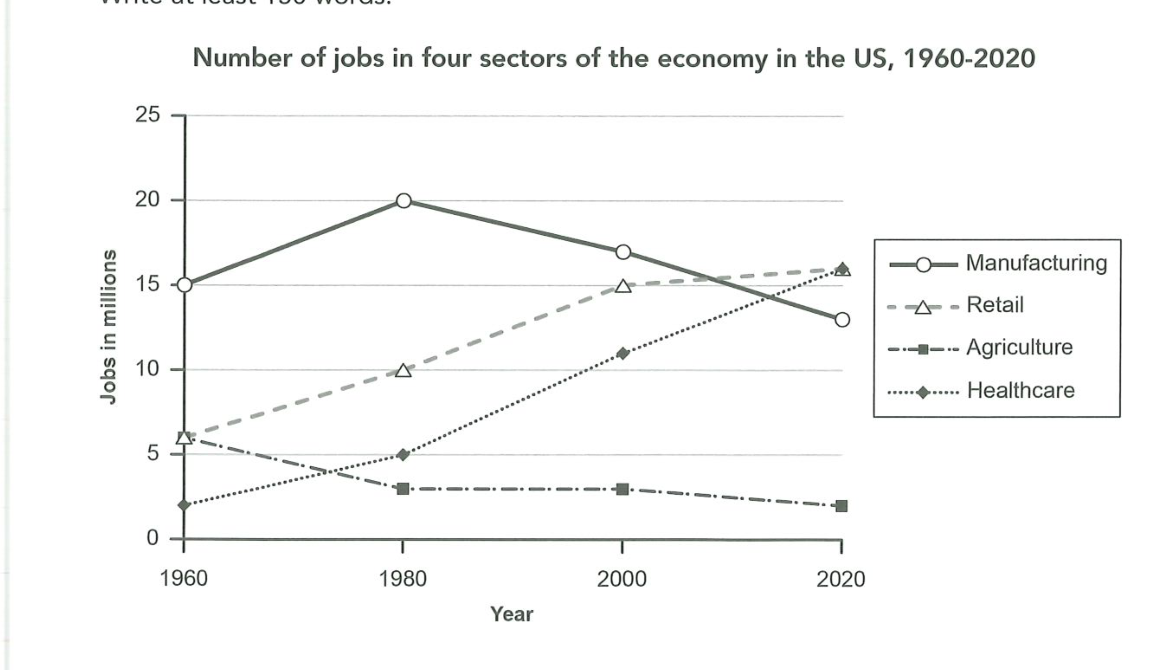
The graph below gives information about the number of jobs in four sectors of the economy in the US between 1960 and 2020.
Summarise the information by selecting and reporting the main features, and make comparisons where relevant.
Number of jobs in four sectors of the economy in the US, 1960-2020
Student answer (Band 6.0)
The graph chart illustrates the number of jobs in the US from 1960 to 2020 by comparing four different sectors of the economy.
Overall, manufacturing contributed most in economy untill 2000.Despite starting with different figures Retail and Agriculture shares the same position in 1960 which changes untill 2020.
Firstly, Manufacturing has almost 15 million job relevantly highest then others.Figure dramatically jump to 20 million in 1980.The Number of jobs drop moderately about 13 million in next 40 years.Retail and Agriculture started with 5.5 million jobs, retail has rapidly increase to 15 million in 2000 and it become slow in next 20 years and ended up qwith 16 million in 2020.
Agriculture figures drop sharply to 3 million in first 20 years then remains constant till 2000 and again decrease slightly to 2 million in 2020.Health care has lowest contribution to whole economy about 2 million jobs in 1960 which modestly increase to 5 million in 1980 and considerably rise to 16 million joining retail until 2020.
AI examiner evaluation
| Criterion | Band |
|---|---|
| Task Achievement / Task Response | 6.0 |
| Coherence and Cohesion | 6.0 |
| Lexical Resource | 5.5 |
| Grammatical Range and Accuracy | 5.5 |
| Overall | 6.0 |
Task Achievement / Task Response: Band 6.0
You cover all four sectors and identify several important trends: manufacturing peaks in 1980 before declining, retail rises, agriculture falls, and healthcare grows to match retail by 2020. The overview also notes manufacturing’s early dominance and the equal starting figures for retail and agriculture. Most reported values are close to the chart, although manufacturing’s fall is described as reaching about 13 million “in next 40 years,” which obscures the intermediate 17-million figure in 2000. The overview could be more precise: manufacturing is no longer the largest sector by 2000, when retail is about 15 million versus manufacturing’s 17 million, and healthcare’s strong rise is a major overall feature. Develop these comparisons more explicitly to make the summary more complete.
Coherence and Cohesion: Band 6.0
The response has a clear overall arrangement: an introduction, an overview, and two detail paragraphs that group the sectors. Sequencing words such as “Overall,” “Firstly,” and “then” help readers follow the timeline, and the main trends are generally easy to locate. However, some connections are awkward or unclear, particularly “Despite starting with different figures Retail and Agriculture shares the same position,” which contradicts itself, and the long final paragraph moves between agriculture and healthcare without a clear transition. Punctuation and spacing also interrupt the flow, as in “2000.Despite” and “2020.Health care.” Use clearer linking phrases to signal comparisons and separate sentences consistently; this would make the progression more controlled rather than occasionally mechanical.
Lexical Resource: Band 5.5
You use a reasonable range of trend vocabulary, including “drop moderately,” “remains constant,” “decrease slightly,” and “considerably rise,” so the reader can understand the main movements. There are also attempts to describe relative importance, such as “lowest contribution.” However, several word choices and collocations are inaccurate or unnatural: “the graph chart,” “jobs relevantly highest,” “Figure dramatically jump,” and “it become slow.” Spelling and word-form slips such as “untill,” “qwith,” and “Health care” also reduce precision. Aim for standard chart language and check the form of each word: for example, say that the number “rose sharply” or “declined gradually,” rather than describing a figure as jumping. This would make the vocabulary more accurate and natural.
Grammatical Range and Accuracy: Band 5.5
You attempt both simple and more complex sentence forms, including a contrast clause beginning “Despite” and several sentences that describe changes over time. The overall meaning is usually recoverable, but some grammatical errors affect clarity. Examples include “Retail and Agriculture shares” (subject–verb agreement), “Figure dramatically jump” (verb form), “it become slow” (tense and sentence construction), and “which modestly increase” (verb form). Articles and sentence boundaries also need attention, as in “in next 40 years” and the run-on sequence ending “2020.Health care.” Keep past-tense verbs consistent when reporting historical data, and proofread agreement, articles, and punctuation. More accurate control of these patterns would support the range of structures you are already attempting.
See this exact question answered at other band scores. The same prompt compared across bands.
Browse more IELTS Writing model answers or get your own writing scored by the same AI examiner.