Band 4.5 IELTS Writing Task 1 Model Answer
Overall Band Score: 4.5 · Cambridge IELTS 21 · 2026-11-24
IELTS Writing Task 1 question
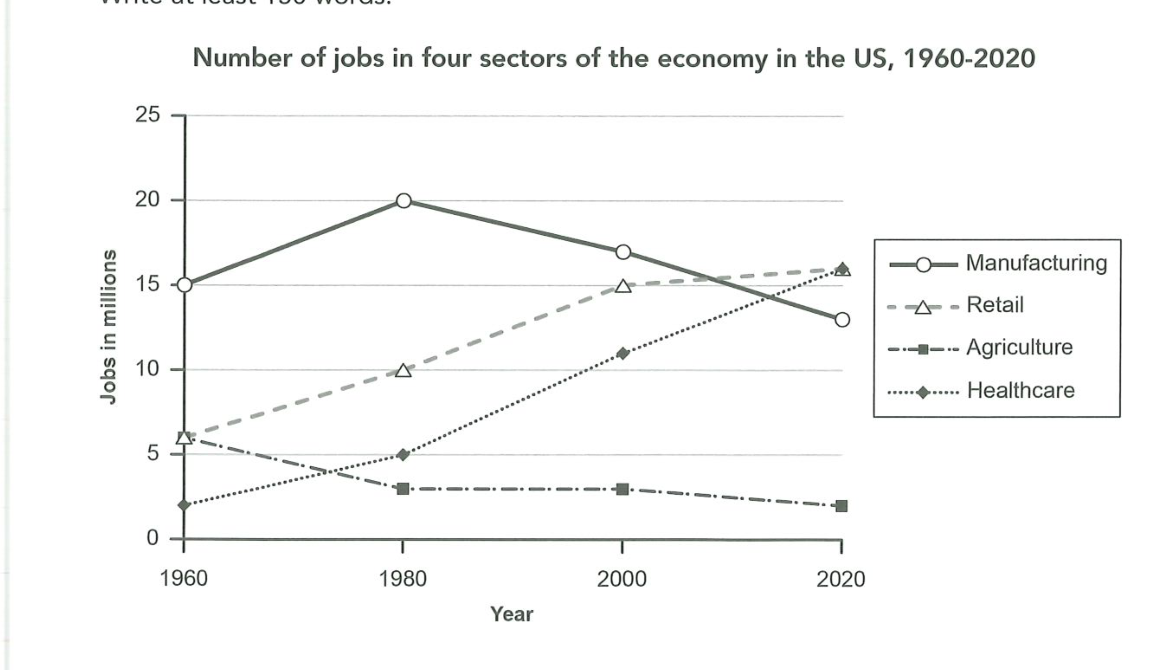
The graph below gives information about the number of jobs in four sectors of the economy in the US between 1960 and 2020.
Summarise the information by selecting and reporting the main features, and make comparisons where relevant.
Number of jobs in four sectors of the economy in the US, 1960-2020
Student answer (Band 4.5)
the chart shows the number or workers in four different decades. how much people join or how much left in America.
the sector divided in four different decades this shows how much people work in manufacturing and reatil moreover agriculture and healthcare to begin with retail jobs in 1960 was 5 million after 20 years it was increased 5 million as well as in 2000s the jobs in retail was 15 million after 20 year it was not highly rise in 2020 was just around 16 million moreover manufacturing jobs were totally changed as compare retail in 1960 the jobs was 15 million after 2 decades it was rise into 20 million after that in 2000s the in manufacturing was around 17 million and then it drop into 14 million in 2020 another point is agriculture jobs on USA in 1960 around 6 million after 2 decades it was decline into 3 million and then it will be not changed after 20 year but in 2020 it was around 2 million jobs on top of that health care in 1960s was just 2 million after two decades it was rise in 5 million as well as in 2000 the health care jobs around 11 million and then in 2020 it was increased in 16 million jobs in America
AI examiner evaluation
| Criterion | Band |
|---|---|
| Task Achievement / Task Response | 5.0 |
| Coherence and Cohesion | 4.0 |
| Lexical Resource | 4.5 |
| Grammatical Range and Accuracy | 4.5 |
| Overall | 4.5 |
Task Achievement / Task Response: Band 5.0
You report figures for all four sectors and identify several important movements, including manufacturing peaking at 20 million in 1980 and agriculture declining from about 6 million to 2 million. Most figures are close to the chart, although manufacturing in 2020 is given as 14 million rather than about 13 million. However, the response only partially fulfils the summary task: it lacks a clear overview of the main patterns, such as manufacturing’s decline after its peak, retail and healthcare growth, and agriculture’s overall fall. The opening also misinterprets the chart as showing how many people “join or…left,” which is not what the data measure. Select the key trends and compare them explicitly rather than describing each series in a long sequence.
Coherence and Cohesion: Band 4.0
The response follows a broadly understandable order, moving through retail, manufacturing, agriculture and healthcare, and time references help readers follow changes. However, the information is presented as one long, largely unpunctuated paragraph, so the progression is difficult to see. Connectors such as “moreover,” “as well as,” and “on top of that” are repeated and sometimes do not show a clear relationship between ideas. The opening repeats the task rather than establishing an overview, and there is no concluding summary of the main comparisons. Use separate paragraphs for an overview and grouped details, and organise comparisons—for example, contrasting the growth in retail and healthcare with the decline in agriculture.
Lexical Resource: Band 4.5
You use relevant topic vocabulary, including “manufacturing,” “agriculture,” “health care,” “jobs,” and “million,” so the reader can generally identify the sectors and figures. However, the range is limited and several expressions are inaccurate or awkward, such as “the jobs was,” “rise into 20 million,” and “not highly rise.” There are also spelling errors, including “reatil,” and imprecise wording such as “number or workers.” These choices sometimes make the intended meaning less clear and keep the description from sounding like a controlled report. Build a small set of accurate trend verbs and collocations, such as “rose to,” “fell to,” “remained stable,” and “employment in the sector,” and check spelling before submitting.
Grammatical Range and Accuracy: Band 4.5
The response attempts to describe changes across time and uses some longer sentences with time clauses, but the structures are mostly repetitive and frequently inaccurate. Examples include “retail jobs in 1960 was 5 million,” “after 20 years it was increased,” and “it will be not changed,” where agreement, tense or verb construction is faulty. Missing punctuation and sentence boundaries also make the long sequence hard to process. These errors can cause difficulty even though the general trend is often recoverable. Practise forming concise past-tense comparisons: “Retail employment stood at 6 million in 1960, then rose to 10 million in 1980.” Use full stops to separate each sector’s description and check subject–verb agreement.
See this exact question answered at other band scores. The same prompt compared across bands.
Browse more IELTS Writing model answers or get your own writing scored by the same AI examiner.