Band 5.5 IELTS Writing Task 1 Model Answer
Overall Band Score: 5.5 · Cambridge IELTS 21 · 2026-11-25
IELTS Writing Task 1 question
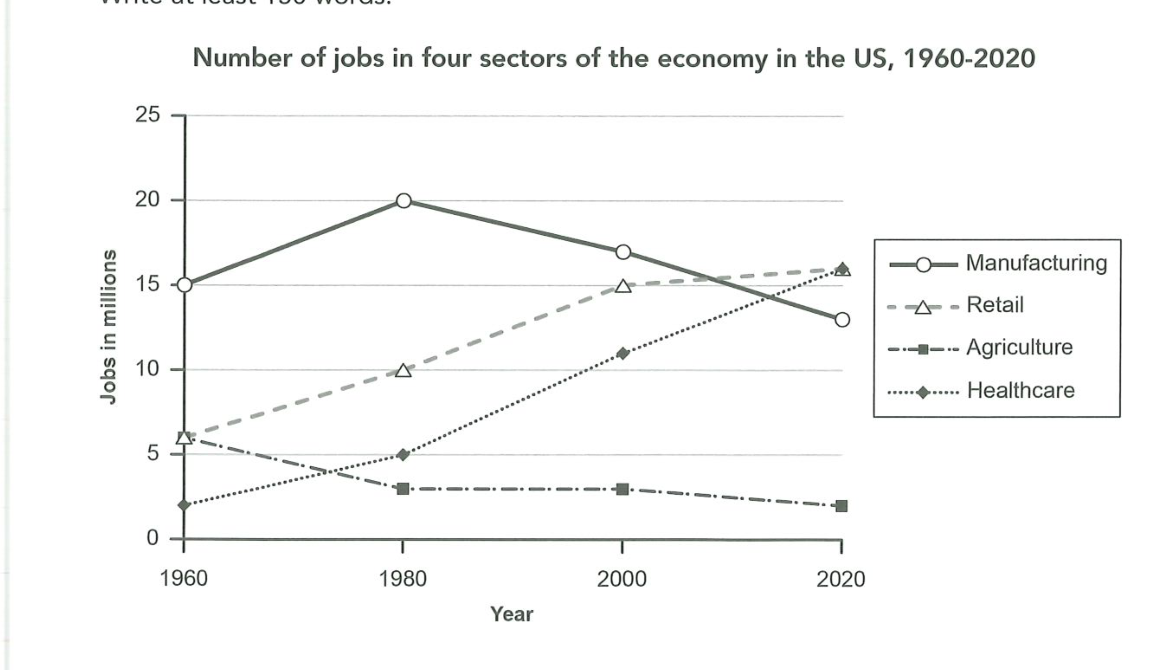
The graph below gives information about the number of jobs in four sectors of the economy in the US between 1960 and 2020.
Summarise the information by selecting and reporting the main features, and make comparisons where relevant.
Number of jobs in four sectors of the economy in the US, 1960-2020
Student answer (Band 5.5)
The above line graph illustrates the data about mulitple number of jobs in four areas like manufacturing, retail, agriculture & healthcare of the budget in the country United states of America(USA) between the year 1960 & 2020.
Overall, the lines which is increasing steadily is Retail and healthcare. the other one which firstly fall then constant in the year 1980 to 2000 and then again fall. Manufacturing is the only line which was first rise in year 1960 to 1980 but after the years we a decline in manufacturing.
firstly we talk about retail and healthcare. as we can see that the origin was same and the ending point of retail and agriculture is same. In 1960 retail got 6 million people at job. however the peoples who worked here increases by the time and in 2020 it's jobs goes above 15 million.
Furthurmore, The manufacturing went up in 1960 to 1980 but afterwards 2020 we see a decline. the jobs went down from 20 million to 13 million.At last is agriculture we see a dip in agriculture in 1980 to 2000. the helthcare also rising and met the retail in the end its jobs in 2020 is about 16 million.
AI examiner evaluation
| Criterion | Band |
|---|---|
| Task Achievement / Task Response | 5.5 |
| Coherence and Cohesion | 5.5 |
| Lexical Resource | 5.0 |
| Grammatical Range and Accuracy | 5.0 |
| Overall | 5.5 |
Task Achievement / Task Response: Band 5.5
You identify the four sectors and give a broad overview of rising employment in retail and healthcare, alongside declines in manufacturing and agriculture. Some relevant figures are included, such as manufacturing peaking at 20 million and falling to 13 million, and retail starting at 6 million. However, the overview is unclear and partly inaccurate: agriculture does not remain constant from 1980 to 2000 and then fall; it drops to about 3 million by 1980, stays level until 2000, and then falls slightly. The claim that retail and agriculture end at the same point is also incorrect; retail and healthcare both finish at about 16 million. Several trends are only briefly described, so the main comparisons are not fully developed.
Coherence and Cohesion: Band 5.5
The response has a recognisable structure, with an introduction, an overview and two detail paragraphs, and it groups some related trends together. However, progression within the paragraphs is uneven: the overview is difficult to follow, and the final paragraph moves from manufacturing to agriculture and then healthcare without a clear organising pattern. Linking expressions such as “firstly,” “furthermore” and “at last” are used mechanically or do not accurately signal the relationship between points. References such as “the other one” and “here” are also unclear. To improve, organise the details by trend or sector and use precise links—for example, contrast manufacturing’s decline with the continued growth of retail and healthcare.
Lexical Resource: Band 5.0
You use some task-relevant vocabulary, including “decline,” “increases” and “dip,” and the reader can generally identify the sectors being discussed. However, the range is limited and several word choices or collocations are inaccurate, which sometimes makes the meaning unclear. For example, “jobs in four areas … of the budget” misrepresents the subject, while “the origin was same” and “the ending point” are imprecise ways to describe starting and final figures. There are also noticeable spelling errors, including “mulitple,” “Furthurmore” and “helthcare.” Build a more precise vocabulary for describing chart trends and values, and check spelling and word forms before submitting.
Grammatical Range and Accuracy: Band 5.0
The response attempts both simple and longer sentences, but control is inconsistent, and errors occur frequently enough to make some statements difficult to interpret. Examples include “the lines which is increasing,” where subject–verb agreement is faulty, and “after the years we a decline,” which lacks a necessary verb. Tense and sentence construction are also problematic in “the peoples who worked here increases by the time” and “its jobs in 2020 is about 16 million.” Capitalisation and punctuation are inconsistent, particularly after full stops and around sentence boundaries. Practise forming accurate comparisons and trend descriptions with clear subjects and verbs, then check agreement, tense and punctuation in each sentence.
See this exact question answered at other band scores. The same prompt compared across bands.
Browse more IELTS Writing model answers or get your own writing scored by the same AI examiner.