Band 6.0 IELTS Writing Task 1 Model Answer
Overall Band Score: 6.0 · Cambridge IELTS 21 · 2026-11-25
IELTS Writing Task 1 question
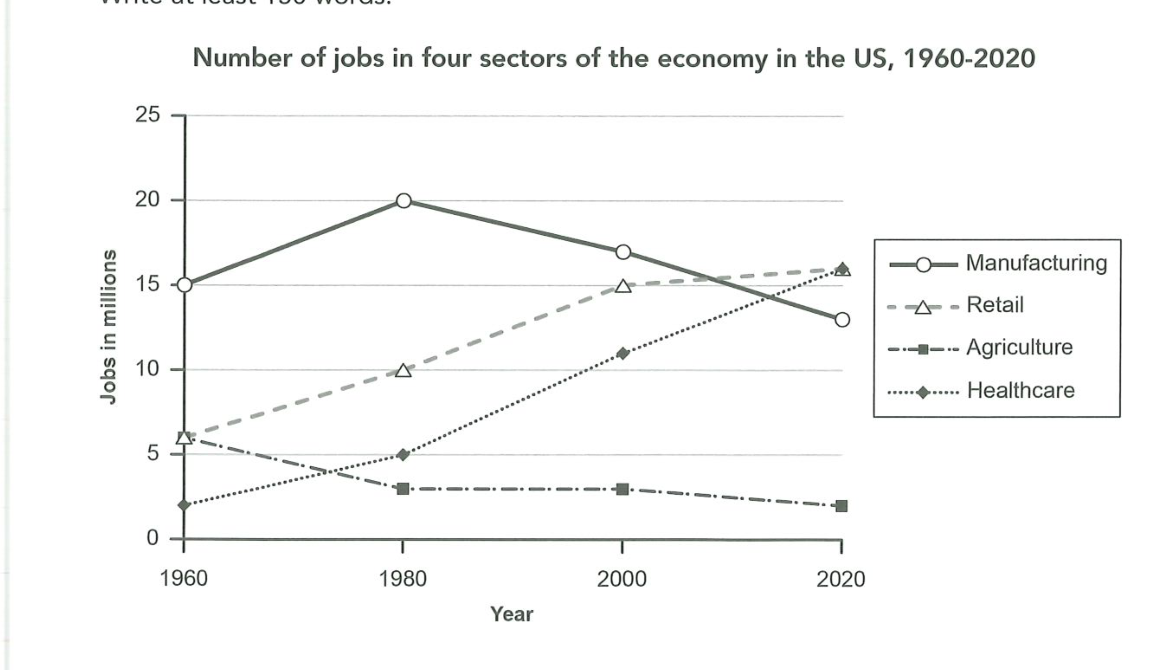
The graph below gives information about the number of jobs in four sectors of the economy in the US between 1960 and 2020.
Summarise the information by selecting and reporting the main features, and make comparisons where relevant.
Number of jobs in four sectors of the economy in the US, 1960-2020
Student answer (Band 6.0)
The line graph illustrates information taken about the number of jobs in different sectio s of the economy in the United State of America from 1960 to 2020.
Agriculture jobs that are available reduce drastically while the manufacture jobs was at the top of the radar, the decline there was not that pronounced while retail and Health care had increased job oppotunities.
The Retail jobs started from above 5million and increased to 16 million it experienced a triumphant increase, while that of health-care experienced a massive increase from 4 million it rose to 16 million this data was taken from the year [redacted phone].
Manufacturing Jobs started with 15 million jobs in 1960 but it reduced to below 14 million jobs, 12 million to be precise this took place in the year 2020.
while Agriculture started with close to 6 million available jobs and decrease to 2 million jobs from [redacted phone].
AI examiner evaluation
| Criterion | Band |
|---|---|
| Task Achievement / Task Response | 6.0 |
| Coherence and Cohesion | 5.5 |
| Lexical Resource | 6.0 |
| Grammatical Range and Accuracy | 5.5 |
| Overall | 6.0 |
Task Achievement / Task Response: Band 6.0
You identify the main overall patterns: agriculture declines, manufacturing falls after an earlier high, and retail and healthcare rise. Several endpoint figures are also broadly accurate, including retail at about 16 million and agriculture at about 2 million in 2020. However, some details are inaccurate or unclear: healthcare begins at about 2 million, not 4 million, and manufacturing peaks at around 20 million in 1980 before declining, a key stage that is omitted. The overview also says manufacturing was “at the top” without clarifying that it led initially but was later matched by retail and healthcare. More precise coverage of the turning points and comparisons would make the report more complete and developed.
Coherence and Cohesion: Band 5.5
The response has a recognisable overall arrangement: an introduction, a brief overview, and paragraphs describing the rising and falling sectors. This gives the reader a basic route through the information. However, progression is not consistently clear. The overview is joined to the introduction in a long, loosely punctuated sentence, and the final paragraph begins with lowercase “while,” making the relationship between ideas less controlled. The report also moves between sectors without grouping them consistently, and phrases such as “this data was taken from the year 1960-2020” add little to the comparison. Use distinct paragraphs for the overview and details, group the rising sectors together, and use clear links to show contrasts and changes over time.
Lexical Resource: Band 6.0
You use an adequate range of vocabulary to describe trends, including “increased,” “decline,” “reduced,” and “massive increase,” so the main message is generally understandable. There are also attempts at more expressive language, such as “triumphant increase” and “top of the radar,” but these are not natural choices for an objective graph report. Spelling and word-form slips, including “sectio s,” “oppotunities,” and “manufacture jobs,” also reduce precision. Prefer standard, accurate trend language and sector names—for example, “rose steadily,” “reached a peak,” and “manufacturing employment.” This would retain sufficient range while making the description more precise and appropriately formal.
Grammatical Range and Accuracy: Band 5.5
You attempt both simple and more extended sentence forms, and the reader can usually understand the trends. Some grammatical errors remain, however. In “the manufacture jobs was at the top,” the plural subject does not agree with “was”; “Agriculture jobs … reduce” also uses an incorrect verb form for a past-period description. The sentence beginning “while Agriculture started…” is not properly integrated with the preceding text, and punctuation is inconsistent, including the lowercase “while” after a full stop. Articles and number forms also need attention in phrases such as “from 4 million it rose to 16 million.” Use consistent past-tense verbs, check subject–verb agreement, and separate or join clauses with accurate punctuation. These changes would improve control without sacrificing sentence variety.
See this exact question answered at other band scores. The same prompt compared across bands.
Browse more IELTS Writing model answers or get your own writing scored by the same AI examiner.