Band 5.0 IELTS Writing Task 1 Model Answer
Overall Band Score: 5.0 · Cambridge IELTS 21 · 2026-11-25
IELTS Writing Task 1 question
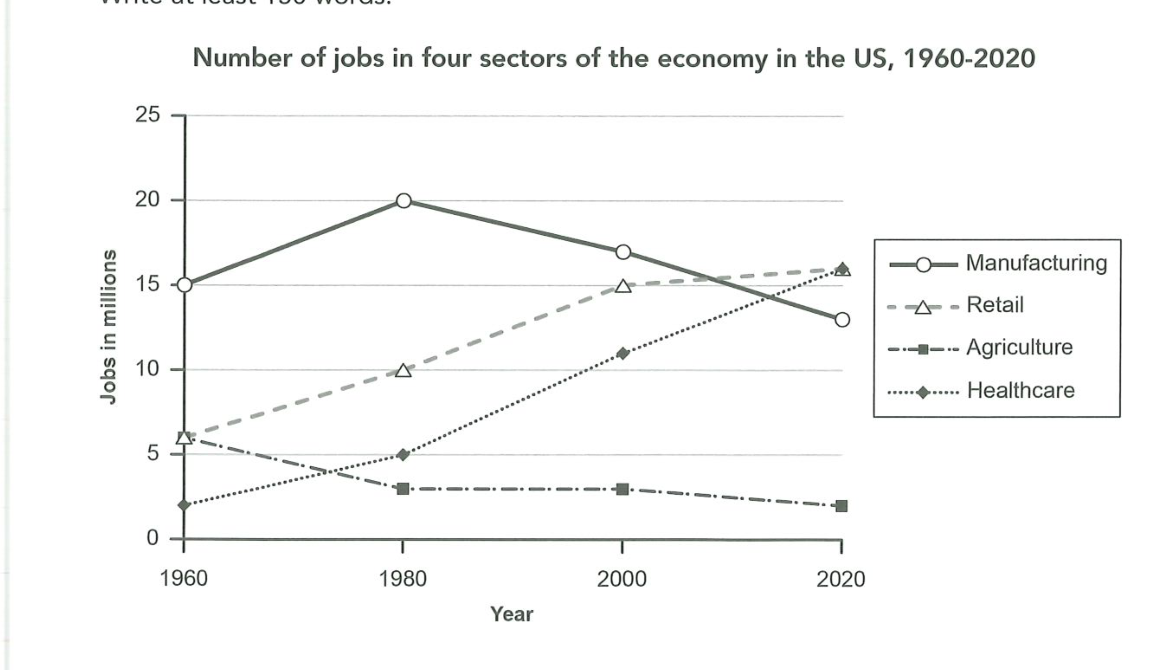
The graph below gives information about the number of jobs in four sectors of the economy in the US between 1960 and 2020.
Summarise the information by selecting and reporting the main features, and make comparisons where relevant.
Number of jobs in four sectors of the economy in the US, 1960-2020
Student answer (Band 5.0)
The graph illustrate about the number of jobs in four sector of the economy in the US between 1960 and 2020.Overall, it is clear that health care had high of jobs , while agriculture had the low of jobs.In addition , the retail rised to be in same numbers of jobs with healthcare.On other hands, Manufacturing didn't remaine stable in high however was declined .Looking first at health care started with 0.5 jobs in millions by 1960 even becomed in 2020 16 millions jobs so it's good offer , majority of people have more untersting in healthcare also yhe retail started with 6 millions jobs in 1960 until become 16 millions jobs .The figures stood at 15 millions jobs in 1960 and then rose to 20 millions jobs in 1980 however manufacturing declined to 13 in 2020 . Simarly agriculture started with 6 and ended with 0.5 in 2020 it means people that not still intersting wit agriculter that let it fell step by step .
AI examiner evaluation
| Criterion | Band |
|---|---|
| Task Achievement / Task Response | 6.0 |
| Coherence and Cohesion | 4.5 |
| Lexical Resource | 5.0 |
| Grammatical Range and Accuracy | 5.0 |
| Overall | 5.0 |
Task Achievement / Task Response: Band 6.0
You identify the main overall contrast: healthcare and retail rise, while agriculture declines, and you report several relevant figures, including manufacturing’s peak of 20 million in 1980 and its fall to 13 million by 2020. This addresses the task and gives a generally grounded overview. However, some details are inaccurate: healthcare began at about 2 million, not 0.5 million, and agriculture ended at about 2 million, not 0.5 million. The claim that healthcare had the highest number overall is also too broad, since manufacturing led in 1960, 1980 and 2000; healthcare only reached a tie with retail in 2020. The explanation about people’s interests is speculative rather than chart-based. More precise comparisons would strengthen the report.
Coherence and Cohesion: Band 4.5
The response has a recognisable sequence: an introduction and overview are followed by details about healthcare, retail, manufacturing and agriculture. Linking expressions such as “Overall,” “Looking first,” and “however” show an attempt to guide the reader. However, the ideas are crowded into one continuous paragraph, and the progression between sectors is not always clear. The overview’s comparison of healthcare and retail is followed by a long sentence mixing healthcare figures with an unsupported explanation, while “On other hands” and “Simarly” do not connect ideas accurately. Use separate overview and detail paragraphs, group related trends, and make each sentence focus on one comparison. This would make the organisation easier to follow and reduce the effect of mechanical or unclear linking.
Lexical Resource: Band 5.0
You use relevant topic vocabulary, including “jobs,” “millions,” “declined,” “rose,” and “figures,” and you attempt to describe trends rather than simply list values. However, the range and control are limited by repeated wording and several inaccurate or unclear expressions. Phrases such as “had high of jobs,” “good offer,” and “more untersting” do not communicate the intended meaning naturally; “people have more interest” is also an unsupported interpretation of the data. Spelling errors such as “remaine,” “Simarly,” and “agriculter” further reduce clarity. Aim for precise chart language and avoid explaining causes or public preferences that the graph does not show. More accurate collocations would make the report clearer and more appropriate to the task.
Grammatical Range and Accuracy: Band 5.0
You attempt both simple and longer sentences, and the reader can usually identify the broad trends. However, control of sentence structure and verb forms is inconsistent. For example, “The graph illustrate” has a subject–verb agreement error, while “health care started with 0.5 jobs … even becomed in 2020” does not form a clear grammatical sentence. Missing articles and awkward clause connections also appear in “in same numbers” and “while manufacturing declined to 13 in 2020.” Punctuation and spacing are inconsistent, especially where sentences run together. Practise building accurate sentences with a clear subject and verb, and use past-tense forms consistently when describing the historical data. Greater control of these patterns would make your comparisons easier to understand.
See this exact question answered at other band scores. The same prompt compared across bands.
Browse more IELTS Writing model answers or get your own writing scored by the same AI examiner.