Band 5.5 IELTS Writing Task 1 Model Answer
Overall Band Score: 5.5 · Cambridge IELTS 21 · 2026-11-25
IELTS Writing Task 1 question
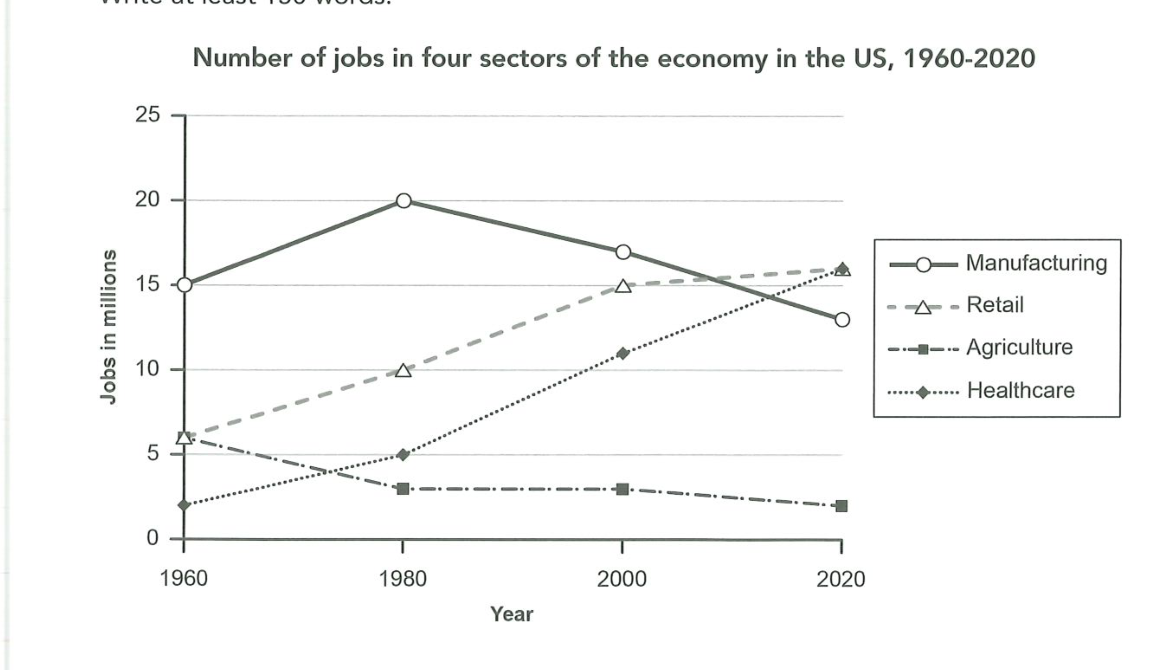
The graph below gives information about the number of jobs in four sectors of the economy in the US between 1960 and 2020.
Summarise the information by selecting and reporting the main features, and make comparisons where relevant.
Number of jobs in four sectors of the economy in the US, 1960-2020
Student answer (Band 5.5)
The line graph illustrates the number of posts in diffrent economy fields in the US from 1960 to 2020.
Overall, the number of jobs in healthcare and agriculture rose dramatically over the time and manufacturing fluctuated in the period of time given, while agriculture dropped slowly and then remained stable.
Healthcare started at nearly 3 millions jobs in 1960, and it continues to grow over the years reaching a few more than 15 millions jobs in 2020.Retail follows almost the same pattern as healthcare as it increases steadily from just above 5 millions jobs in 1960 to slightly more than 15 millions jobs.
Manufacturing began with the highest number od jobs in 1960, then it fluctuated between 20 and 15 millions jobs, and finished at around 13 millions jobs in 2020.For agriculture, the number
of jobs fall from just above 5 millions to nearly 4 millions in 1980 and it remained the same to the end of the period.
AI examiner evaluation
| Criterion | Band |
|---|---|
| Task Achievement / Task Response | 5.5 |
| Coherence and Cohesion | 5.5 |
| Lexical Resource | 5.5 |
| Grammatical Range and Accuracy | 5.0 |
| Overall | 5.5 |
Task Achievement / Task Response: Band 5.5
You identify the main sectors and provide an overview, noting manufacturing’s changing pattern and agriculture’s decline. However, the overview is internally inconsistent: it says both healthcare and agriculture “rose dramatically” and then says agriculture “dropped slowly.” The chart shows healthcare rising strongly, while agriculture falls throughout, with a brief plateau from 1980 to 2000. Some details are also inaccurate: manufacturing peaks at about 20 million in 1980, rather than fluctuating between 20 and 15 across the period, and agriculture reaches about 2 million by 2020, not remaining unchanged to the end. To strengthen the report, make the overview precise and compare the sectors’ final figures, especially healthcare and retail, which both end at around 16 million.
Coherence and Cohesion: Band 5.5
The response has a recognisable structure: an introduction, an overview, and paragraphs describing the rising sectors and the declining ones. This gives the reader a basic route through the information. However, progression is weakened by the contradictory overview, and the grouping is not fully clear: agriculture is first described as rising, then discussed as falling in the final paragraph. Linking is also limited, with repeated use of “and” and “then,” while the healthcare and retail comparison is introduced but not developed consistently. Improve cohesion by grouping the two rising sectors together and the two declining or fluctuating sectors together, and use clear contrasts such as “by comparison” or “whereas.” Check that each paragraph supports the overview.
Lexical Resource: Band 5.5
You use relevant vocabulary for describing trends, including “increases steadily,” “fluctuated,” “reaching,” and “finished at around,” so the main information is generally understandable. However, the range is somewhat repetitive, and several choices are imprecise or unnatural for this chart. “Posts” is not an appropriate substitute for jobs, and “economy fields” is less natural than “economic sectors.” Phrases such as “a few more than 15 millions jobs” and “the number of jobs fall” also show weak control of word forms and collocation; the latter is addressed grammatically, but the phrasing itself needs refinement. Use concise, accurate expressions such as “just over 15 million jobs” and “employment in agriculture declined.” Proofread spelling, including “different” and “of.”
Grammatical Range and Accuracy: Band 5.0
You attempt a mix of simple and complex sentences, including a comparison with “while” and a sequence using “then,” but errors are frequent enough to limit control. For example, “it continues to grow” shifts into the present tense even though the period is historical; use “continued to grow.” In “the number of jobs fall,” the past-tense verb should be “fell,” and “it remained the same to the end” needs a more suitable time expression, such as “until the end.” Plural and quantity forms are also inaccurate in “3 millions jobs” and “15 millions jobs”; use “3 million jobs” and “15 million jobs.” Add spaces after full stops, and use punctuation to separate the long final sentence more clearly.
See this exact question answered at other band scores. The same prompt compared across bands.
Browse more IELTS Writing model answers or get your own writing scored by the same AI examiner.