Band 6.0 IELTS Writing Task 1 Model Answer
Overall Band Score: 6.0 · Cambridge IELTS 21 · 2026-11-26
IELTS Writing Task 1 question
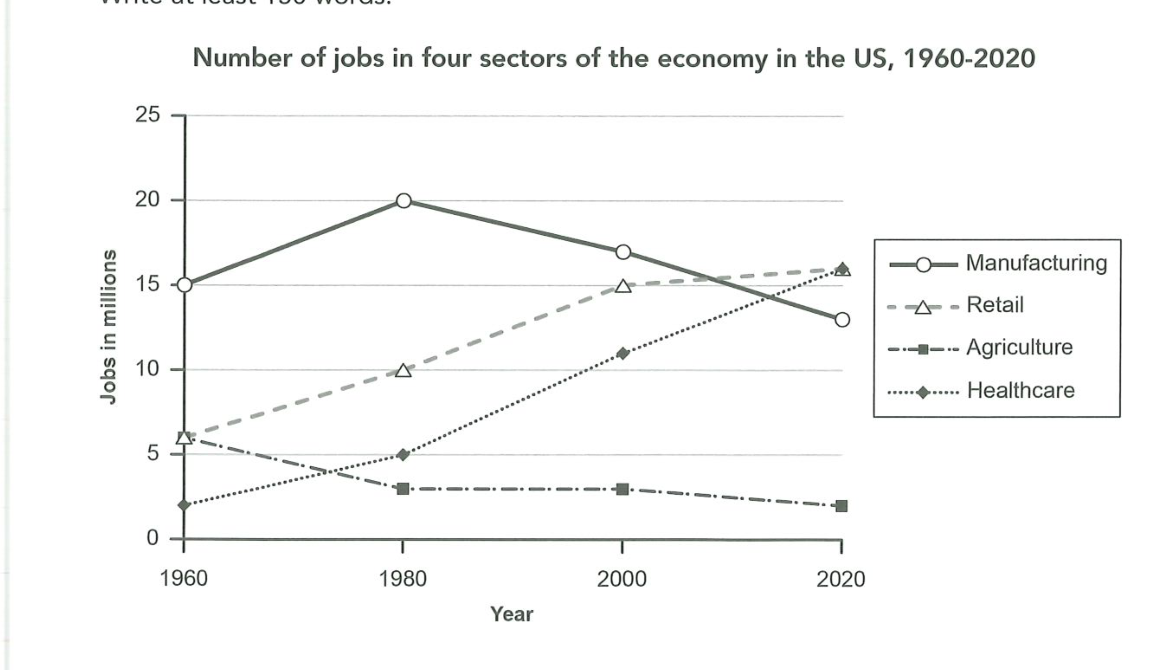
The graph below gives information about the number of jobs in four sectors of the economy in the US between 1960 and 2020.
Summarise the information by selecting and reporting the main features, and make comparisons where relevant.
Number of jobs in four sectors of the economy in the US, 1960-2020
Student answer (Band 6.0)
The line graph illustrate about four different sector of job that play crucial role in US economy in sixty year, between 1960 and 2020.
Overall, in beginning Manufacturing job is very demanding job. Although, at the end Healthcare sector job have important impact in the US economy.
First of all, in 1960 most demanding sector is Manufacturing sector with 15 million jobs. Furthermore, Retail sector and Agriculture sector have equal opportunity about 6 million jobs, then least sector with job is Healthcare with 2 million jobs. After twenty year in 1980, Manufacturing increased steadily with 20 million jobs. Retail sector also increased majorly with 10 million. However, Agriculture job descended slightly 3 million and Healthcare sector took over the Agriculture sector with 5 million jobs.
Furthermore, Manufacturing sector gradually decreasing in 2000 with 16.5 million jobs and 2020 with 13 million jobs. Hence, Retail sector growing in 2000 with 15 million then slightly 15.9 million in 2020. Also Healthcare department rapidly increasing 15 million jobs at 2000 then slightly 15.9 million in 2020 same as Retail sector. Nonetheless, Africulture sector remain same at 2000 with 3 million then decreases with 2 million jobs
AI examiner evaluation
| Criterion | Band |
|---|---|
| Task Achievement / Task Response | 6.0 |
| Coherence and Cohesion | 6.0 |
| Lexical Resource | 5.5 |
| Grammatical Range and Accuracy | 5.5 |
| Overall | 6.0 |
Task Achievement / Task Response: Band 6.0
You cover all four sectors and identify the broad shifts: manufacturing peaks in 1980 and then declines, while retail and healthcare rise and agriculture falls. The opening comparison between manufacturing at the start and healthcare at the end also gives the reader a useful overall picture. However, some figures are inaccurate: manufacturing in 2000 is about 17 million, not 16.5; healthcare is about 11 million in 2000, not 15; and retail and healthcare finish at about 16 million, rather than 15.9. The overview could also state more clearly that retail and healthcare end jointly highest. More precise reporting of the main comparisons, alongside the trends you already select, would make the summary more complete and reliable.
Coherence and Cohesion: Band 6.0
The response has a clear overall arrangement: an introduction and overview are followed by chronological details, first for 1960–1980 and then for 2000–2020. This makes the main sequence easy to follow, and connectors such as “However,” “Furthermore,” and “Nonetheless” help signal contrasts. At times, though, these links feel mechanical or do not express the relationship precisely; for example, “Hence” introduces the retail figures without a clear cause-and-effect connection. The final paragraph also places several sectors and dates in one long sequence, making comparisons harder to track. Grouping the rising sectors together and contrasting them with manufacturing and agriculture would improve progression and cohesion.
Lexical Resource: Band 5.5
You use a reasonable range of trend vocabulary, including “increased steadily,” “gradually decreasing,” “rapidly increasing,” and “descended.” These choices show an effort to describe change rather than simply list figures. However, several expressions are unnatural or imprecise for a graph summary: “most demanding sector,” “equal opportunity,” and “important impact” do not accurately describe job totals. “Healthcare department” is also less suitable than “healthcare sector,” and “Africulture” is misspelled. Some repetition of “sector” and “jobs” further limits flexibility. Choose standard terms for employment data and use verbs such as “stood at,” “rose,” and “fell” accurately; this would make the account clearer and more idiomatic.
Grammatical Range and Accuracy: Band 5.5
You attempt both simple and more complex sentence forms, including contrast clauses beginning “Although” and “However,” and the overall meaning is generally understandable. Some grammatical errors remain, particularly with articles, agreement, and sentence construction. For example, “The line graph illustrate” needs subject–verb agreement, while “in beginning” requires an article or a different construction. “Although, at the end…” is not a complete sentence as written, and “Manufacturing increased steadily with 20 million jobs” has an unclear grammatical relationship between the trend and the figure. There are also inconsistent tense choices when describing past data. Review sentence boundaries and use consistent past-tense forms, such as “manufacturing employment rose to 20 million.”
See this exact question answered at other band scores. The same prompt compared across bands.
Browse more IELTS Writing model answers or get your own writing scored by the same AI examiner.