Band 6.0 IELTS Writing Task 1 Model Answer
Overall Band Score: 6.0 · Cambridge IELTS 21 · 2026-11-27
IELTS Writing Task 1 question
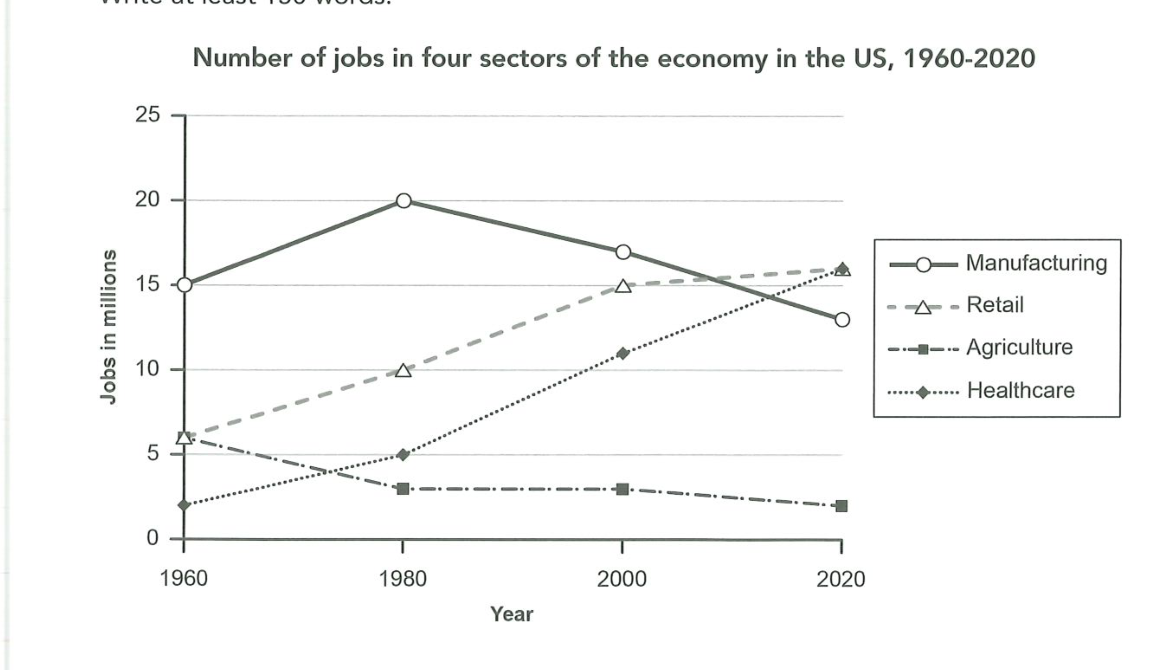
The graph below gives information about the number of jobs in four sectors of the economy in the US between 1960 and 2020.
Summarise the information by selecting and reporting the main features, and make comparisons where relevant.
Number of jobs in four sectors of the economy in the US, 1960-2020
Student answer (Band 6.0)
The line graph below illustrates the information about the number of jobs in four different sectors of economy namely manufacturing, retail, agriculture, and healthcare, in US for 60 years.
Overall, the number of jobs for retail and healthcare department go on increasing over the years. Meanwhile, the ratio of jobs for the sectors of agriculture and manufacturing first rise sharply and then fall down.
It is quite evident from the given graph that there are fifteen million jobs available for the people in the department of manufacturing in 1960, and this proportion increases sharply till the year 1980. In the following years, there comes a fall in this ratio and in 2020, almost 13 million seats are remained. In contrast, the number of jobs in the sector of agriculture are around 6 million in 1960, and this figure drops to almost 3 million in 1980. After that, in 2020, there are 2 million seats available in this sector.
However, the number of jobs for healthcare and retail increased sharply from almost 3 and 6 million in 1960, to about 16 million in 2020, respectively. It is the highest figure shown by the given line graph.
AI examiner evaluation
| Criterion | Band |
|---|---|
| Task Achievement / Task Response | 6.0 |
| Coherence and Cohesion | 6.0 |
| Lexical Resource | 6.0 |
| Grammatical Range and Accuracy | 6.0 |
| Overall | 6.0 |
Task Achievement / Task Response: Band 6.0
The response identifies the main broad trends and includes several relevant figures: manufacturing rises to 20 million in 1980 before declining, while agriculture falls from about 6 million to 2 million. However, the overview misrepresents manufacturing as first rising “sharply” alongside agriculture, although agriculture declines throughout, and it does not clearly state that retail and healthcare both finish at about 16 million. Some details are also unclear: the final sentence appears to assign 16 million to retail but gives no distinct 2020 figure for healthcare, and the 1980 and 2000 values for retail and healthcare are omitted. The report addresses the graph, but more accurate comparisons and a clearer account of all four trends would make the key features more fully developed.
Coherence and Cohesion: Band 6.0
The response has a clear overall structure: an introduction, an overview, and two detail paragraphs grouping manufacturing with agriculture and retail with healthcare. This makes the information reasonably easy to follow. Linking expressions such as “Overall,” “Meanwhile,” “In contrast,” and “However” help signal relationships, though some transitions are mechanical or do not accurately reflect the data. For example, “However” introduces two rising sectors rather than a contrast, and the overview’s “Meanwhile” groups trends that are not alike. The final sentence also combines the two sectors in a way that makes the figures difficult to assign. Use more precise comparisons and refer explicitly to each sector when reporting values to strengthen progression and cohesion.
Lexical Resource: Band 6.0
There is an adequate range of vocabulary for describing trends, including “increases,” “drops,” “fall,” and “figure,” and the meaning is generally understandable. However, some choices are imprecise or unnatural for a statistical report. “Ratio of jobs” is not the right term for the number of jobs, while “seats are remained” and “jobs available for the people” do not describe the chart naturally. “Department” is also less suitable than “sector,” and “sharply” overstates some changes. These attempts show some range, but more accurate collocations and consistent use of terms such as “employment,” “number of jobs,” and “million” would improve precision and style.
Grammatical Range and Accuracy: Band 6.0
The response uses a mix of simple and more complex sentence forms, including clauses introduced by “while,” “and,” and “in contrast,” and the main message remains clear. Some grammatical errors persist, particularly with agreement and sentence construction. For example, “the number of jobs … go on increasing” should use a singular verb, and “there are 2 million seats available” is an awkward construction for reporting a figure. The phrase “almost 13 million seats are remained” also has an incorrect passive form; a direct construction such as “the figure falls to about 13 million” would be clearer. Articles and prepositions are sometimes missing or awkward, as in “in US.” Greater control of these patterns would make the report more accurate.
See this exact question answered at other band scores. The same prompt compared across bands.
Browse more IELTS Writing model answers or get your own writing scored by the same AI examiner.