Band 5.0 IELTS Writing Task 1 Model Answer
Overall Band Score: 5.0 · Cambridge IELTS 21 · 2026-11-27
IELTS Writing Task 1 question
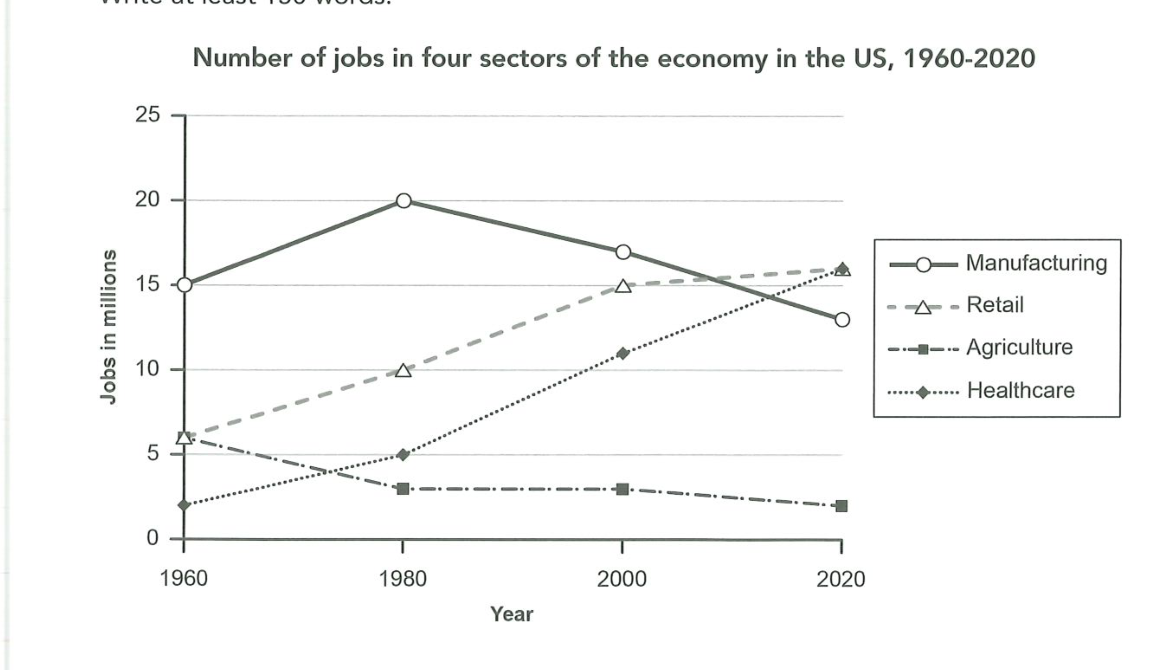
The graph below gives information about the number of jobs in four sectors of the economy in the US between 1960 and 2020.
Summarise the information by selecting and reporting the main features, and make comparisons where relevant.
Number of jobs in four sectors of the economy in the US, 1960-2020
Student answer (Band 5.0)
The graph show the information of jobs in the four sectors of the economy in the US between 1960 to 2020. The four sectors is Manufacturing,Retail,Agriculture,and Healthcare.
First of all, Healthcare is at the lowest in 1960 below 5 than they takeover agriculture in below 1980 and is on 5 percent jobs in millions and now in 2020 its on 16 percent top of all four sectors.
On second, Agriculture start from 6 percent in 1960 and go down every years in 1980 its go down at the lowest even healthcare sectors at 2.5 percent and in 2000 its go more down on 2 percent in 2020 its lowest all of them on 1.5 percent.
Further more, I also mention retail sectors in 1960 its on 6 percent in jobs in millions than they grow up very fast in year 1980 retail sectors is on 10 persent than in 2000 its on 15 persent and in 2010 its takeover manufacturing sector in 2020 its go on 16 percent.
At the end, i will discuss Manufacturing sectors in 1960 its on 15 percents and than its go down in 2020 on 13 percent in jobs in millions.
AI examiner evaluation
| Criterion | Band |
|---|---|
| Task Achievement / Task Response | 5.0 |
| Coherence and Cohesion | 5.5 |
| Lexical Resource | 5.0 |
| Grammatical Range and Accuracy | 5.0 |
| Overall | 5.0 |
Task Achievement / Task Response: Band 5.0
You identify all four sectors and report several relevant figures, including manufacturing at 15 million in 1960 and 13 million in 2020, and retail rising to 16 million by 2020. However, the response only partly summarises the graph: it lacks a clear overview of the main patterns, such as manufacturing peaking in 1980 before declining, while retail and healthcare rose overall and agriculture fell. Some details are inaccurate or unclear: healthcare was about 2 million in 1960, not simply “below 5,” and agriculture was about 3 million in both 1980 and 2000, rather than continuing to fall at each point. You also say retail overtook manufacturing in 2010, although the graph only gives data for 2000 and 2020. Select the key trends and compare them accurately.
Coherence and Cohesion: Band 5.5
The response has some organisation: it moves through healthcare, agriculture, retail and manufacturing in separate paragraphs, and phrases such as “First of all” and “Further more” signal transitions. However, this sector-by-sector sequence does not create a clear overall progression or bring the main comparisons together. Several links are awkward or unclear, including “than they takeover agriculture in below 1980” and “even healthcare sectors at 2.5 percent,” so the reader has to infer how the figures relate. The repeated “At the end” framing also makes the report sound like a list rather than a connected summary. Grouping related trends—for example, rising sectors together and declining sectors together—and using clear comparisons would improve cohesion.
Lexical Resource: Band 5.0
You use some relevant topic vocabulary, including “sectors,” “jobs in millions,” “grow,” and “go down,” so the general subject is understandable. However, the range is limited and several choices are inaccurate or repetitive. “Percent” is repeatedly used for figures that represent millions of jobs, while “takeover” is not the right form for describing one sector becoming larger than another. Phrases such as “grow up very fast” and “go more down” are also unnatural in this context, and spelling errors such as “persent” reduce accuracy. Use precise trend language and vary it: describe figures as job numbers, and use verbs such as “rise,” “decline,” “peak,” and “overtake” appropriately.
Grammatical Range and Accuracy: Band 5.0
The response attempts to connect ideas in longer sentences, but the range of sentence structures is limited and these attempts often contain errors that make relationships difficult to follow. For example, “The graph show” has subject–verb disagreement, and “The four sectors is” repeats this problem. Verb forms and tense are also frequently inaccurate, as in “Agriculture start” and “in 1980 its go down.” Articles, prepositions and sentence boundaries need more control; the opening sentence, for instance, uses “between 1960 to 2020” rather than a correct time expression. Practise building accurate simple sentences first, then combine them with clauses using “while” or “whereas.” Check agreement, past-tense verbs and punctuation in each sentence.
See this exact question answered at other band scores. The same prompt compared across bands.
Browse more IELTS Writing model answers or get your own writing scored by the same AI examiner.