Band 6.0 IELTS Writing Task 1 Model Answer
Overall Band Score: 6.0 · Cambridge IELTS 21 · 2026-11-27
IELTS Writing Task 1 question
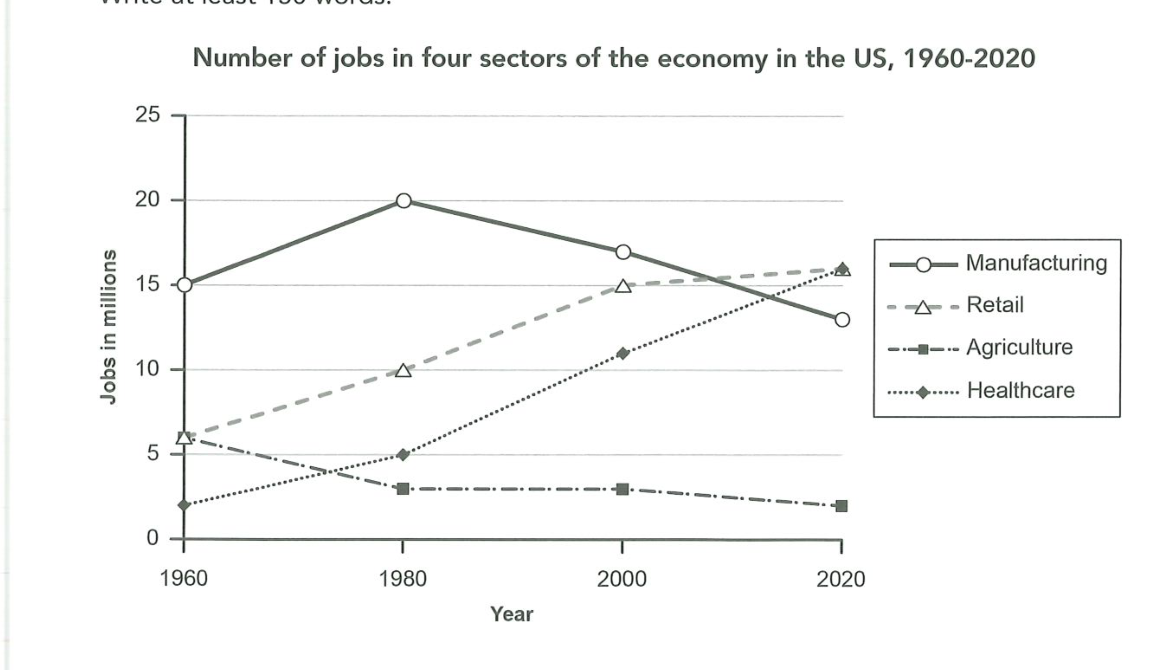
The graph below gives information about the number of jobs in four sectors of the economy in the US between 1960 and 2020.
Summarise the information by selecting and reporting the main features, and make comparisons where relevant.
Number of jobs in four sectors of the economy in the US, 1960-2020
Student answer (Band 6.0)
Introduction :
The graph illustrates the number of US jobs in different sectors (manufacturing , retail , agriculture and healthcare ) in various years from 1960 to 2020.
Overview :
As per the graph, manufactoring has the highest number of jobs in 1960 on the other hand healthcare started the lowest but healthcare and retail dominated the graph on 2020.
Paragraph 1 :
The graph indicates that in 1960 , healthcare contains the lowest jobs about 2 million jobs but rapidly increase to about 16 million on the other hand agriculture has about 6 millions jobs but decline to just 3 million in 2020.
Paragraph 2 :
As per the graph , in 1960 , manufacturing starts the highest about 15 million and after the incline in 1980 it rapidly declines to 13 million while retail gets 6 million jobs which constantly increase to highest about 16 million in 2020 .
AI examiner evaluation
| Criterion | Band |
|---|---|
| Task Achievement / Task Response | 6.5 |
| Coherence and Cohesion | 6.0 |
| Lexical Resource | 5.5 |
| Grammatical Range and Accuracy | 5.5 |
| Overall | 6.0 |
Task Achievement / Task Response: Band 6.5
You identify the four sectors and report several important trends accurately: manufacturing peaks at about 20 million in 1980 before falling to 13 million, while retail rises from 6 million to around 16 million. Your overview also notes manufacturing’s early lead and healthcare’s low starting point. This gives the response a relevant summary, but the overview’s claim that healthcare and retail “dominated” in 2020 is imprecise: both finish at roughly 16 million, tied for the highest level. Agriculture’s decline is described, though its 1980 and 2000 plateau is omitted, and healthcare’s strong rise after 1960 is not clearly traced. More precise comparisons and a fuller account of healthcare would make the key features more complete.
Coherence and Cohesion: Band 6.0
The response has a recognisable structure, with an introduction, overview and two detail paragraphs, and the reader can follow the broad movement from the starting year to 2020. You also attempt to connect comparisons using phrases such as “on the other hand” and “while.” However, these links are sometimes mechanical or do not express the relationship accurately; for example, “on the other hand” joins facts that are not necessarily contrasting, and the overview’s contrast is difficult to follow. The paragraphing is clear, but the two detail paragraphs could group and compare trends more systematically. Use a wider range of precise links, and make each paragraph’s focus explicit—for instance, compare the rising sectors together and the declining sectors together.
Lexical Resource: Band 5.5
You use relevant task vocabulary, including “number of jobs,” “sectors,” “declines,” and “increase,” so the main information is generally understandable. There are also attempts at more formal reporting language, such as “illustrates” and “indicates.” However, several word choices and collocations are inaccurate or repetitive: “healthcare contains the lowest jobs” and “retail dominated the graph” are not natural ways to describe the data. “Incline” is also unsuitable for the rise in manufacturing, and “manufactoring” is misspelled. Aim for precise trend language and accurate forms, such as “employed,” “rose,” “fell,” and “reached a peak.” This would improve clarity and give you more flexibility without changing the meaning.
Grammatical Range and Accuracy: Band 5.5
You attempt both simple statements and longer sentences that compare sectors, and the overall meaning can usually be understood. However, some grammatical errors recur. For example, “healthcare started the lowest” lacks a suitable noun or complement, while “healthcare contains” uses an inappropriate tense for a chart describing past years. In “agriculture has about 6 millions jobs,” the verb form and plural construction are not controlled, and “manufacturing starts the highest” has an awkward grammatical pattern. Commas are also often separated from the preceding word, and some long sentences need clearer punctuation. Practise past-tense reporting and sentence patterns such as “Healthcare had the fewest jobs, at about two million, before rising…” to improve accuracy and control.
See this exact question answered at other band scores. The same prompt compared across bands.
Browse more IELTS Writing model answers or get your own writing scored by the same AI examiner.