Band 5.5 IELTS Writing Task 1 Model Answer
Overall Band Score: 5.5 · Cambridge IELTS 21 · 2026-11-27
IELTS Writing Task 1 question
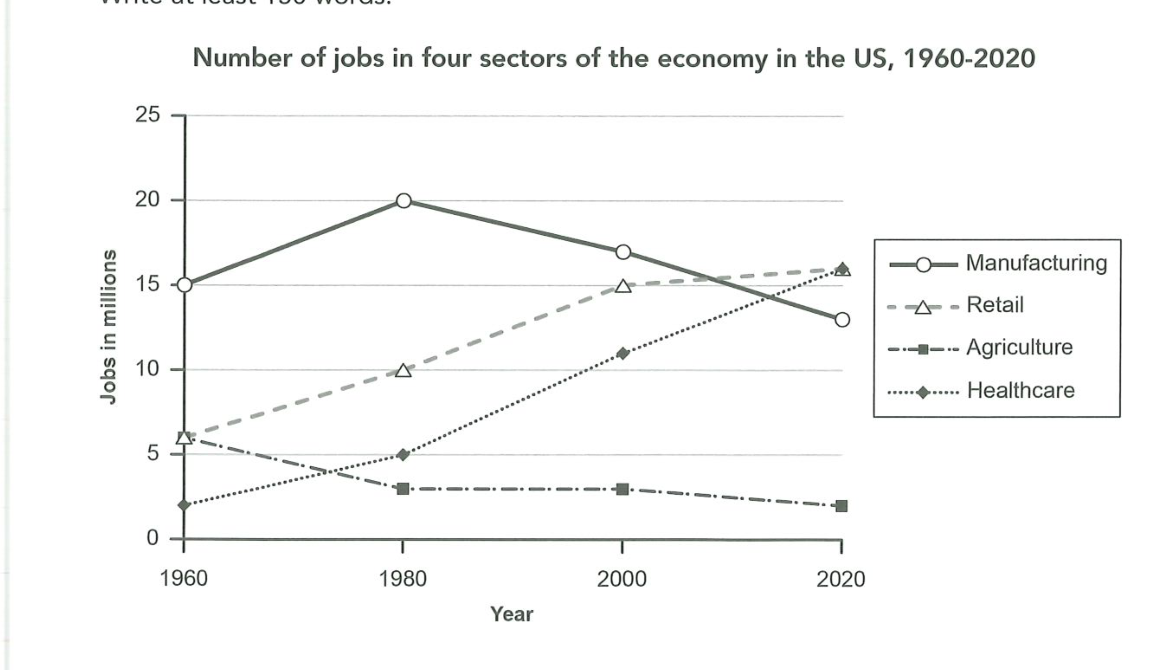
The graph below gives information about the number of jobs in four sectors of the economy in the US between 1960 and 2020.
Summarise the information by selecting and reporting the main features, and make comparisons where relevant.
Number of jobs in four sectors of the economy in the US, 1960-2020
Student answer (Band 5.5)
The line graph illustrates the amount of jobs in four branches of the economy in the US from 1960 to 2020.
Overall, manufacturing sector got a largest number of employment and healthcare was the lowest in 1960. At the end, retail and healthcare got a highest proportion of jobs. Agriculture decreased to the lowest figure at 2020.
Manufacturing line started with 15 millions at 1960, then it significantly rose to 20 millions in 1980, then it decreased below 15 millions in 2020. Also agriculture declined through those years , from above 5 million at 1960 to around 2.5 millions in 2020 and it remained constant in 1980 and 2000.
Retail and healthcare sectors are sharply increased from more than 5 millions and around 2.5 millions respectively, to the same number above 15 millions in 2020.
AI examiner evaluation
| Criterion | Band |
|---|---|
| Task Achievement / Task Response | 5.5 |
| Coherence and Cohesion | 6.0 |
| Lexical Resource | 5.5 |
| Grammatical Range and Accuracy | 5.5 |
| Overall | 5.5 |
Task Achievement / Task Response: Band 5.5
You identify the main overall pattern: manufacturing rises before falling, agriculture declines, and retail and healthcare grow to similar levels by 2020. You also include several relevant figures, such as manufacturing’s peak of 20 million in 1980. However, some comparisons are incomplete or inaccurate: manufacturing ends at about 13 million, not simply “below 15,” and agriculture is roughly 2 million in 2020, rather than 2.5 million. The overview’s claim that manufacturing had the largest employment in 1960 is supported, but the final ranking could be clearer: retail and healthcare are both about 16 million. The response is 15 words below the required minimum, and several trends receive little detail. Add precise comparisons and develop the key changes more fully.
Coherence and Cohesion: Band 6.0
The response has a clear four-part structure: an introduction, an overview, and two paragraphs grouping the declining sectors and the growing sectors. This makes the main information easy to locate, and words such as “Overall,” “then,” and “Also” help signal progression. However, some links are mechanical, and the final paragraph compresses two distinct trends into one sentence. The phrase “it remained constant in 1980 and 2000” is also unclear because the reader must infer that it refers to agriculture. Improve cohesion by using explicit references and separating the retail and healthcare figures or stages where needed. A more developed sequence of comparisons would make the progression smoother.
Lexical Resource: Band 5.5
You use relevant chart vocabulary, including “declined,” “rose,” “remained constant,” and “sectors,” so the reader can understand the broad trends. However, several choices are imprecise or unnatural for describing data: “amount of jobs” is better expressed as “number of jobs,” while “got a largest number of employment” and “got a highest proportion” do not fit the intended meaning. “Proportion” is also inaccurate here because the graph reports job totals, not shares. Repetition of “millions” and “increased” limits the range. Use precise terms such as “employment,” “stood at,” and “reached,” and vary trend language while keeping collocations natural.
Grammatical Range and Accuracy: Band 5.5
You attempt both simple and more extended sentences, including sequences linked with “then,” and the overall meaning is generally understandable. However, errors in articles, agreement, plurals, and prepositions recur: “a largest number” should be “the largest number,” “at 1960” should be “in 1960,” and “15 millions” should be “15 million.” The sentence “Retail and healthcare sectors are sharply increased” also has an incorrect verb construction; use “increased sharply” or “rose sharply.” Some sentences join several stages with repeated “then,” which limits control of complex structures. Check article use, time prepositions, and singular forms after numbers, then practise combining comparisons in accurate sentences.
See this exact question answered at other band scores. The same prompt compared across bands.
Browse more IELTS Writing model answers or get your own writing scored by the same AI examiner.