Band 6.0 IELTS Writing Task 1 Model Answer
Overall Band Score: 6.0 · Cambridge IELTS 21 · 2026-11-27
IELTS Writing Task 1 question
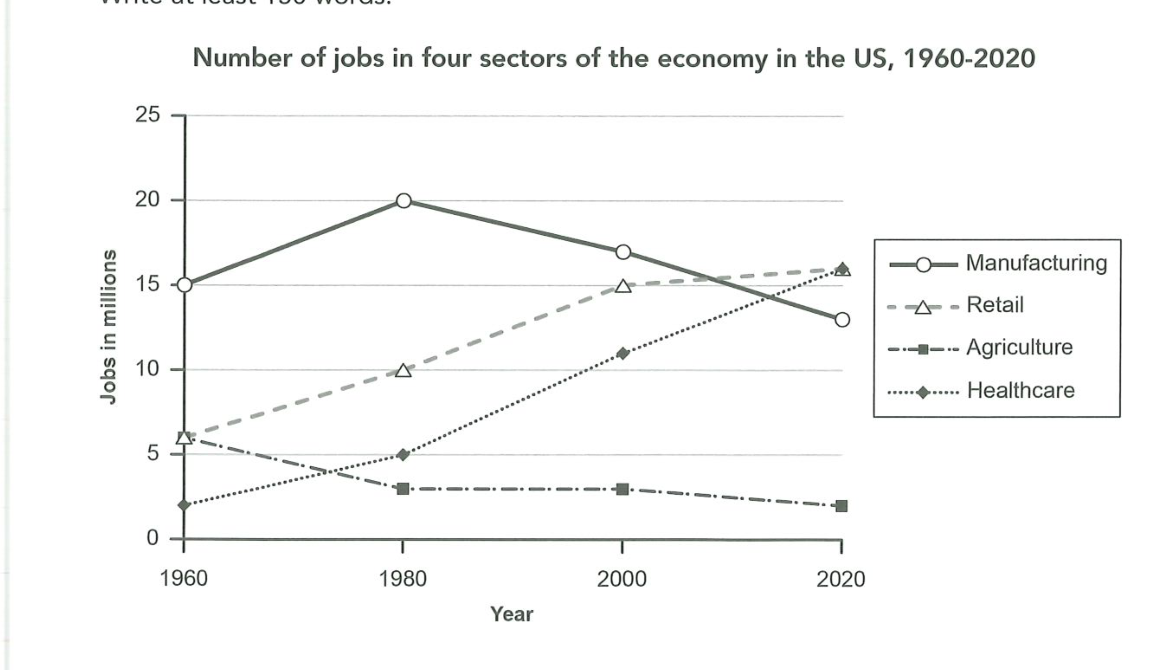
The graph below gives information about the number of jobs in four sectors of the economy in the US between 1960 and 2020.
Summarise the information by selecting and reporting the main features, and make comparisons where relevant.
Number of jobs in four sectors of the economy in the US, 1960-2020
Student answer (Band 6.0)
The image given here shows the number of jobs in four sectors of the economy in the US from 1960 to 2020. In the graph, on the x-axis we have years, and on the y-axis we have the number of jobs in millions. And, also in the graph, the jobs are shown of four major sectors of work: Manufacturing, Retail, Agriculture and Healthcare.
Firstly, we will be talking about the manufacturing sector. In the beginning, it had 15 million jobs and slowly increased and reached 20 million jobs in 1980, but then it started to decrease, and in 2000 it reached 16 million jobs. Shockingly, in 2020 it reduced to 13 million; this might be because of better machinery in the manufacturing sector and might be because of the help of robots and AI.
Now, in retail, they have done a fantastic job because in the beginning [1960] it only had around 6 million jobs, but at the end of 2020 they have around 16 million jobs, so from this we can conclude that they have made a very good improvement.
The agriculture sector has also faced a downfall because in the beginning they had approx. 6 million jobs, but by the end of 2020 they only had around 2 million jobs. If this number reduces even more, that might lead to food shortages in various nations, so the government should take some steps to boost the number of jobs in this sector by implementing some policies or subsidies.
Lastly, we have the healthcare sector; this is the most important sector amongst all, and as a result, we can see how much this sector has developed because, amongst all of them, this sector has developed the most. In 1960, they only had around 3 million jobs, but now they have 16 million jobs in 2020. This is very big difference if we compare in 1960 and 2020 it will be increase in 13 million jobs increased in 60 years.
AI examiner evaluation
| Criterion | Band |
|---|---|
| Task Achievement / Task Response | 5.5 |
| Coherence and Cohesion | 6.5 |
| Lexical Resource | 6.0 |
| Grammatical Range and Accuracy | 5.5 |
| Overall | 6.0 |
Task Achievement / Task Response: Band 5.5
You cover all four sectors and report several key movements, including manufacturing’s rise to 20 million before declining and the fall in agriculture. However, the overview is not clearly stated, and some important comparisons are underdeveloped: retail and healthcare both finish at about 16 million, while healthcare rises steadily and retail grows more gradually. There are also factual inaccuracies: manufacturing is about 17 million in 2000, not 16, and healthcare starts at about 2 million, not 3. The explanations about robots, food shortages and government subsidies are speculative and do not describe the graph; the recommendations also move away from the task. Focus on the main trends and comparisons, using only information shown.
Coherence and Cohesion: Band 6.5
The response is arranged in a clear sequence, with separate paragraphs for manufacturing, retail, agriculture and healthcare, and signposts such as “Firstly” and “Lastly” help the reader follow the sectors. This gives the report a coherent overall structure. However, the progression is somewhat mechanical, and the opening mainly describes the axes rather than presenting an overview of the main patterns. Some links also connect ideas that do not belong in a graph summary, such as the move from falling agricultural employment to possible food shortages and policy recommendations. To strengthen the organisation, add a concise overview after the introduction and group related trends for direct comparison, especially the similar final figures for retail and healthcare.
Lexical Resource: Band 6.0
You use an adequate range of vocabulary to describe change, including “increased,” “decrease,” “downfall,” “developed” and “reduced,” and the sector names are handled clearly. Some choices are imprecise or too conversational for an academic report: “fantastic job,” “Shockingly,” and “very good improvement” express judgement rather than neutral description. “This is very big difference” is also an awkward phrase, and “jobs are shown of” is an unnatural construction. Aim for precise, neutral trend language and avoid evaluating the sectors. For example, describe a figure as “rose steadily” or “declined to” a stated level, and use “employment” or “number of jobs” consistently. This would make the vocabulary more suitable and controlled.
Grammatical Range and Accuracy: Band 5.5
You attempt both simple and longer sentences, and most of the trends remain understandable. However, some sentence structures and forms are inaccurate, particularly in the final sentence: “it will be increase in 13 million jobs increased in 60 years” does not form a clear grammatical statement. There are also awkward constructions such as “In the graph, on the x-axis we have years” and “they only had around 6 million jobs,” where the referent is unclear. The repeated use of “they” for sectors also creates agreement and reference problems. Practise concise comparative structures, such as “Healthcare employment rose from about 2 million to 16 million,” and check verb forms, articles and sentence boundaries when editing.
See this exact question answered at other band scores. The same prompt compared across bands.
Browse more IELTS Writing model answers or get your own writing scored by the same AI examiner.