Band 5.0 IELTS Writing Task 1 Model Answer
Overall Band Score: 5.0 · Cambridge IELTS 21 · 2026-11-27
IELTS Writing Task 1 question
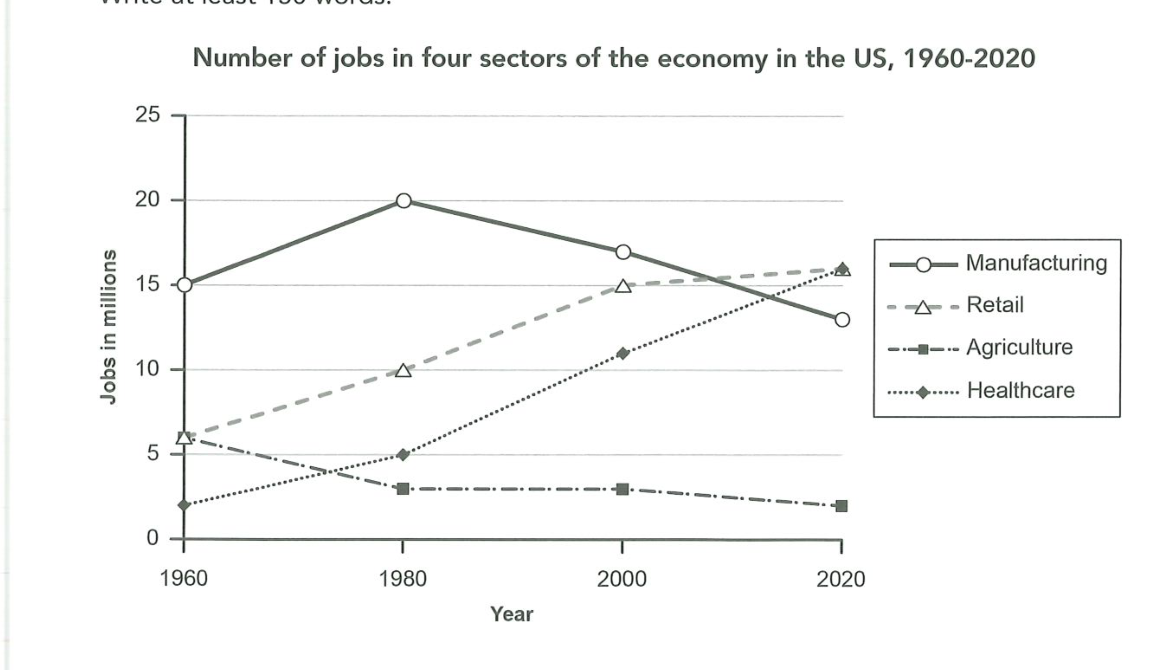
The graph below gives information about the number of jobs in four sectors of the economy in the US between 1960 and 2020.
Summarise the information by selecting and reporting the main features, and make comparisons where relevant.
Number of jobs in four sectors of the economy in the US, 1960-2020
Student answer (Band 5.0)
The line graph illustrates information about the number of jbs in four sectors of the population in the US from 1960 to 2020.
Overall the number of jobs in four sectors are fluctuated. In 1960 the number of jobs in manufacturing is 15 million and retail 5 million. The manufacturing jobs grow from 20 million in 1980 and retail job also increases 10 million. in 1960 the number of jibs in agriculture is arround 5 million and healthcare job is arround 3 million. In 1980 the number of jibs in agriculture decrease gradually and healthcare jobs increase 5 million. In 2000 the number of jobs in manufacturing decrease at 13 million and retail jobs sharply increase at 15 million. On the other hand the amount of agriculture jobd also decrease at arround 2 million and healthcare jobs sharply increase at 12 million.
At the end the number of manufacturing jobs increase and at the end it decrease and the retail jobs sharply increase.
AI examiner evaluation
| Criterion | Band |
|---|---|
| Task Achievement / Task Response | 5.0 |
| Coherence and Cohesion | 4.5 |
| Lexical Resource | 5.0 |
| Grammatical Range and Accuracy | 5.0 |
| Overall | 5.0 |
Task Achievement / Task Response: Band 5.0
You identify all four sectors and include several relevant figures, such as manufacturing at 15 million in 1960 and retail reaching about 15 million in 2000. However, the overview is unclear: “the number of jobs in four sectors are fluctuated” does not summarise the main contrasting trends. Some data and time references are also inaccurate. For example, manufacturing peaks at 20 million in 1980, then falls to 17 million in 2000 and 13 million in 2020; your account places 13 million in 2000 and later says it increases before decreasing. The final comparison is incomplete, and the rise of healthcare to around 16 million by 2020 is omitted. A clearer overview and accurate coverage of the end-point trends would make the report more complete.
Coherence and Cohesion: Band 4.5
The response has a basic sequence through the years and uses a few linking expressions, including “Overall” and “On the other hand.” However, the progression is difficult to follow because several figures are grouped together without a consistent comparison, and the final sentence repeats the retail trend while giving a confusing account of manufacturing. The paragraphing does not clearly separate an overview from the detailed comparisons. Some transitions also do not match the information that follows: “At the end” introduces a statement that does not accurately describe the final data. Organise the report into a concise overview and two detail paragraphs, grouping related sectors and moving consistently from 1960 to 2020.
Lexical Resource: Band 5.0
You use some task-relevant vocabulary, including “increase,” “decrease,” “sharply,” and “million,” so the general subject is understandable. However, the range is limited and several word-choice or spelling errors make the report less clear: “jbs,” “jibs,” and “jobd” appear repeatedly, while “sectors of the population” is not the right phrase for the chart. “The number of jobs … are fluctuated” also uses an unsuitable expression for describing trends. Use precise terms such as “employment,” “number of jobs,” “rose,” and “fell,” and check spelling carefully. Avoid repeating “jobs” in every clause by using clear references such as “this figure” where the meaning is unambiguous.
Grammatical Range and Accuracy: Band 5.0
You attempt both simple statements and longer comparisons, but the range of sentence structures is limited, and errors occur frequently enough to make some relationships unclear. For example, “the number of jobs in four sectors are fluctuated” has problems with the verb form and subject–verb agreement, while “manufacturing jobs grow from 20 million in 1980” uses an inconsistent tense and does not express the trend accurately. Capitalisation after full stops is also inconsistent, as in “in 1960.” Several sentences join multiple figures with little grammatical control. Practise forming accurate past-tense trend sentences, for example, “Manufacturing employment rose to 20 million in 1980 before declining.” Use full stops to separate comparisons and check agreement and tense.
See this exact question answered at other band scores. The same prompt compared across bands.
Browse more IELTS Writing model answers or get your own writing scored by the same AI examiner.