Band 5.0 IELTS Writing Task 1 Model Answer
Overall Band Score: 5.0 · Cambridge IELTS 21 · 2026-11-27
IELTS Writing Task 1 question
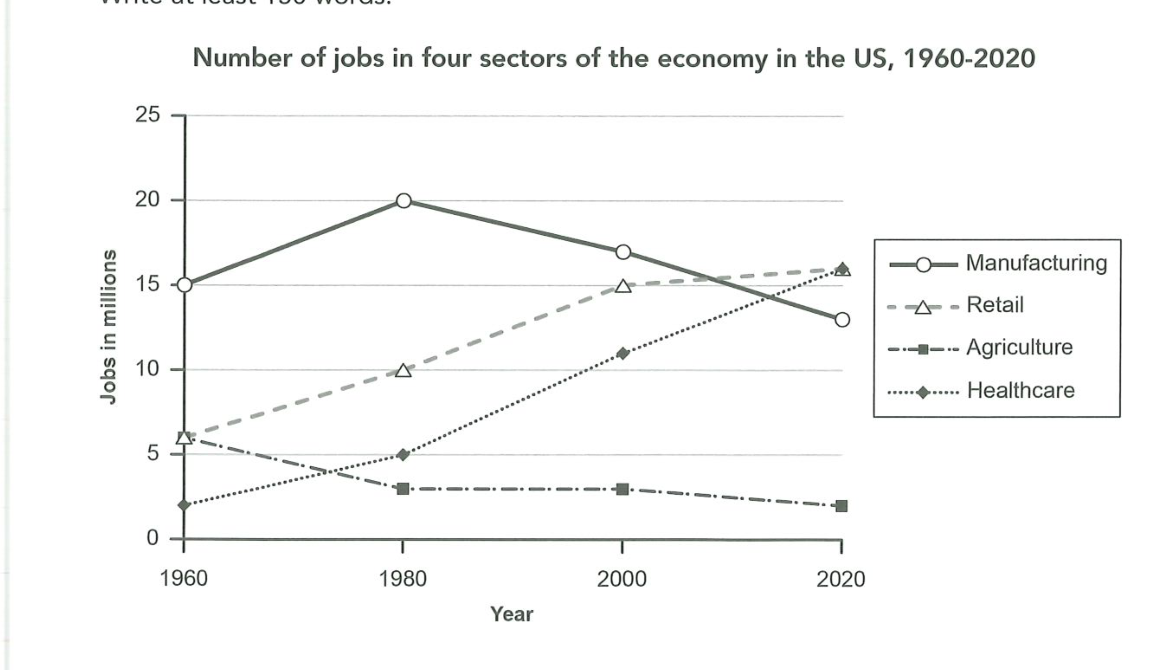
The graph below gives information about the number of jobs in four sectors of the economy in the US between 1960 and 2020.
Summarise the information by selecting and reporting the main features, and make comparisons where relevant.
Number of jobs in four sectors of the economy in the US, 1960-2020
Student answer (Band 5.0)
The line graph illusrates the ideas about the numbers of employes in four sectore of the economy of America from 1960 to 2020.
Overall, in the graph line manufacturing tope of jobs in fifteen millions, so with time increased in reached to twenty millions, but after that repidly t decreasing and finly stoped in thirteen percent, and other one is healthcare in first time in ninteen sixty less then five millions, but started growing and reached to five millions than ten and the last fixed in sixteen or seventeen millions,
In this line graph the Retail expanded like munufacturing, like in 1960, Retail, in 5 millions employes category but repidly increased to 10% and completely sisteen milliones employes figure. Moreover, healthcear was same expended, but Agriculture is a from of declined , like at 1960, the jobs holder minimum five millions, so after in 20 years sharply decreasd in came to 3 millions and still mantand more twenty years, but at the end 2020 reached to less two millions.
AI examiner evaluation
| Criterion | Band |
|---|---|
| Task Achievement / Task Response | 5.5 |
| Coherence and Cohesion | 5.0 |
| Lexical Resource | 4.5 |
| Grammatical Range and Accuracy | 5.0 |
| Overall | 5.0 |
Task Achievement / Task Response: Band 5.5
You identify the four sectors and report several important movements, including manufacturing peaking in 1980 before declining, healthcare rising, and agriculture falling. These are relevant features, and the response includes an overall summary. However, some figures and comparisons are inaccurate or unclear: manufacturing is described as ending at “thirteen percent” rather than about 13 million jobs, and retail’s rise is not clearly reported at 2000 before reaching about 16 million in 2020. The overview also focuses heavily on manufacturing and healthcare without clearly stating the key end-point comparison: retail and healthcare finish at similar levels, while agriculture is lowest. More precise reporting and a clearer selection of the main trends would make the response more complete.
Coherence and Cohesion: Band 5.0
The response has a basic structure, with an opening, an overview, and a further paragraph describing the sectors. Linking expressions such as “Overall,” “Moreover,” and “but” show an attempt to connect ideas. However, progression within the paragraphs is difficult to follow because several trends are crowded into long, loosely connected sentences. For example, the overview moves from manufacturing to healthcare in one sentence, while the final paragraph shifts between retail, healthcare, and agriculture without a clear sequence. Some references, such as “other one” and “this line graph,” are vague, and connectors do not always clarify the relationship between points. Organising the details into clearer comparisons and using more precise referencing would improve the flow.
Lexical Resource: Band 4.5
You attempt vocabulary relevant to describing trends, including “increased,” “reached,” “declined,” and “sharply decreased.” This gives the reader some sense of the changes shown. However, spelling errors and inaccurate word choices are frequent and sometimes make the meaning difficult to interpret, as in “illusrates,” “employes,” “sectore,” “repidly,” and “mantand.” Several phrases are also unnatural or imprecise, such as “the ideas about the numbers” and “the jobs holder minimum five millions.” Use standard chart language and check spelling carefully; for example, describe the number of jobs as rising or falling to a figure, rather than using “percent” for a quantity measured in millions.
Grammatical Range and Accuracy: Band 5.0
You attempt to combine ideas using clauses and contrast, as in “but after that … decreasing,” and you use time references to describe change. However, the range of sentence structures is limited, and attempts at longer sentences often contain errors that make relationships unclear. Examples include “in first time in ninteen sixty less then five millions” and “after in 20 years sharply decreasd in came to 3 millions.” Verb forms, articles, sentence boundaries, and clause construction need more control. The manufacturing overview also shifts awkwardly between past and present forms. Practise writing shorter, complete sentences first, then combine them accurately with connectors such as “while” and “whereas.”
See this exact question answered at other band scores. The same prompt compared across bands.
Browse more IELTS Writing model answers or get your own writing scored by the same AI examiner.