Band 6.5 IELTS Writing Task 1 Model Answer
Overall Band Score: 6.5 · Cambridge IELTS 21 · 2026-11-28
IELTS Writing Task 1 question
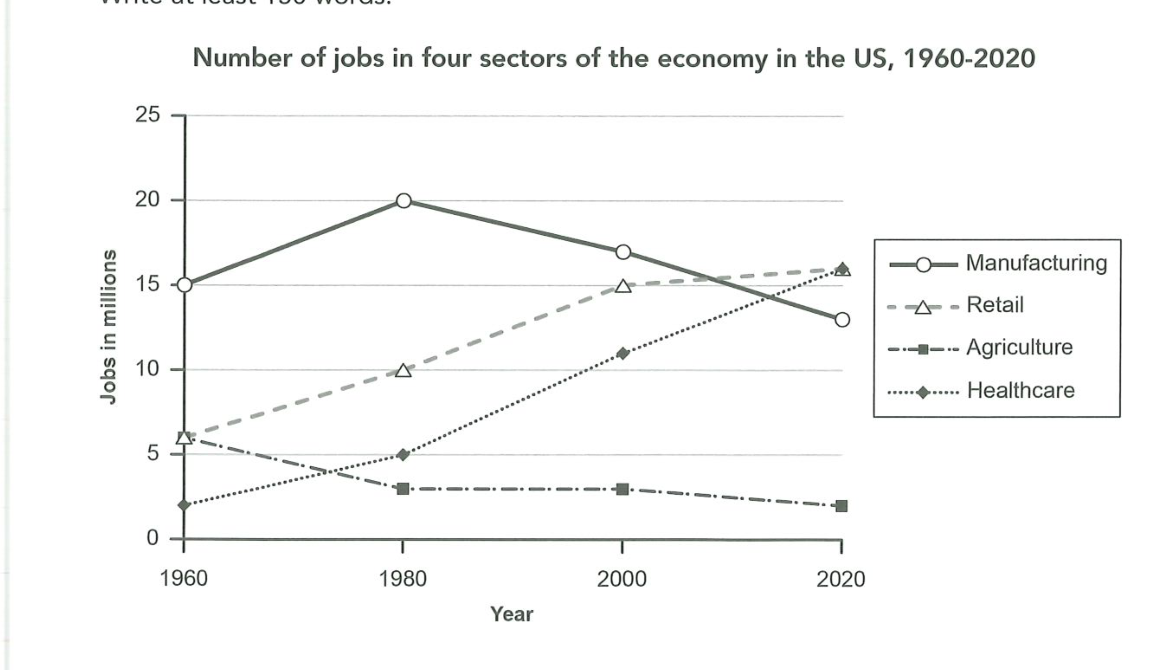
The graph below gives information about the number of jobs in four sectors of the economy in the US between 1960 and 2020.
Summarise the information by selecting and reporting the main features, and make comparisons where relevant.
Number of jobs in four sectors of the economy in the US, 1960-2020
Student answer (Band 6.5)
The line graph illustrates the data about number of jobs in four economic sectors in US between year 1960 and 2020.
Overall the graph has increasing trend for health care and retail sector while agriculture sector shows declining trend and has least number of jobs. Although Manufacturing sector shows declining trend in number of jobs after 1980, still it had most number of jobs for majority of time period.
Manufacturing sector had around 15 million jobs in 1960 which increased to almost 20 million jobs in 1980. After 1980 it started to fall and in year 2020 it reduced to around 13 million jobs.
Retail and health care sector observe increasing trend throughout the period. Retail sector started little more than 5 million jobs in year 1960 which become approximately 15 million in year 2000. After year 2000 increase in number of jobs reduced and no significant increase can be seen in next 2 decades.
Healtcare sector observed significant rising trend it started around 2 million jobs in year 1960 and that number became 15 million jobs in year 2020.
Agriculture sector observed declining trend and it started around 5 million jobs in starting year 1960, and it ended with almost 2 million jobs in ywae 2020.
AI examiner evaluation
| Criterion | Band |
|---|---|
| Task Achievement / Task Response | 7.0 |
| Coherence and Cohesion | 7.0 |
| Lexical Resource | 6.0 |
| Grammatical Range and Accuracy | 6.0 |
| Overall | 6.5 |
Task Achievement / Task Response: Band 7.0
The response selects the main trends and gives a clear overview: healthcare and retail rise, agriculture declines, and manufacturing peaks in 1980 before falling. Most reported figures match the chart, including manufacturing at about 15 million in 1960 and 13 million in 2020, and retail reaching about 15 million in 2000. The comparison that manufacturing had the most jobs for most of the period is also supported. Some details could be more precise: healthcare reaches approximately 16 million in 2020, not 15 million, and retail rises slightly from 15 to 16 million after 2000 rather than showing no significant increase. More explicit comparison of the sectors at the end would strengthen the report further.
Coherence and Cohesion: Band 7.0
The information is arranged in a clear progression: an introduction, an overview, and then details about manufacturing, the two rising sectors, and agriculture. This makes the main trends easy to follow, and phrases such as “After 1980” and “After year 2000” help signal changes over time. The grouping of retail and healthcare is logical because both rise, although their different rates and final figures could be contrasted more directly. Some linking is repetitive, particularly the repeated use of “sector” and “trend,” and the final agriculture sentence repeats information already stated in the overview. More varied referencing and tighter connections between comparisons would make the cohesion more flexible.
Lexical Resource: Band 6.0
The vocabulary is adequate for describing the graph, with useful trend language such as “increased,” “declining,” “fall,” and “significant rising trend.” The writer also uses relevant terms including “million jobs” and “period.” However, several word choices and collocations are awkward or imprecise, such as “the graph has increasing trend,” “observe increasing trend,” and “started little more than 5 million jobs.” “Reduced” is also less natural than “fell” when describing a figure. There are spelling and form slips, including “Healtcare” and “ywae,” which do not prevent understanding but reduce accuracy. More precise, natural phrases for describing rises, falls, and plateaus would improve the range and control.
Grammatical Range and Accuracy: Band 6.0
The response uses a mix of simple and more complex sentence forms, including a contrast with “Although” and time clauses beginning “After 1980” and “After year 2000.” The meaning is generally clear, but some grammatical errors remain. For example, the opening needs articles and a preposition (“the number of jobs … in the US”), while “increased trend” requires an article and a more suitable construction. In “that number became approximately 15 million,” the subject and phrasing are not well formed for describing a chart value. There are also inconsistent article and tense patterns, as in “in starting year 1960.” Checking articles, sentence patterns, and consistent past-tense reporting would improve accuracy while preserving the range of structures.
See this exact question answered at other band scores. The same prompt compared across bands.
Browse more IELTS Writing model answers or get your own writing scored by the same AI examiner.