Band 6.0 IELTS Writing Task 1 Model Answer
Overall Band Score: 6.0 · Cambridge IELTS 21 · 2026-11-28
IELTS Writing Task 1 question
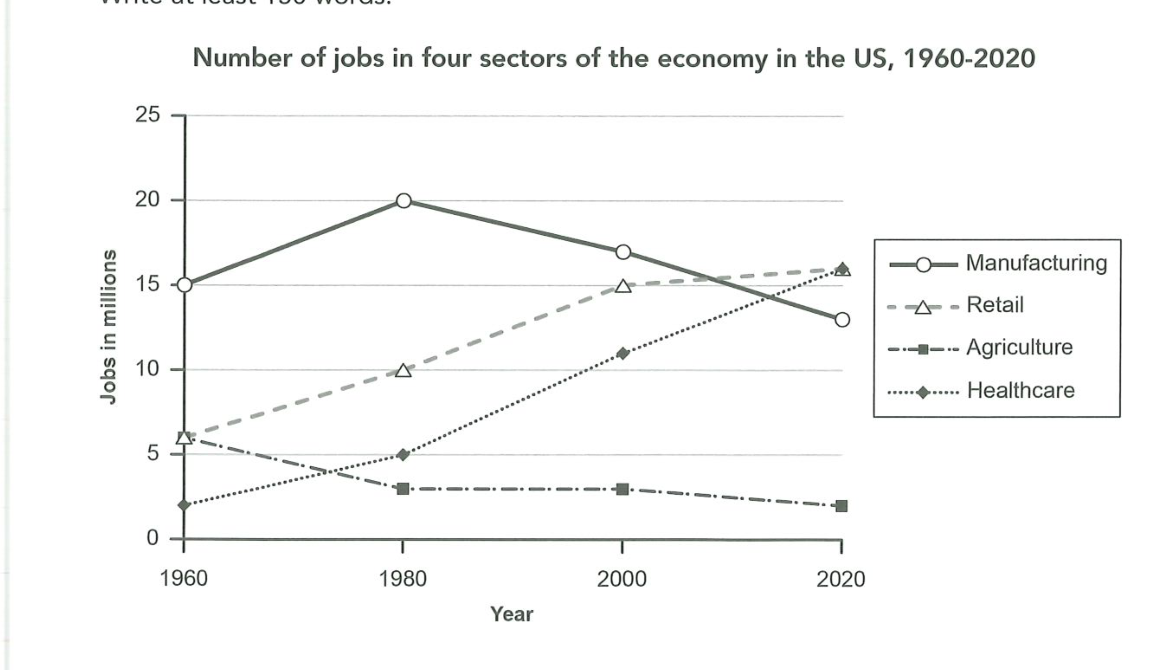
The graph below gives information about the number of jobs in four sectors of the economy in the US between 1960 and 2020.
Summarise the information by selecting and reporting the main features, and make comparisons where relevant.
Number of jobs in four sectors of the economy in the US, 1960-2020
Student answer (Band 6.0)
The line graph illustrate the number of people employed in four sectors of US economy (Manufacture, Retail, Agriculture, Healthcare) between 1960 and 2000.
Overall, it is clear that employment in healthcare and retail increased considerable over the period.whereas agriculuture experienced a continues decline. Manufacture was largest employment sector, but its figure decline towards the end. By 2020 healthcare and retail became the highest of the sector.
Looking at the details, In 1960 manufacture employed approximately 15 million, compared to around 6 million in retail. The figure for manufacturing then rose signifivcantly to peak of 20 million in 1980. before falling to 17 million in the 2000 and reach about 13 million in the end. Retail employed increased from 6 million in 1960 to 10 million in 1980 and nearly 15 million in 2000, reaching approximately 16 million in the end of the period.
Turning to the remaining category, healthcare had the lowest employed figure in 1960 at just 2 million. However, it incresed at reaching 5 million in 1980., 11 million in 2000 and 16 million in 2020. In contrast, agriculture showed a downward trend. its figure then fell about to 6 million in 1980. In 2020, its reached around 2 million at the end of the period.
AI examiner evaluation
| Criterion | Band |
|---|---|
| Task Achievement / Task Response | 6.5 |
| Coherence and Cohesion | 6.5 |
| Lexical Resource | 6.0 |
| Grammatical Range and Accuracy | 5.5 |
| Overall | 6.0 |
Task Achievement / Task Response: Band 6.5
You cover all four sectors and report the main directions of change, with a useful overview noting growth in healthcare and retail, decline in agriculture, and manufacturing’s rise followed by a fall. Most figures are consistent with the graph, including manufacturing’s peak at 20 million and healthcare’s increase to 16 million. However, the opening says the period is 1960–2000, although the graph continues to 2020, and the overview could state more precisely that retail and healthcare finish joint highest. Agriculture’s fall to 3 million by 1980 and its stable level in 2000 are omitted, so this trend is less fully described. More precise coverage of the endpoint and intermediate stages would make the report more complete.
Coherence and Cohesion: Band 6.5
The response has a clear overall arrangement: an introduction, an overview, and two detail paragraphs grouping manufacturing with retail and healthcare with agriculture. This gives the reader a sensible route through the information, and phrases such as “Looking at the details” and “Turning to the remaining category” signal transitions. Some linking and punctuation are less controlled, however: “period.whereas” runs two ideas together, and “1980. before falling” breaks a sentence unnecessarily. The agriculture description also jumps from its 1960 value to 1980 and then 2020, leaving the sequence less complete. Use consistent sentence boundaries and connect comparisons more smoothly to strengthen the progression.
Lexical Resource: Band 6.0
You use an adequate range of task-relevant vocabulary, including “peak,” “compared to,” “downward trend,” and “employed,” and the main trends remain understandable. There are, however, several spelling and word-choice errors, such as “Manufacture” for “manufacturing,” “agriculuture,” “signifivcantly,” and “incresed.” Some expressions are also unnatural or imprecise: “increased considerable,” “lowest employed figure,” and “at reaching 5 million.” These errors do not prevent the reader from following the report, but they limit precision and naturalness. Check spelling carefully and favour standard collocations such as “employment rose considerably” and “the number employed.”
Grammatical Range and Accuracy: Band 5.5
You attempt both simple and more complex sentence forms, including comparisons and contrast clauses, and the overall meaning is generally clear. Some grammatical errors remain, particularly with verb forms, agreement, articles, and sentence boundaries. For example, “The line graph illustrate” needs subject–verb agreement, while “Retail employed increased” has an incorrect construction; “its reached” also uses the wrong pronoun form. The opening’s “between 1960 and 2000” conflicts with the chart’s full period, and punctuation in “1980., 11 million” disrupts the sentence. Build accuracy by checking each sentence for a clear subject and correctly formed verb, and use full stops and commas consistently.
See this exact question answered at other band scores. The same prompt compared across bands.
Browse more IELTS Writing model answers or get your own writing scored by the same AI examiner.