Band 4.0 IELTS Writing Task 1 Model Answer
Overall Band Score: 4.0 · Cambridge IELTS 21 · 2026-11-28
IELTS Writing Task 1 question
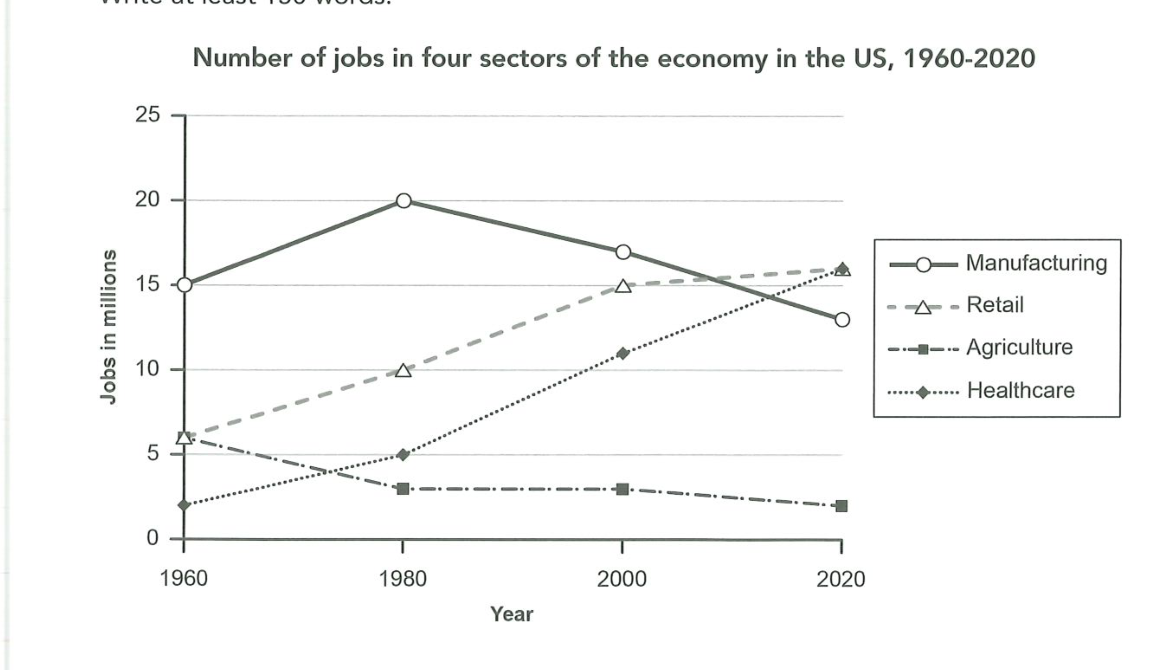
The graph below gives information about the number of jobs in four sectors of the economy in the US between 1960 and 2020.
Summarise the information by selecting and reporting the main features, and make comparisons where relevant.
Number of jobs in four sectors of the economy in the US, 1960-2020
Student answer (Band 4.0)
The line chart presents the number of people employed in four sectors of the economy in the US from 1960 to 2020.
Overall, retail and healthcare started from different levels but ended up together in 2020 with the highest number of jobs. Manufacturing and agriculture had steadily declined.
Manufacturing started from 15 million jobs in 1960 and 1980 manufacturing started increasing sharply with 20 million jobs.
AI examiner evaluation
| Criterion | Band |
|---|---|
| Task Achievement / Task Response | 3.0 |
| Coherence and Cohesion | 4.5 |
| Lexical Resource | 4.5 |
| Grammatical Range and Accuracy | 4.5 |
| Overall | 4.0 |
Task Achievement / Task Response: Band 3.0
The opening identifies the chart’s subject and period, and the overview correctly notes that retail and healthcare finish at the joint highest level. However, the response is far too incomplete to summarise the main features: it gives no figures or trends for retail, healthcare, or agriculture, and the claim that manufacturing and agriculture “had steadily declined” is inaccurate because manufacturing rose to a peak of 20 million in 1980 before falling. The final sentence also repeats the 1980 increase rather than describing the later decline. The response contains 57 words, below the required 150; the nine words copied from the prompt are excluded from that count. Include the key changes and comparisons across all four sectors, supported by accurate figures.
Coherence and Cohesion: Band 4.5
The response has a basic, recognisable structure: an introduction, an overview beginning with “Overall,” and a detail sentence about manufacturing. This gives the reader a starting point, but the ideas do not develop into a complete or clearly sequenced account. The overview groups manufacturing with agriculture as declining, although manufacturing first rises, and the final sentence repeats the same sector without moving on to other data. The abrupt ending also leaves the comparison unfinished. To improve progression, organise the details by contrasting trends—for example, rising sectors against falling ones—and use clear links such as “By contrast” or “Meanwhile” where they express the relationship accurately.
Lexical Resource: Band 4.5
The vocabulary is sufficient to identify the chart and its subject, with relevant terms such as “employed,” “sectors,” and “number of jobs.” However, the range is narrow because the response is very short, and key trend language is not used precisely: “steadily declined” does not describe manufacturing, which rose before falling. “Started increasing sharply” is understandable but could be expressed more naturally and accurately as a rise to a peak. Repetition of “manufacturing” also limits variety. Use a broader set of precise reporting verbs and phrases, such as “climbed,” “reached a peak,” “fell,” and “remained stable,” while ensuring each phrase matches the data.
Grammatical Range and Accuracy: Band 4.5
The response uses mostly understandable sentence forms, including a clear introductory sentence and the overview sentence beginning “Overall.” However, the final sentence has a faulty structure: “Manufacturing started from 15 million jobs in 1960 and 1980 manufacturing started increasing sharply with 20 million jobs.” The time reference is awkwardly joined to a second clause, and the repeated subject makes the sentence difficult to follow. The response also shows little range beyond simple statements, so there is limited evidence of control over varied sentence structures. Separate the time points and use a clear clause pattern, for example: “Manufacturing employed 15 million people in 1960, rising to 20 million in 1980.”
See this exact question answered at other band scores. The same prompt compared across bands.
Browse more IELTS Writing model answers or get your own writing scored by the same AI examiner.