Band 6.0 IELTS Writing Task 1 Model Answer
Overall Band Score: 6.0 · Cambridge IELTS 21 · 2026-11-28
IELTS Writing Task 1 question
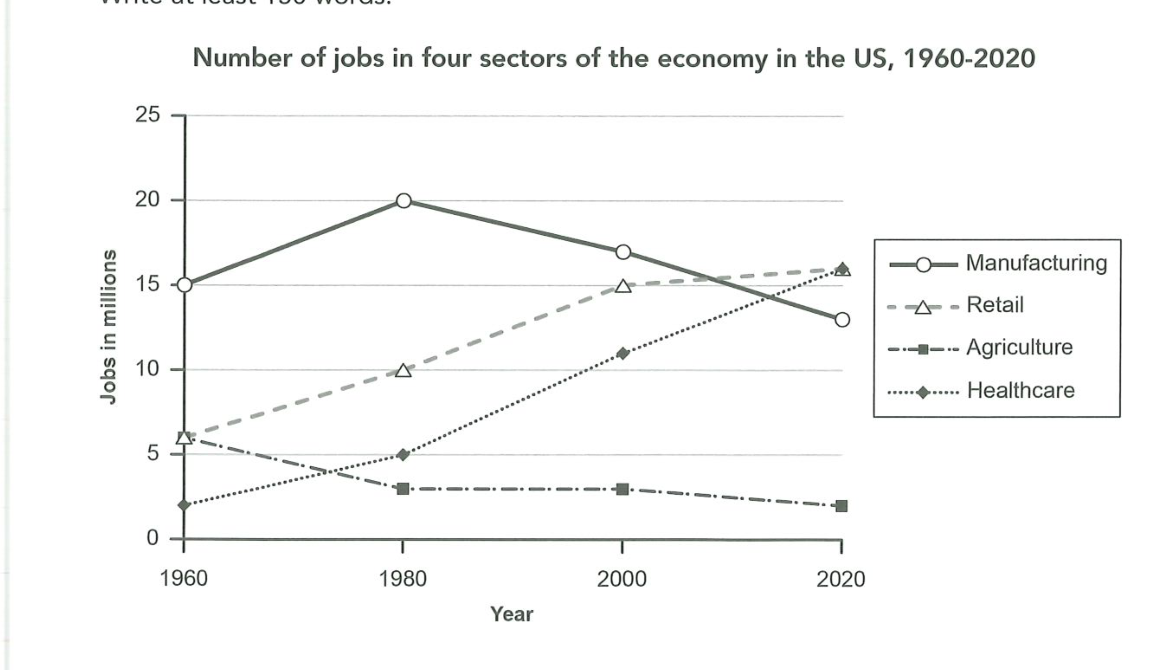
The graph below gives information about the number of jobs in four sectors of the economy in the US between 1960 and 2020.
Summarise the information by selecting and reporting the main features, and make comparisons where relevant.
Number of jobs in four sectors of the economy in the US, 1960-2020
Student answer (Band 6.0)
The given graph compares the number of jobs in the four sectors of the economy in Us between the years 1960 to 2020.
Overall, from the graph it is evident that all four sectors that are manufacturing, retail, agriculture and healthcare has their individual growth rate. Healthcare and retail shows constant growth where as manufacturing and agriculture were decreasing as the year kept increasing.There is a strong fluctuation in all four sectors.
It can be seen that through the year 1960 to 2020, there is a rapid increase in healthcare and retail. Retail shows some consitency from the year 2000 to 2020. Healthcare on the other hand has same growth .By the year 2020, they are on the same level. Talking about manufacturing sector, it was growing till 1980 and gradually was dropping till it reached 2020. Agriculture department could barely see the growth , by 2020 it was almost negligible.
AI examiner evaluation
| Criterion | Band |
|---|---|
| Task Achievement / Task Response | 6.0 |
| Coherence and Cohesion | 6.0 |
| Lexical Resource | 5.5 |
| Grammatical Range and Accuracy | 5.5 |
| Overall | 6.0 |
Task Achievement / Task Response: Band 6.0
You identify the main broad movements: manufacturing rises to a peak before declining, agriculture falls, and healthcare and retail increase. The ending comparison that healthcare and retail are at the same level in 2020 is also accurate. However, the overview is not fully reliable: it says retail and healthcare show “constant growth,” although retail’s rise slows between 2000 and 2020, and it describes “strong fluctuation” across all sectors, which does not accurately summarise the mostly steady trends. Some key comparisons are underdeveloped, such as manufacturing remaining the largest sector until 2000 and healthcare’s particularly sharp rise after 1980. Include selected figures to support these points and distinguish the sectors’ different patterns more precisely.
Coherence and Cohesion: Band 6.0
The response has a recognisable structure, with an introduction, an overview and a paragraph describing the individual sectors. Its sequence from the overall trends to details is generally easy to follow, and phrases such as “on the other hand” help signal a contrast. However, the overview’s ideas are not always clearly connected: “all four sectors … has their individual growth rate” is followed by a claim of “strong fluctuation,” which does not clarify the actual patterns. Some linking is mechanical or imprecise, and the final paragraph moves between sectors without a consistent comparison. Organise the details into clearer comparisons—for example, rising sectors together and declining sectors together—and use references that make each trend easy to track.
Lexical Resource: Band 5.5
You use relevant vocabulary for describing trends, including “rapid increase,” “gradually … dropping,” and “same level,” so the main information remains understandable. However, the range is limited and several choices are inaccurate or unnatural for a graph report. “Strong fluctuation” does not fit the relatively steady movements shown, while “same growth” is unclear when you mean that healthcare continued to rise. “Agriculture department” is also not the appropriate name for a sector, and “almost negligible” is an imprecise way to describe its low job total. Spelling errors such as “consitency” and inconsistent capitalisation of “US” further reduce control. Choose precise trend terms and check spelling and collocations.
Grammatical Range and Accuracy: Band 5.5
You attempt both simple and more complex sentence forms, including contrastive structures such as “Healthcare, on the other hand…” and a time clause beginning “By the year 2020.” The overall meaning is usually clear, but some grammatical errors remain. For example, “Healthcare and retail shows” needs a plural verb, while “all four sectors … has” also has subject–verb disagreement; “where as” should be written as one word. There are also sentence-boundary and punctuation problems, such as the missing space after the full stop in “growth .By,” and the opening phrase “between the years 1960 to 2020” uses an incorrect preposition pattern. Review agreement, clause punctuation and standard time expressions.
See this exact question answered at other band scores. The same prompt compared across bands.
Browse more IELTS Writing model answers or get your own writing scored by the same AI examiner.