Band 6.5 IELTS Writing Task 1 Model Answer
Overall Band Score: 6.5 · Cambridge IELTS 21 · 2026-11-26
IELTS Writing Task 1 question
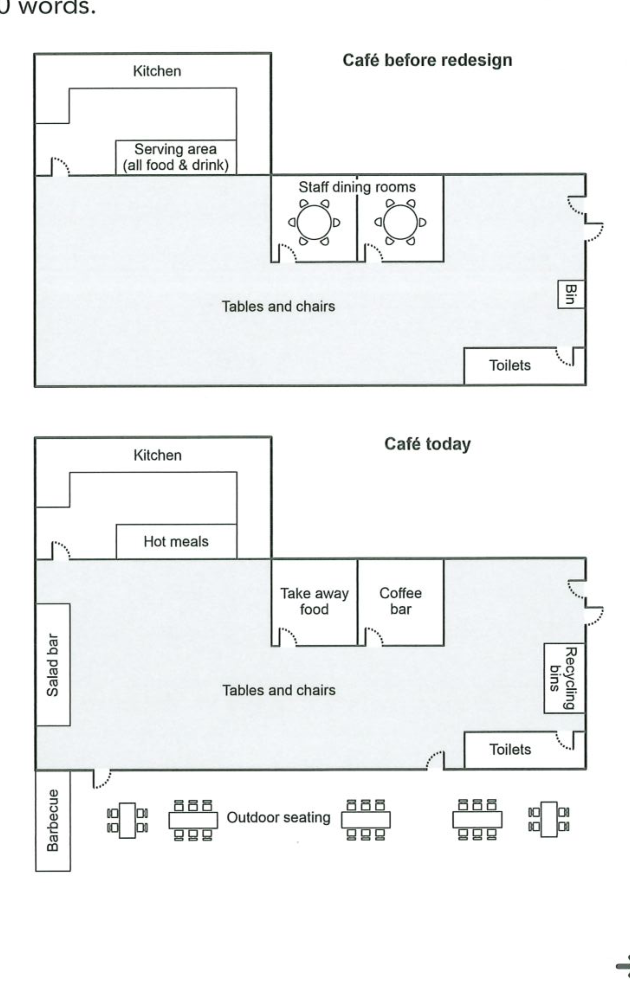
The plans below show a college cafe before it was redesigned and how it looks now.
Summarise the information by selecting and reporting the main features, and make comparisons where relevant.
The plans below show a college cafe before it was redesigned and how it looks now.
Student answer (Band 6.5)
overall, the architecture changed from a simple traditional cafe to a modern design with more facilities like takeaways ,salad bar and an outdoor seating plan to enjoy the barbecue in the open air.
In the older cafe, there is a serving area to the south of the kitchen where all foods and drinks were served but it changed to hot meals area in the new design.To the west of cafe, a salad bar is build which was not part of the cafe before the renovation.The area for the tables and chairs remained the same in both designs whereas to the north of it were staff dining rooms in the older version which were replaced by two new blocks, take away food and coffe bar built adjacent to each other.
There was a bin for trash on the east of the cafe which extented by size to a recycled bins area in the newer version and the toilets beneath it remained in the same place and did not change but to the left of the toilet was built an opening, probably a door to make an entrance to the toilets from outside the building.
The most prominent change is the barbecue place made outside the cafe, with outdoor seating plan, which was not part of the cafe before the redesign.
AI examiner evaluation
| Criterion | Band |
|---|---|
| Task Achievement / Task Response | 7.5 |
| Coherence and Cohesion | 6.5 |
| Lexical Resource | 6.5 |
| Grammatical Range and Accuracy | 6.0 |
| Overall | 6.5 |
Task Achievement / Task Response: Band 7.5
The response gives a clear overview of the redesign, highlighting the new food facilities and outdoor seating with a barbecue, and it accurately compares several key features: the kitchen and toilets remain in place, the serving counter becomes a hot-meals area, and the former staff rooms are replaced by takeaway and coffee sections. These details show good selection and reporting of the plans. However, a few descriptions are imprecise or unsupported: the bin did not “extend by size”; it was replaced by recycling bins in the same position, and the new southern doors lead to the outdoor seating rather than forming an entrance to the toilets. The overview could also mention the added salad bar and the unchanged central seating more systematically. Overall, the main changes are well covered, with some details needing sharper precision.
Coherence and Cohesion: Band 6.5
The response is organised into a broad overview followed by comparisons of the interior and then the outdoor changes. This gives the reader a generally clear route through the information, and linking expressions such as “whereas,” “but,” and “which” help connect old and new features. The progression is not fully controlled, however: the second paragraph combines several changes in a long sentence, while the third introduces the toilets, then an inaccurate door detail, and finally returns to the barbecue and seating. Some references, such as “to the left of the toilet,” are also difficult to interpret in relation to the plan. Grouping features by location and using shorter, more clearly linked sentences would make the organisation more consistently logical and the cohesion less mechanical.
Lexical Resource: Band 6.5
There is an adequate range for describing a plan, including “redesign,” “adjacent,” “remained,” “replaced,” and “prominent change.” These choices help communicate comparisons and spatial relationships. Some word choices and collocations are imprecise, though: “architecture” is not the most suitable term for changes to a café layout, “extent(ed) by size” does not describe the recycling bins accurately, and “outdoor seating plan” is less natural than a direct reference to an outdoor seating area. There are also spelling errors in “coffe” and “recycled bins,” and “build” is used where the past participle is needed. More precise plan vocabulary and careful proofreading would improve flexibility and accuracy without changing the clear overall meaning.
Grammatical Range and Accuracy: Band 6.0
The response attempts a mix of simple and complex sentences, using clauses such as “where all foods and drinks were served” and contrasts with “whereas.” Most relationships remain understandable, but some grammatical errors recur. For example, “a salad bar is build” has an incorrect verb form, and “which extented by size to a recycled bins area” has problems with verb construction and number agreement. The sentence beginning “There was a bin…” also becomes overloaded, making the relationship between the bin, recycling bins, toilets, and the supposed door unclear. Capitalisation after sentence openings and punctuation around sentence boundaries are inconsistent. Aim for more controlled sentence lengths, accurate past-tense forms, and clearer clause boundaries; this would strengthen accuracy while retaining the range already attempted.
See this exact question answered at other band scores. The same prompt compared across bands.
Browse more IELTS Writing model answers or get your own writing scored by the same AI examiner.