Band 6.0 IELTS Writing Task 1 Model Answer
Overall Band Score: 6.0 · Cambridge IELTS 21 · 2026-11-05
IELTS Writing Task 1 question
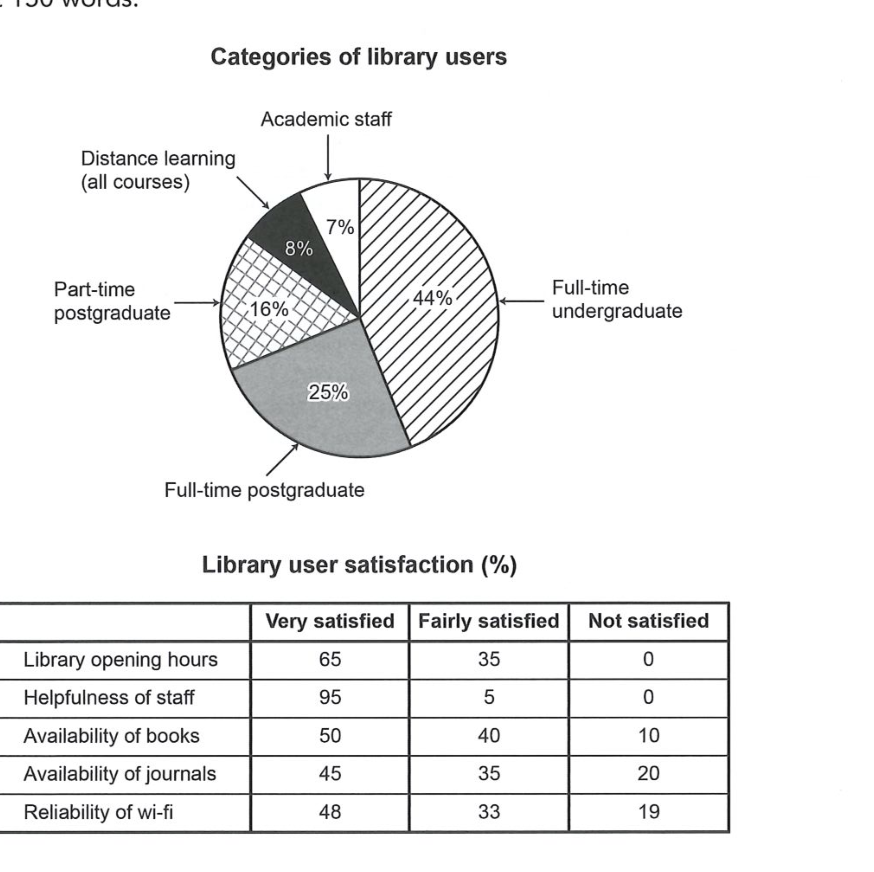
The chart and table below show the results of a survey of library users at a university.
Summarise the information by selecting and reporting the main features, and make comparisons where relevant.
Categories of library users
Student answer (Band 6.0)
The pie chart shows five differents categories of library users at a university and the table provides information about the library user satisfaction level.
Overall, the users of the libraby are mostly full- time undergraduate and the users are highly satisfied with staff helpful nature.
In the pie chart, full-time postgraduate and full-time undergraduate has the biggest proportion of users compare to other categories which is 25% and 44% respectfully. Moreover, 16% part-time postgraduate , 8% distance learning (all courses) and 7% academic staff is included in the library users list.
In the table, users review are provided in five sections and three level- very satisfied, fairly satisfied and not satisfied. With the opening hours, 65% users are very satisfied but 35% fairly satisfied. Staff helpfull behaviour are praised by 95% users , while 5% slightly less satisfied. The other sectors - availability of books and journals ,reliability of wifi shows similar kinds of review, not more than 50% users are very satisfied, around 35%users are fairly satisfied and less than 20% users are not satisfied at all.
AI examiner evaluation
| Criterion | Band |
|---|---|
| Task Achievement / Task Response | 6.0 |
| Coherence and Cohesion | 6.0 |
| Lexical Resource | 5.5 |
| Grammatical Range and Accuracy | 5.5 |
| Overall | 6.0 |
Task Achievement / Task Response: Band 6.0
You cover both visuals and give a relevant overview, identifying full-time undergraduates as the largest user group and staff helpfulness as the strongest satisfaction result. The user-category figures are reported accurately. You also describe opening-hours satisfaction correctly and capture the broad pattern for books, journals and Wi-Fi. However, the overview could compare the satisfaction results more fully: for example, staff helpfulness has the highest very-satisfied share, while journals have the highest dissatisfaction. The final summary groups three categories together and is imprecise: books have 50% very satisfied, but journals have 45% and Wi-Fi 48%; dissatisfaction ranges from 10% to 20%, rather than being uniformly below 20%. Selecting these contrasts would make the key features clearer and more complete.
Coherence and Cohesion: Band 6.0
The response has a clear overall arrangement: an introduction, an overview, and separate paragraphs for the chart and table. This makes the two sources easy to follow, and linking expressions such as “Overall,” “Moreover,” and “while” help connect information. The progression is generally logical, but some cohesion is mechanical or unclear. For instance, “The other sectors … shows similar kinds of review” bundles three rows together without clearly distinguishing their results, and “which is 25% and 44%” has an unclear reference. Use more precise links and organise the table paragraph around meaningful comparisons, such as the high ratings for staff and opening hours versus the more mixed ratings for resources and Wi-Fi. This would improve flow without changing the basic paragraph structure.
Lexical Resource: Band 5.5
You use enough task-related vocabulary to describe the visuals, including “proportion,” “satisfaction level,” “opening hours,” and “availability.” Some variation is also evident in phrases such as “users” and “library users.” However, several word choices and collocations are inaccurate or awkward, including “users review,” “staff helpfull behaviour are praised,” and “similar kinds of review.” Spelling errors such as “differents,” “libraby,” and “helpfull” also reduce accuracy. Aim for standard reporting language and accurate forms: for example, “users’ reviews,” “staff helpfulness,” and “similar patterns of satisfaction.” More precise vocabulary for comparisons, such as “highest,” “lowest,” and “dissatisfaction,” would help you report the data more efficiently and naturally.
Grammatical Range and Accuracy: Band 5.5
You attempt both simple and more complex sentence forms, including a contrast with “while” and a relative clause in “which is 25% and 44%.” The main meaning is usually clear, but some grammatical errors remain. In “full-time postgraduate and full-time undergraduate has,” the plural subject requires “have”; “users review are provided” also has faulty agreement and sentence construction. Articles and plural forms are inconsistent, as in “the users are mostly full-time undergraduate,” and the phrase “35% users” needs a determiner or possessive construction. Punctuation around lists and spaces before commas also need attention. Practise checking subject–verb agreement, plural nouns, and complete sentence patterns, while retaining your attempts at varied structures.
See this exact question answered at other band scores. The same prompt compared across bands.
Browse more IELTS Writing model answers or get your own writing scored by the same AI examiner.