Band 5.0 IELTS Writing Task 1 Model Answer
Overall Band Score: 5.0 · Cambridge IELTS 21 · 2026-11-06
IELTS Writing Task 1 question
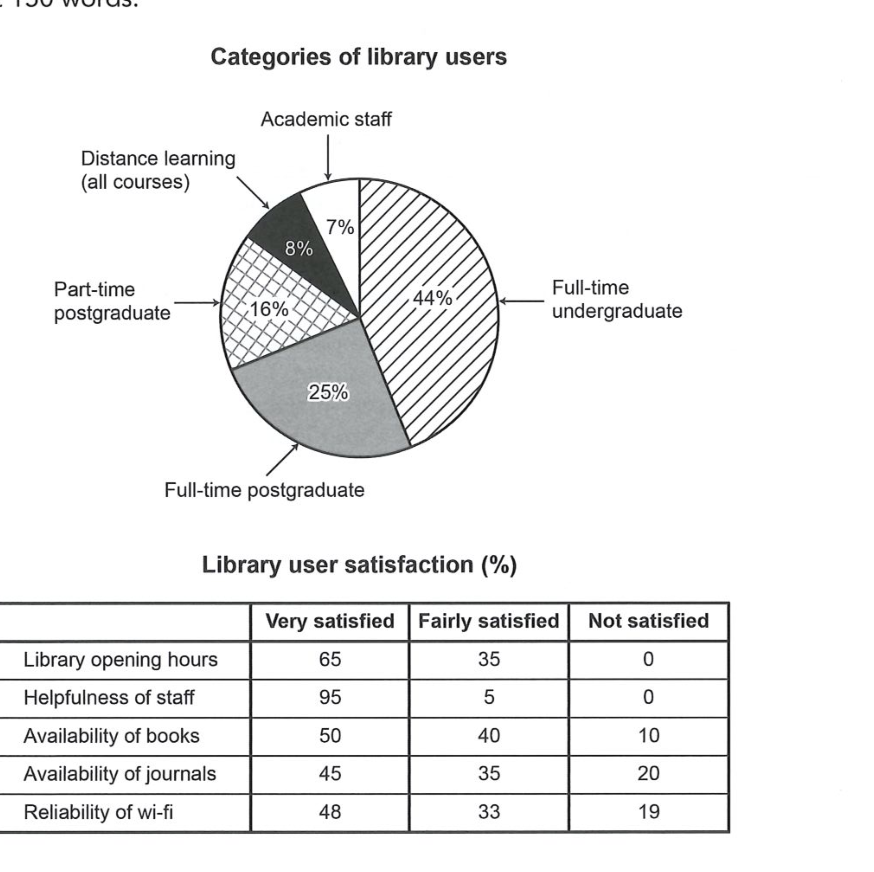
The chart and table below show the results of a survey of library users at a university.
Summarise the information by selecting and reporting the main features, and make comparisons where relevant.
Categories of library users
Student answer (Band 5.0)
The bar chart and table illustrate the results of a view of library users at a university,
Overall, There are categories of library users in chart and in table. User satisfaction, There are 44% full timer undergraduate, Academic staff 7%, Distance learning ( all courses ) 8%, part time postgraduate are 16%, Moreover, 25% full time postgraduate,
On the other hand, helpfulness of staff very satisfied 95%, fairly satisfied only 5%, people's are agree with library opening hours , 65% and fairly satisfied 35%, there are 50% members fully satisfied from availability of books and low satisfied are 40%, Furthermore, the availability of journals had 45% and fairly satisfied 35% and fully not satisfied 20%, at the last line in this table it shows about internet . In another side we see the reliability of wi-fi 19% not agree with this "but" little bit satisfied 33% whereas 48% very satisfied,
AI examiner evaluation
| Criterion | Band |
|---|---|
| Task Achievement / Task Response | 5.5 |
| Coherence and Cohesion | 5.0 |
| Lexical Resource | 5.0 |
| Grammatical Range and Accuracy | 4.5 |
| Overall | 5.0 |
Task Achievement / Task Response: Band 5.5
You include figures from both visuals and identify several relevant comparisons, especially the high satisfaction with staff helpfulness (95% very satisfied) and the lower ratings for journals and Wi-Fi. However, the response does not give a clear overview of the main patterns: for example, staff helpfulness is the strongest-rated feature, while journals receive the highest dissatisfaction. The opening claim that the chart and table show “categories of library users” is inaccurate for the table, which reports satisfaction. Some figures are also misinterpreted: 40% for books are fairly satisfied, not “low satisfied,” and 20% for journals are not satisfied, not “fully not satisfied.” A clearer summary of the key contrasts, with accurate labels, would make the response more complete and developed.
Coherence and Cohesion: Band 5.0
The response covers the user categories first and then moves to satisfaction results, so there is some basic organisation. However, the information is presented as one long sequence rather than in clearly separated paragraphs, and there is little overall progression from an overview to supporting details. Linking phrases such as “On the other hand,” “Furthermore,” and “In another side” are either awkward or do not clearly express the relationship between the points. The repeated use of “there are” also makes the account feel list-like. Group the user profile into one paragraph and the satisfaction findings into another, and use a concise overview before the details. This would make the relationships between the figures easier to follow.
Lexical Resource: Band 5.0
You use some task-relevant vocabulary, including “library users,” “availability,” “helpfulness,” and “reliability of wi-fi,” and the main subject is generally understandable. However, the range is limited and several word choices or collocations are inaccurate, sometimes making the data difficult to interpret. For example, “a view of library users” does not mean survey results, “people's are agree” is not a natural way to describe satisfaction, and “fully not satisfied” is an unsuitable label for the dissatisfied group. Repeated use of “satisfied” also limits precision. Learn and reuse the chart’s exact categories—“very satisfied,” “fairly satisfied,” and “not satisfied”—and choose standard reporting phrases such as “the proportion of users” or “rated the service positively.”
Grammatical Range and Accuracy: Band 4.5
The response attempts to report several figures in connected sentences, but grammatical control is weak and errors frequently affect clarity. Sentence boundaries are often missing, as in the long sequence beginning “On the other hand,” which joins multiple findings with commas. There are also problems with articles, agreement, and sentence construction: “There are categories of library users in chart and in table” and “people's are agree” are not grammatically complete or well-formed. Capitalisation is inconsistent, including “Overall, There,” and punctuation around “but” is confusing. Use shorter, complete sentences with a clear subject and verb—for example, “Staff helpfulness received the highest satisfaction rating”—and check agreement and punctuation when combining comparisons.
See this exact question answered at other band scores. The same prompt compared across bands.
Browse more IELTS Writing model answers or get your own writing scored by the same AI examiner.