Band 6.0 IELTS Writing Task 1 Model Answer
Overall Band Score: 6.0 · Cambridge IELTS 21 · 2026-11-06
IELTS Writing Task 1 question
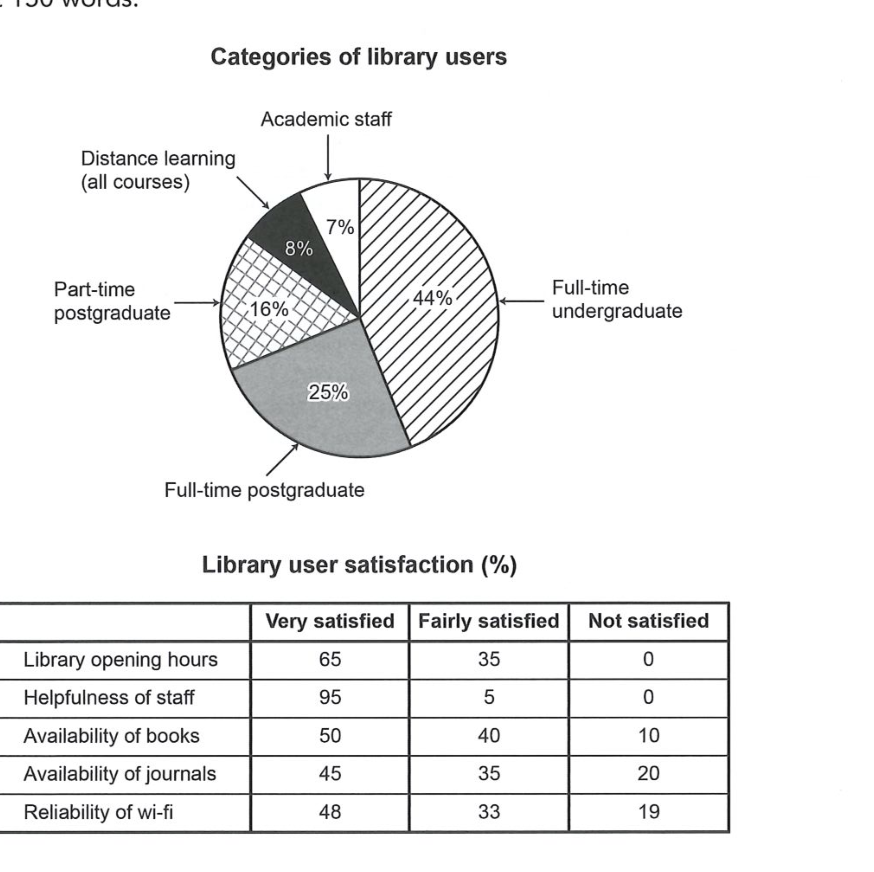
The chart and table below show the results of a survey of library users at a university.
Summarise the information by selecting and reporting the main features, and make comparisons where relevant.
Categories of library users
Student answer (Band 6.0)
The given piechart provides data about the library users at a university and the table shows the level of user satisfaction with the library facilities.
Overall, largest proportion of library users are full time undergraduate whereas academic staff contribute the smaller portion and maximum number of users are very satisfied with the library facilities only few peoples are not satisfied.
Turning to the details, Library is caterogrized into 5 users where full time undergruate accounted 44% almost contributing half the proportion, followed by full time postgraduates 25% and part time postgraduate by 16%. Whereas distance learning accounted 8% and academic staff contributes the least by 7%.
On the other hand, large number of user are verysatisfied which is 95% and only 5% are fairly satisfied. Whereas 65% of user are very satisfied with library opening hours and 35% fairly satisfied. Half of the user are very satisfied wit the availability of books with only 10 percentage not satisfied. Following the availability of journals and relability of wifi 45% and 48% are very satisfied with the service provided and half of the user are fairly satisfied and not satisfied.
AI examiner evaluation
| Criterion | Band |
|---|---|
| Task Achievement / Task Response | 6.0 |
| Coherence and Cohesion | 6.0 |
| Lexical Resource | 5.5 |
| Grammatical Range and Accuracy | 5.5 |
| Overall | 6.0 |
Task Achievement / Task Response: Band 6.0
You identify the main user group accurately: full-time undergraduates make up 44%, while academic staff are the smallest group at 7%. You also include several satisfaction figures, and the overview attempts to highlight the largest and smallest user categories. However, the overview misrepresents the satisfaction results by saying the maximum number of users are very satisfied overall; satisfaction is reported separately for five facilities, not as one overall figure. The statement that 95% are very satisfied refers specifically to staff helpfulness. Some comparisons are useful, such as the 65% very satisfied with opening hours, but the discussion of journals and Wi-Fi is unclear and does not accurately describe the fairly and not satisfied proportions. More precise coverage of the strongest and weakest satisfaction results would make the summary more complete.
Coherence and Cohesion: Band 6.0
The response has a clear overall structure: an introduction, an overview, and separate paragraphs for user categories and satisfaction. This gives the reader a generally coherent route through the information. Linking phrases such as “Turning to the details” and “On the other hand” help signal shifts, although the latter does not establish a clear contrast between the two charts. Within the satisfaction paragraph, several facilities are compressed into one long sequence, and the final sentence makes it difficult to tell which percentages refer to journals and which to Wi-Fi. Grouping the satisfaction results more deliberately—for example, comparing opening hours and staff helpfulness, then comparing books, journals and Wi-Fi—would improve progression and make the references clearer.
Lexical Resource: Band 5.5
You use relevant task vocabulary, including “proportion,” “accounted,” “very satisfied,” and “availability of books,” so the meaning is generally understandable. There is some variety in how figures are described, but several word-choice and collocation problems reduce precision: “library is categorized into 5 users” suggests the library itself is divided into users, and “large number of user” is not a natural way to describe a percentage. Spelling errors such as “piechart,” “undergruate,” “caterogrized,” “verysatisfied,” and “relability” also detract from control. Aim for accurate, natural reporting phrases and check spelling carefully; this will help you express comparisons without relying on vague wording such as “large number.”
Grammatical Range and Accuracy: Band 5.5
You attempt both simple and more complex sentence forms, including clauses introduced by “whereas” and “with,” and the main message can usually be followed. However, some grammatical errors recur. For example, “Overall, largest proportion … are” needs an article and singular agreement, while “full time undergruate accounted 44%” is missing a preposition and has an incorrect verb pattern. In “library is caterogrized into 5 users,” the passive construction does not fit the intended meaning. There are also problems with plural forms and sentence boundaries, particularly in the long final sentence, where several comparisons run together. Practise accurate subject–verb agreement, articles, and complete sentence structures while retaining your attempts at complex sentences.
See this exact question answered at other band scores. The same prompt compared across bands.
Browse more IELTS Writing model answers or get your own writing scored by the same AI examiner.