Band 6.0 IELTS Writing Task 1 Model Answer
Overall Band Score: 6.0 · Cambridge IELTS 21 · 2026-11-08
IELTS Writing Task 1 question
The chart and table below show the results of a survey of library users at a university.
Summarise the information by selecting and reporting the main features, and make comparisons where relevant.
Categories of library users
Student answer (Band 6.0)
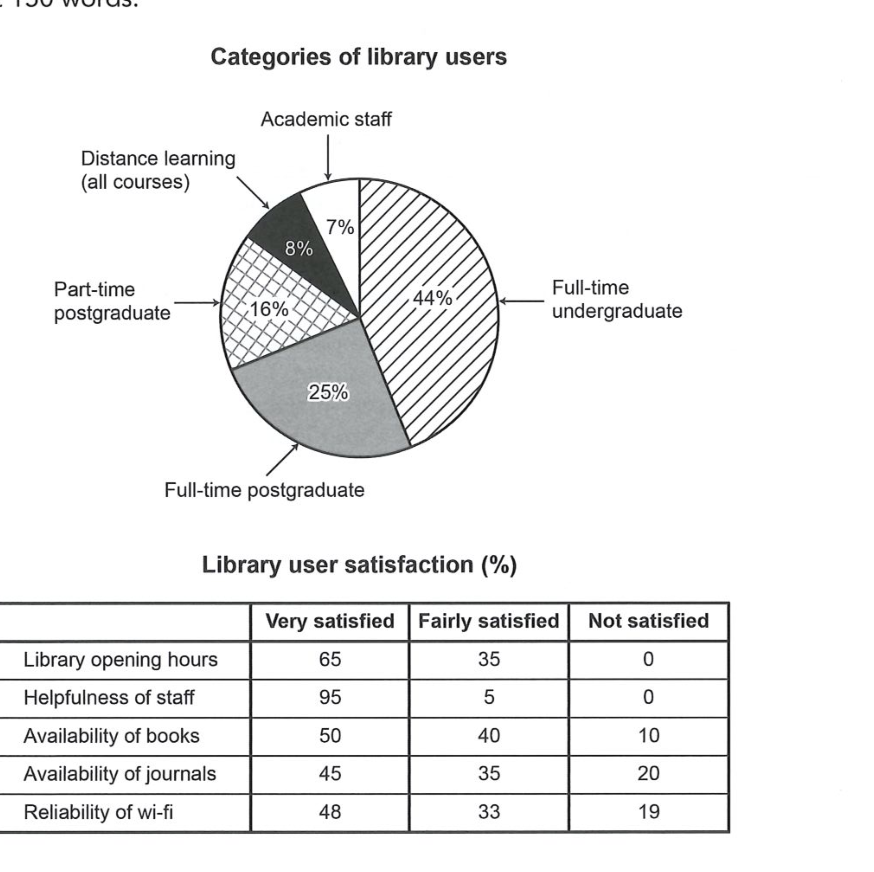
The pie chart below gives information about the proportion of those using library in the university while the table shows their levels of satisfaction ranging from very satisfied to not satisfied. Overall , those using the library most are the full-time undergraduates while the least users are the academic staff, and are very satisfied because of its helpfulness.
To begin, 44% of those using library are the full-time undergraduate, followed by full time postgraduate accounting to 25%. Academic staff and distance learning are the lowest consumers accouting to 7% and 8% respectively. Moreover, part- time uses account to 16 % of the library use.
It is indicated that 65% and 35% of the library users are very and fairly safistied resppectively with the opening hours.The satisfaction level of how the library is helpful to the staff shows that 95% are very satisfied with very low percentage of fairly satisfaction accouting to 5%. Furthermore, the availability of books and journals indicate more than 45% are very satisfied and less than 11% are not satisfied.
AI examiner evaluation
| Criterion | Band |
|---|---|
| Task Achievement / Task Response | 6.0 |
| Coherence and Cohesion | 6.5 |
| Lexical Resource | 5.5 |
| Grammatical Range and Accuracy | 5.5 |
| Overall | 6.0 |
Task Achievement / Task Response: Band 6.0
You identify the main user group and the smallest group accurately: full-time undergraduates account for 44%, while academic staff make up 7%. You also report several satisfaction figures correctly, including the opening-hours split and staff helpfulness. However, the overview’s claim that users are “very satisfied” is too broad: satisfaction varies by category, and the table shows notable dissatisfaction with journals and wi-fi. The final comparison is also imprecise: “more than 45%” very satisfied with books and journals overlooks that journal satisfaction is exactly 45%, and “less than 11%” dissatisfied omits the higher figures for journals and wi-fi. Include those categories and their key contrasts to make the summary more complete and precise.
Coherence and Cohesion: Band 6.5
The response has a clear overall arrangement: an introduction and overview are followed by user-category figures and then satisfaction results. Sequencing within the first data paragraph is easy to follow, with “followed by” and “Moreover” helping connect the comparisons. This coherent structure meets the task well, and the paragraphing is appropriate. To make progression more controlled, separate the satisfaction results into clearer comparisons rather than moving quickly from opening hours to staff helpfulness and then grouping books and journals. The overview’s broad statement about users being very satisfied also makes the relationship between the two visuals less clear. More precise referencing and a concluding comparison of the satisfaction extremes would strengthen cohesion.
Lexical Resource: Band 5.5
You use relevant task vocabulary such as “proportion,” “levels of satisfaction,” “availability,” and “accounting to,” and the reader can generally understand the intended comparisons. However, several word choices and collocations are inaccurate or awkward, including “lowest consumers,” “part-time uses,” and “account to.” Spelling errors such as “accouting,” “safistied,” and “resppectively” are noticeable and reduce the accuracy of the vocabulary. The phrase “the library is helpful to the staff” also changes the meaning of the table category, which is the helpfulness of library staff. Aim for standard chart language and check spelling carefully; this will make your descriptions more precise and natural.
Grammatical Range and Accuracy: Band 5.5
You attempt both simple and more complex sentence forms, including the overview sentence beginning “Overall” and the clause “while the table shows…”. Most of the intended meaning remains understandable, but some grammatical errors affect accuracy. For example, “those using library” needs an article, and “the full-time undergraduate” does not agree naturally with the plural group being described. In “65% and 35% … are very and fairly satisfied,” the construction is awkward and the subject is unclear. There are also punctuation and spacing problems, such as the missing space after “hours.” Work on articles, plural forms, and clear subject–verb structures, while retaining your attempts to combine related information.
See this exact question answered at other band scores. The same prompt compared across bands.
Browse more IELTS Writing model answers or get your own writing scored by the same AI examiner.