Band 6.0 IELTS Writing Task 1 Model Answer
Overall Band Score: 6.0 · Cambridge IELTS 21 · 2026-11-08
IELTS Writing Task 1 question
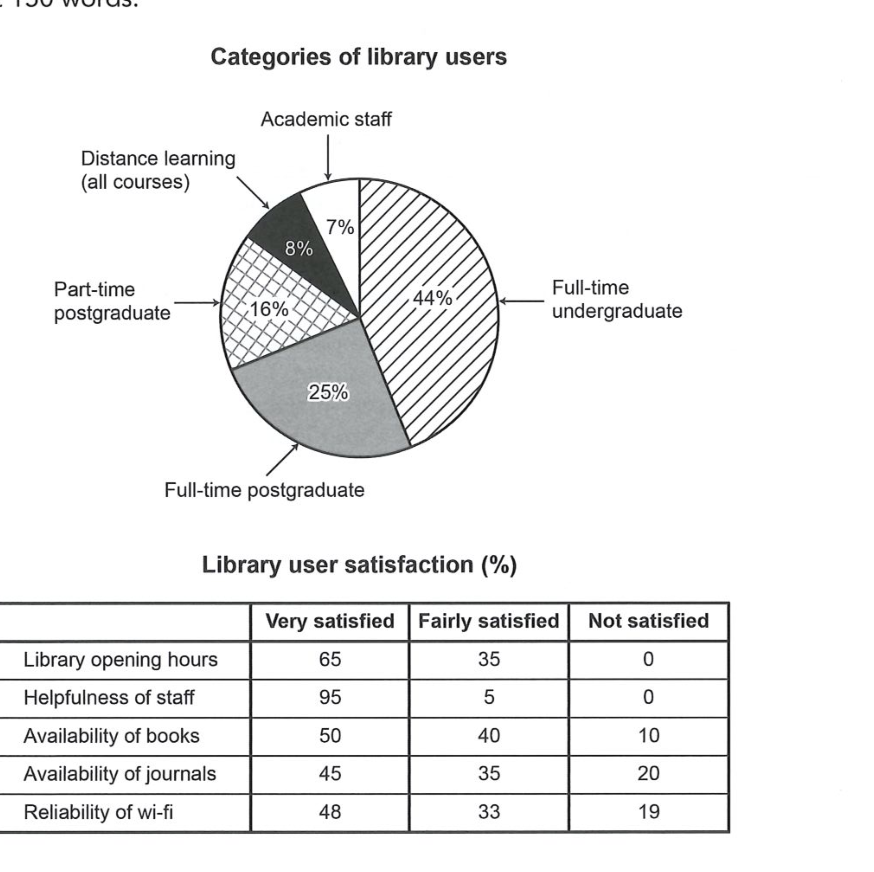
The chart and table below show the results of a survey of library users at a university.
Summarise the information by selecting and reporting the main features, and make comparisons where relevant.
Categories of library users
Student answer (Band 6.0)
The chart and and table gives information about the results of a survey about a university library users and satisfaction about five types of library services.
Overall, it is clear that full time undergraduate students spend more time for learning among five categories. However, academic staff spends users least time. On the other hand, there are none who are not satisfied with the opening time and helpfulness of staff of the library, additionally most library users are very satisfied about helpful staffs.
On one hand, the pie chart shows that, academic staffs spent least time, only 7% are active reader of them. Distance learning of all courses uses library 1% more than academic staffs, by 8%. Part-time postgraduates and full-time postgraduates uses library 16% and 25% respectively. Full-time undergraduates uses signifecantly to 44%.
On the other hand, Among all the library users 20% are not satisfied about the availability of journals; however, 45% and 35% are satisfied very and fairly. 50% users are very satisfied and 40% are fairly satisfied about books availability. Whereas, 81% in total are satisfied about the internet service; however 19% are not satisfied with it.
AI examiner evaluation
| Criterion | Band |
|---|---|
| Task Achievement / Task Response | 6.0 |
| Coherence and Cohesion | 6.0 |
| Lexical Resource | 5.5 |
| Grammatical Range and Accuracy | 5.5 |
| Overall | 6.0 |
Task Achievement / Task Response: Band 6.0
You cover both the user categories and satisfaction results, and several figures are accurate: undergraduates are the largest group at 44%, academic staff the smallest at 7%, and journal dissatisfaction is 20%. Your overview also identifies the strong satisfaction with staff and opening hours. However, some key information is omitted: the table shows 95% are very satisfied with staff helpfulness, and the opening-hours figures are 65% very satisfied and 35% fairly satisfied. The overview’s claim that undergraduates “spend more time for learning” is not supported; the chart reports their share of library users, not time spent. The internet summary is broadly accurate, but the response would be more complete with direct comparisons across all five services and a clearer overview of the main satisfaction patterns.
Coherence and Cohesion: Band 6.0
The response has a recognisable structure: an introduction, an overview, and separate paragraphs for the user categories and satisfaction data. This gives the reader a coherent overall route through the information. Some linking is effective, such as “On the other hand” to introduce the satisfaction figures, but the repeated “On one hand” and “On the other hand” framing is somewhat mechanical. The final paragraph also moves from journals to books and then wi-fi without covering opening hours or staff helpfulness, so the selection feels incomplete. Grouping the satisfaction results into positive findings and areas of lower satisfaction, with clear comparisons between services, would improve progression. Check that references such as “it” and “them” have clear antecedents.
Lexical Resource: Band 5.5
You use relevant task vocabulary, including “availability,” “satisfied,” “library users,” and “distance learning,” and the reader can generally understand the intended comparisons. However, several word choices and collocations are inaccurate or unnatural, such as “active reader,” “spend more time for learning,” “satisfied about,” and “uses library.” There are also spelling and form errors, including “signifecantly” and “staffs” when referring to staff collectively. These issues make the description less precise, particularly when reporting what the chart measures. Aim for standard data-reporting phrases such as “accounted for,” “made up,” and “were satisfied with,” and use the exact concepts shown in the visuals.
Grammatical Range and Accuracy: Band 5.5
You attempt a mix of simple and more complex sentences, including contrast clauses with “however” and “whereas,” and the main figures remain understandable. Some grammatical errors persist, though. In the opening, “The chart and and table gives” has a repeated conjunction and a subject–verb agreement error; “Part-time postgraduates and full-time postgraduates uses” also needs a plural verb. Other examples include “there are none who are not satisfied,” where the construction is awkward, and “45% and 35% are satisfied very and fairly,” where the adverbs are placed incorrectly. Article use, sentence punctuation, and comma placement also need attention. Proofread for agreement and build comparisons with complete, parallel clauses.
See this exact question answered at other band scores. The same prompt compared across bands.
Browse more IELTS Writing model answers or get your own writing scored by the same AI examiner.