Band 5.0 IELTS Writing Task 1 Model Answer
Overall Band Score: 5.0 · Cambridge IELTS 21 · 2026-11-09
IELTS Writing Task 1 question
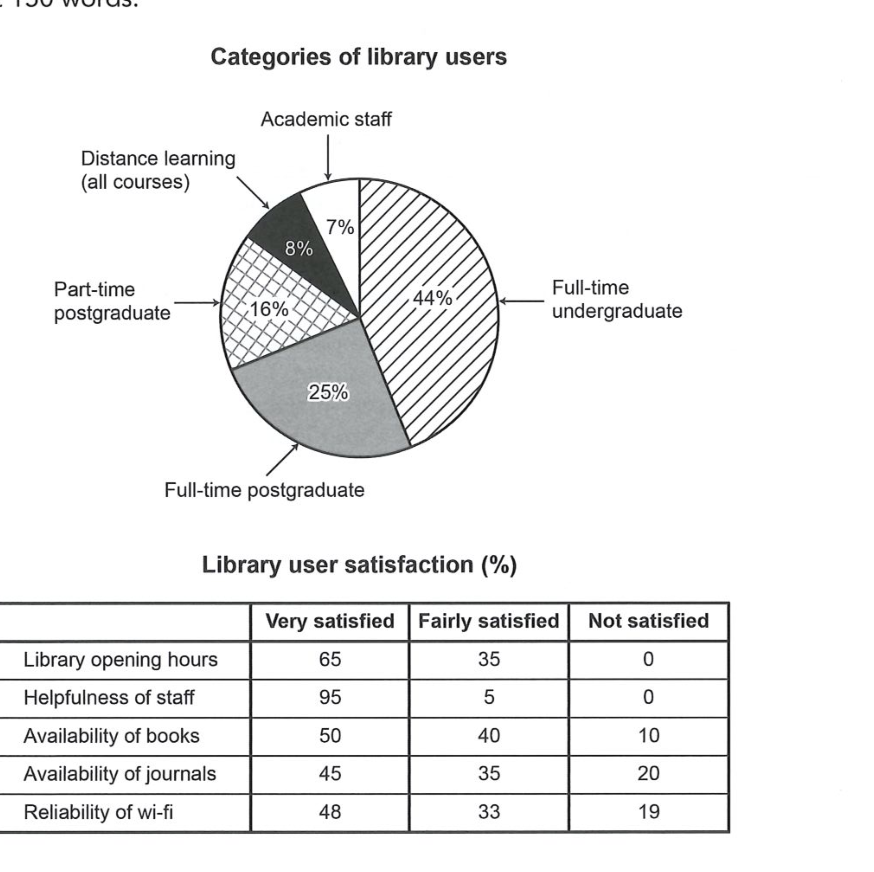
The chart and table below show the results of a survey of library users at a university.
Summarise the information by selecting and reporting the main features, and make comparisons where relevant.
Categories of library users
Student answer (Band 5.0)
the pie chart illustrates libarary users survey results from five unique categories (full-time undergraduate, full-time postgraduate, part-time postgraduate, distance learning and academic staff ) and their satisfaction level.
Overall, full-time undergraduate users represents that highest proportion of libaray users, and most of all users are very satisfied with staff collaboration.
Full-time undergraduate forms 44% of all users, while full-time postgraduate ranks second. Those two accounts for more than two-third of the eniter users. Part-time postgraduate forms 15% of enitre user which is a 1% more than academic staff and distance learning users compined.
According to the table results, nearly half of users are not very satified with the wi-fi reliablity. as well as the availability of books.
AI examiner evaluation
| Criterion | Band |
|---|---|
| Task Achievement / Task Response | 5.0 |
| Coherence and Cohesion | 5.5 |
| Lexical Resource | 5.0 |
| Grammatical Range and Accuracy | 5.0 |
| Overall | 5.0 |
Task Achievement / Task Response: Band 5.0
You identify the largest user group correctly (full-time undergraduates, 44%) and include an overview, but the response covers the satisfaction table only partially. The claim that users are “very satisfied with staff collaboration” is imprecise: the table concerns helpfulness of staff, which has the highest very-satisfied figure at 95%. The statement that nearly half are “not very satisfied” with Wi-Fi and books misreads the data: 48% and 50% are very satisfied, while only 19% and 10% are not satisfied. Some user-category figures are also inaccurate: part-time postgraduates are 16%, not 15%, and the two largest groups together make up 69%, not more than two-thirds by a clear margin. The response is 33 words below the required minimum. Report the main satisfaction contrasts accurately and develop them with key figures.
Coherence and Cohesion: Band 5.5
The response has a recognisable structure: an introduction, an overview, a paragraph on user categories, and a final sentence about satisfaction. This gives the reader some organisation, and phrases such as “Overall” and “According to the table” signal shifts in focus. However, progression is limited because the final paragraph combines two satisfaction categories without explaining the comparisons, and the overview’s reference to staff is not clearly connected to the table’s specific measure of helpfulness. The short, isolated final sentence also leaves the table discussion incomplete. Use a fuller paragraph to group the highest satisfaction results separately from areas with more mixed responses, and connect each comparison explicitly to its data.
Lexical Resource: Band 5.0
You use some relevant task vocabulary, including “proportion,” “categories,” “satisfaction level,” and “availability,” so the topic is generally understandable. However, the range is limited and several noticeable spelling and word-choice errors reduce precision: “libarary,” “libaray,” “eniter,” “satified,” and “reliablity.” Some expressions are also unnatural or inaccurate for describing survey data, such as “staff collaboration” for helpfulness of staff and “forms 15% of entire user.” Prefer standard chart language and accurate labels, for example, “accounts for 16% of users” and “satisfaction with staff helpfulness.” Proofreading spelling and choosing collocations that match the table’s labels would make the information clearer and more formal.
Grammatical Range and Accuracy: Band 5.0
The response communicates its basic meaning through mostly simple sentence patterns, but grammatical control is inconsistent. Subject–verb agreement is faulty in “users represents” and “Those two accounts,” while the phrase “Part-time postgraduate forms 15% of entire user” lacks a clear plural noun and article. The final sentence begins “as well as” after a full stop, creating a fragment, and the lowercase “as” after the preceding period is also a punctuation error. There is little variety in sentence structure, and the attempted comparisons are not consistently formed. Practise accurate plural subjects and verbs, and build comparisons in complete sentences—for example, “Together, these groups account for 69% of users.”
See this exact question answered at other band scores. The same prompt compared across bands.
Browse more IELTS Writing model answers or get your own writing scored by the same AI examiner.