Band 5.0 IELTS Writing Task 1 Model Answer
Overall Band Score: 5.0 · Cambridge IELTS 21 · 2026-11-10
IELTS Writing Task 1 question
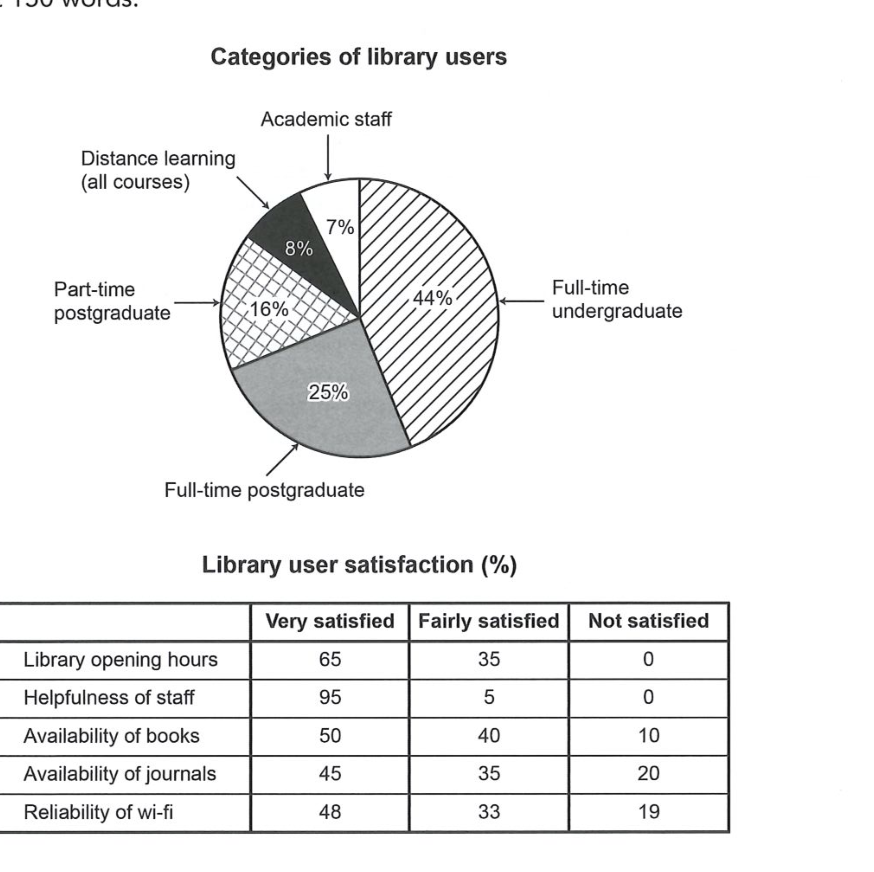
The chart and table below show the results of a survey of library users at a university.
Summarise the information by selecting and reporting the main features, and make comparisons where relevant.
Categories of library users
Student answer (Band 5.0)
The information is given here about the categories of library users.From the pie chart , it is very clear that the full-time undergraduate are highly involved in the library. They might like reading books and are more satisfied by the service provided by the library.When it comes to full-time postgraduate , they might also like reading books.And it is clear that the part-time postgraduate comes in library but they are in minority , reasons can be the part time postgraduates have very less time to study and they might do work somewhere.The distance learning may be through online courses , these type of users prefer to study at home and come when they need books and some not come because they study through E-Books.The academic staff portion is saying that very few staff members come , it may be due to they have lectures in different classes.It is very clear that the library opens at right time without delays as members are satisfied from this. Staff is quite helpful to users in finding books and providing services.Books are available but some readers does not find their interest books and journals. Sometimes, wi-fi goes down.Wi-fi can be better.
AI examiner evaluation
| Criterion | Band |
|---|---|
| Task Achievement / Task Response | 5.0 |
| Coherence and Cohesion | 4.5 |
| Lexical Resource | 5.0 |
| Grammatical Range and Accuracy | 5.0 |
| Overall | 5.0 |
Task Achievement / Task Response: Band 5.0
You identify the largest user group, full-time undergraduates, and mention several satisfaction areas, including opening hours, staff, books, journals and Wi-Fi. However, the response only partially reports the visual data: it gives no percentages and does not compare the satisfaction results systematically. The claim that users are satisfied with opening hours and staff is broadly supported, but the chart shows specifically that staff helpfulness has the highest very-satisfied figure (95%), while opening hours has 65%. Comments about users’ reading habits, reasons for low attendance and online study are speculation rather than information shown in the chart. A clearer overview of the main patterns, supported by accurate figures and comparisons, would make the report more complete.
Coherence and Cohesion: Band 4.5
The response moves from user categories to satisfaction topics, so the reader can broadly follow its subject matter. However, it is presented as one continuous paragraph, with no clear separation between the two visuals or an overall progression from overview to details. Several sentences repeat the pattern “they might,” and transitions such as “When it comes to” and “And it is clear” do not consistently show how the points relate. The shift from user numbers to opening hours and staff satisfaction is abrupt. Organise the report into an introduction and overview, followed by a paragraph on user categories and another on satisfaction, using comparisons to connect related figures.
Lexical Resource: Band 5.0
You use enough basic vocabulary to communicate the topic, including “full-time undergraduate,” “part-time postgraduate,” “satisfied,” and “availability” concepts such as books and journals. However, the range is limited and several expressions are imprecise or repetitive, such as “highly involved in the library,” “come in library,” and “right time without delays.” These phrases do not describe the chart data precisely; for example, the chart reports user categories and satisfaction with opening hours, not attendance habits or punctual opening. Repeated use of “might” also makes the report sound speculative. Use more precise reporting language, such as “accounted for,” “represented,” and “rated,” and choose terms that describe the measured information rather than assumed reasons.
Grammatical Range and Accuracy: Band 5.0
The response attempts some longer sentences using clauses, for example, “The distance learning may be through online courses” and “some readers does not find their interest books,” but control is inconsistent. Errors in agreement and sentence construction occur in phrases such as “the full-time undergraduate are,” “the part-time postgraduate comes,” and “some readers does not.” Articles and prepositions are also often missing or awkward, as in “come in library” and “satisfied from this.” Punctuation and spacing are uneven, with missing spaces after full stops and unnecessary spaces before commas. These errors do not make the overall meaning impossible to follow, but they reduce clarity. Practise accurate simple reporting sentences before adding complex explanations.
See this exact question answered at other band scores. The same prompt compared across bands.
Browse more IELTS Writing model answers or get your own writing scored by the same AI examiner.