Band 5.5 IELTS Writing Task 1 Model Answer
Overall Band Score: 5.5 · Cambridge IELTS 21 · 2026-11-10
IELTS Writing Task 1 question
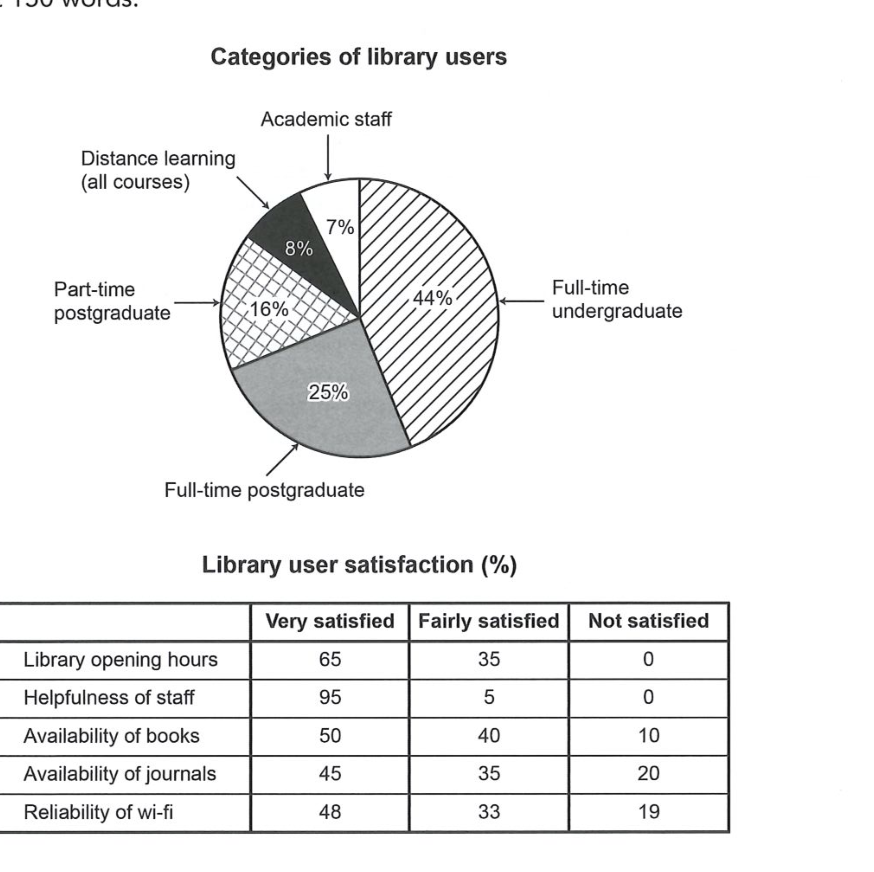
The chart and table below show the results of a survey of library users at a university.
Summarise the information by selecting and reporting the main features, and make comparisons where relevant.
Categories of library users
Student answer (Band 5.5)
The given pie chart provides the percentage of users of who visits library and the stipulated data in the table represents the level of their satisfaction in three different levels for the services provided in the library. Most of the library users are full time undergraduate students. Academic staff and distance learning students are benefitted from the library. All the users are satistfied with the timings and helpfulness of the staff. The library provides books, journals and wifi as well for the users.
69% of full time students visits library and are satisfied with the services. 16% of part time postgraduate students uses the library for studies. The percentage of users who are not satisfies with the unavailabilty of books and journals are 10% ans 20% respectively. Reliability of wifi is an issue for 19% of users.
Non-attending students and Professors are also elihible to use the library and comprises of about 15% of the librarry user percentage. More than 90% of the users are satisfied with the books and journals available for the users.
AI examiner evaluation
| Criterion | Band |
|---|---|
| Task Achievement / Task Response | 5.0 |
| Coherence and Cohesion | 5.0 |
| Lexical Resource | 5.5 |
| Grammatical Range and Accuracy | 5.5 |
| Overall | 5.5 |
Task Achievement / Task Response: Band 5.0
You identify the largest user group and include several satisfaction figures, such as 10% dissatisfied with book availability and 20% with journals. However, the response only partially summarises the visuals: it gives no clear overview of the main satisfaction pattern, and some statements are inaccurate or unsupported. The 69% figure for full-time students combines undergraduate and postgraduate users, but this is not explained; the chart shows 44% and 25% separately. “Non-attending students and Professors” is not a category shown, and the claim that more than 90% are satisfied with books and journals is not supported by the table. Focus on the largest and smallest user groups and compare the satisfaction results accurately.
Coherence and Cohesion: Band 5.0
The response has some organisation: it introduces both visuals, then discusses user categories and satisfaction, with a final comparison about books and journals. However, the progression is not consistently clear. The opening moves from the chart to broad claims about services, while the next paragraph shifts between user proportions and dissatisfaction without a clear organising principle. The final paragraph introduces “Non-attending students and Professors,” which does not connect logically to the preceding points. Use a clearer structure, such as an overview followed by one paragraph on user categories and another on satisfaction. Linking phrases should show comparisons between the figures rather than simply adding separate observations.
Lexical Resource: Band 5.5
You use some task-relevant vocabulary, including “percentage,” “level of their satisfaction,” “availability,” and “reliability,” which helps communicate the topic. There is also some repetition of general terms such as “users,” “library,” and “satisfied,” and several word-choice or spelling errors reduce precision: “satistfied,” “unavailabilty,” “ans,” “elihible,” and “librarry.” Phrases such as “users of who visits library” and “not satisfies with the unavailability” are awkward or unclear. Aim for accurate collocations such as “library users,” “were dissatisfied with,” and “accounted for.” More precise vocabulary would make the comparisons easier to follow.
Grammatical Range and Accuracy: Band 5.5
You attempt both simple and more extended sentence forms, and the main topic is generally understandable. However, errors in agreement, articles, and sentence construction occur repeatedly. For example, “users of who visits library” has an incorrect relative construction and verb form, while “69% of full time students visits” should use a plural verb. In “16% ... uses,” the verb also fails to agree with the plural subject. The sentence “Academic staff and distance learning students are benefitted” uses an awkward passive construction, and “comprises” in the final paragraph does not agree with its subject. Work on subject–verb agreement and build shorter, accurate comparisons before attempting more complex sentences.
See this exact question answered at other band scores. The same prompt compared across bands.
Browse more IELTS Writing model answers or get your own writing scored by the same AI examiner.