Band 6.0 IELTS Writing Task 1 Model Answer
Overall Band Score: 6.0 · Cambridge IELTS 21 · 2026-11-10
IELTS Writing Task 1 question
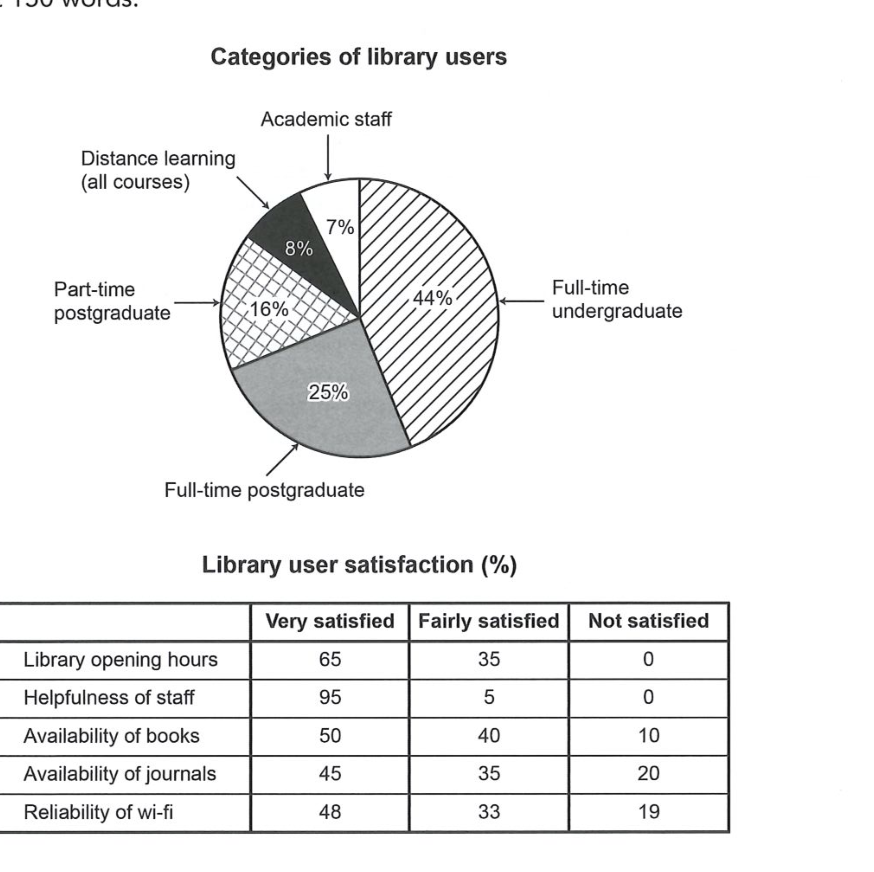
The chart and table below show the results of a survey of library users at a university.
Summarise the information by selecting and reporting the main features, and make comparisons where relevant.
Categories of library users
Student answer (Band 6.0)
The chart and table demonstrate the outscome of a survey conducted of library attendence at university.
The pie chart shows that overall full-time undergraduate are more in attendence with 44%, whereas academic staff used library in the least percent of 7%. Full time graduates reached out at library with 25% while part-time postgraduate stand at 16% and distance learning (all course) students were second last in attendence with 8%.
In chart diagram, percentage of library user satisfication with respect to different aspect is shown. Helpfulness of staff topped the satisfication of library users with 95%, in the same aspect 5% remained fairly satisfied and none remained unsatisfied. For opening library hours 65% were very satisfied, 35% were failt satisfied. Prominent figure is of availability of journals where 20% were unsatisfied; the highest in the category of unsatisfied. For reliability of wi-fi, 48% were in fully satisfied category and 33% fairly satisfied whike 19% showed dissatisfication.
AI examiner evaluation
| Criterion | Band |
|---|---|
| Task Achievement / Task Response | 6.0 |
| Coherence and Cohesion | 6.0 |
| Lexical Resource | 6.0 |
| Grammatical Range and Accuracy | 5.5 |
| Overall | 6.0 |
Task Achievement / Task Response: Band 6.0
You cover both the user categories and satisfaction results, and several key figures are accurately reported: undergraduates form the largest group at 44%, academic staff the smallest at 7%, and staff helpfulness receives 95% very satisfied responses. You also identify the high dissatisfaction with journals and report the wi-fi figures. However, the response gives no clear overall summary comparing the two sets of results, and some important information is less fully covered: for example, the book-availability results are omitted. The phrase “second last” for distance learners is also unclear, since their 8% is the second-smallest share. A concise overview of the main patterns, followed by selected comparisons, would make the report more complete and clear.
Coherence and Cohesion: Band 6.0
The response has a generally understandable order: it first describes the user categories and then moves to satisfaction, with a paragraph break marking the change in chart. Linking expressions such as “whereas,” “while,” and “For” help show comparisons and transitions. However, the organisation is mostly a sequence of individual details rather than a clear overview followed by grouped comparisons. The opening does not preview the main findings, and the satisfaction paragraph moves from staff helpfulness to opening hours, journals, and wi-fi without covering books or grouping related results. Some references, such as “in the same aspect,” are not fully clear. A stronger overview and more deliberate grouping would improve progression.
Lexical Resource: Band 6.0
You use an adequate range of task-related vocabulary, including “full-time undergraduate,” “part-time postgraduate,” “availability,” “reliability,” and “unsatisfied.” These terms allow the reader to understand the main subject and many comparisons. There are, however, several inaccurate or unnatural choices that reduce precision, such as “library attendence,” “reached out at library,” and “topped the satisfication.” Spelling errors in “outscome,” “satisfication,” “failt,” and “dissatisfication” also detract from control. Some phrases repeat “attendence” when a more direct description of the proportions would be clearer. Aim for standard chart-reporting collocations and check spelling carefully; this would make your otherwise relevant vocabulary more precise and natural.
Grammatical Range and Accuracy: Band 5.5
You attempt a mix of simple and more complex sentence forms, including comparisons with “whereas” and “while,” and most of the data remains understandable. Some grammatical errors are present, particularly with articles, agreement, and sentence construction. For example, “full-time undergraduate are more in attendence” has a singular/plural agreement problem and an incomplete comparison, while “academic staff used library in the least percent” is not formed naturally. “For opening library hours 65% were very satisfied” also needs a clearer grammatical link between the topic and the figures. The response relies heavily on similar sentence patterns, so try varying structures while keeping them controlled. Proofreading for articles, plural forms, and complete comparisons would improve accuracy.
See this exact question answered at other band scores. The same prompt compared across bands.
Browse more IELTS Writing model answers or get your own writing scored by the same AI examiner.