Band 6.5 IELTS Writing Task 1 Model Answer
Overall Band Score: 6.5 · Cambridge IELTS 21 · 2026-11-10
IELTS Writing Task 1 question
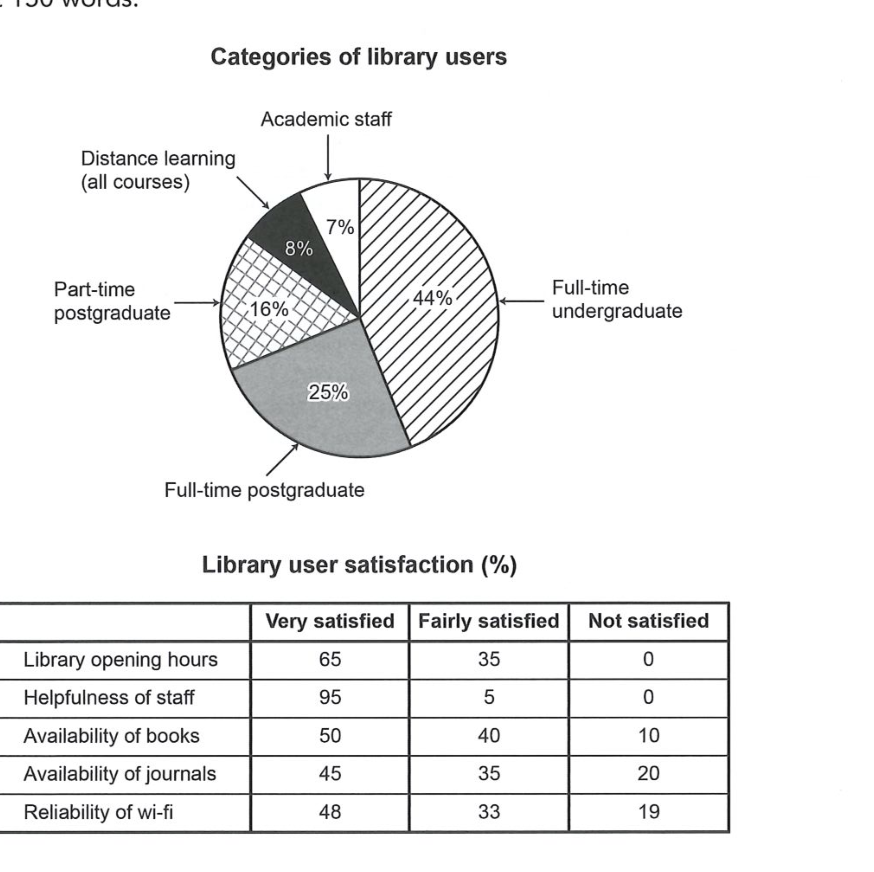
The chart and table below show the results of a survey of library users at a university.
Summarise the information by selecting and reporting the main features, and make comparisons where relevant.
Categories of library users
Student answer (Band 6.5)
The given chart and table illustrates the outcome of a survey of a university's library users. From the chart, it is visible that full-time undergraduate students use the library most of the time and the maximum satisfaction of library user's comes from the helpfulness of the staffs.
Overall, almost 70% of library users are full time students, combining both postgraduate and undergraduate students. Whereas only 16% of part-time postgraduate students uses the university library. The other 15% of library users are the combination of the distance learners and the academic staff.
Furthermore, when it comes to the user satisfaction, most of them are satisfied with the helpfulness of staff. In contrast, the availability of journals has the less amount of satisfaction recorded. 65% of students were very satisfied with the opening hours of the library. The availability of books and reliability of wifi were respectively less satisfactory. We can also see that the two highest satisfaction recorded areas: library opening hours and helpfulness of staff has 0 not satisfied record.
AI examiner evaluation
| Criterion | Band |
|---|---|
| Task Achievement / Task Response | 6.5 |
| Coherence and Cohesion | 6.5 |
| Lexical Resource | 6.0 |
| Grammatical Range and Accuracy | 6.0 |
| Overall | 6.5 |
Task Achievement / Task Response: Band 6.5
The response identifies the main user group and several satisfaction patterns, including the high rating for staff helpfulness and the lower satisfaction with journals. It also reports the 65% figure for opening hours and notes that no respondents were dissatisfied with either opening hours or staff helpfulness. However, the overview is not fully precise: “almost 70%” combines full-time undergraduates and postgraduates, but the response does not give their separate shares (44% and 25%), and “only 16%” refers specifically to part-time postgraduates. The claim that the “other 15%” combines distance learners and academic staff is inaccurate; together they account for 15%, but this is not the remainder after the 70% group and 16% group. More precise comparisons across all five satisfaction categories would make the report more complete and better supported.
Coherence and Cohesion: Band 6.5
The response has a clear overall arrangement: an introduction, a summary of user categories, and a final paragraph on satisfaction. This makes the main topics easy to follow, and transitions such as “Overall,” “Furthermore,” and “In contrast” help signal shifts. The progression is generally logical, but the final paragraph moves from a broad comparison to individual figures without consistently presenting the satisfaction data in a structured way. For example, books and wi-fi are described as “respectively less satisfactory,” but the comparison is not explained, and the reader must infer which figures support it. The contrast between the 70% full-time total and the 16% part-time figure also leaves the category overview incomplete. Clearer grouping of related figures and more precise referencing would make cohesion more flexible and less dependent on general linking phrases.
Lexical Resource: Band 6.0
The vocabulary is adequate for describing the chart and table, with relevant terms such as “satisfaction,” “availability,” “opening hours,” and “reliability.” The writer also attempts more formal phrasing, including “In contrast” and “recorded.” However, several choices are imprecise or unnatural for data reporting. “Use the library most of the time” suggests frequency rather than the largest user category, while “maximum satisfaction … comes from” is awkward. “The less amount of satisfaction” and “the two highest satisfaction recorded areas” are also not natural collocations. There are minor spelling and form issues in “wifi” and “staffs.” More precise expressions such as “accounted for the largest share” and “the lowest satisfaction rating” would improve clarity and control.
Grammatical Range and Accuracy: Band 6.0
The response uses a mix of simple and more complex sentence forms, including a subordinate clause in “when it comes to the user satisfaction” and a contrast structure beginning “Whereas.” Meaning is generally clear, but some grammatical errors remain. In the opening, “chart and table illustrates” has a subject–verb agreement error; “library user's” uses an incorrect apostrophe and singular form. The sentence beginning “Whereas only 16%...” is a fragment, and “students uses” has a plural subject with a singular verb. In the final sentence, “areas … has” also shows agreement problems, while “0 not satisfied record” lacks a grammatical structure. These errors do not usually prevent understanding, but more reliable agreement, sentence completion, and article use would strengthen accuracy.
See this exact question answered at other band scores. The same prompt compared across bands.
Browse more IELTS Writing model answers or get your own writing scored by the same AI examiner.