Band 5.5 IELTS Writing Task 1 Model Answer
Overall Band Score: 5.5 · Cambridge IELTS 21 · 2026-11-11
IELTS Writing Task 1 question
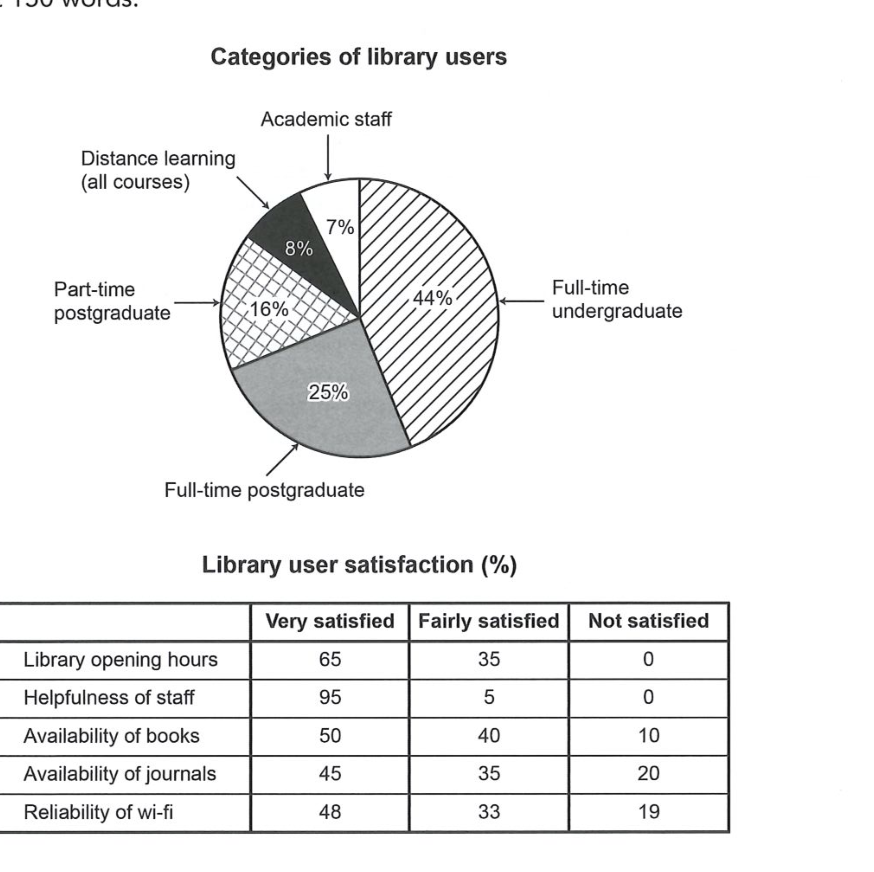
The chart and table below show the results of a survey of library users at a university.
Summarise the information by selecting and reporting the main features, and make comparisons where relevant.
Categories of library users
Student answer (Band 5.5)
The given chart and table illustrate the results about the library by students.
Overall, the users who used library are mostly undergraduates and postgraduates students.But 31% users are from others courses.However, mostly users are satisfied by the staff , schudule of library but some having conern about the books, avalibality of journals and lack of free wifi services.
Library are 69% used by full-time undergraduates and full-time postgraduate students like 44% undergraduate and 25 postgraduate students.It is also used by 16% part-time postgraduate, 7% from academic staff and 8% from various programs.
Most of the users are satisfie by the timing of the library and no one student has face the problem about the opening hours of library. 95% of the students are by the librarian. But 10% of the students having facing the problem about the less variety of books. However, 90% are happy with the avaliable books in the library. AS well some also having conern about the journals and avalibality of free internet in the libaray. finally, most of the library users are satisfied by the libaray.
AI examiner evaluation
| Criterion | Band |
|---|---|
| Task Achievement / Task Response | 6.0 |
| Coherence and Cohesion | 6.0 |
| Lexical Resource | 5.0 |
| Grammatical Range and Accuracy | 5.0 |
| Overall | 5.5 |
Task Achievement / Task Response: Band 6.0
You identify the main user groups and report the key figures accurately: full-time undergraduates account for 44%, full-time postgraduates 25%, and together they make up 69%. You also note that staff helpfulness and opening hours receive strong satisfaction, while books, journals and Wi-Fi attract some dissatisfaction. This covers both visuals and gives a relevant overall picture. However, some details are unclear or incomplete: “31% users are from others courses” does not clearly explain that this is the combined share of the remaining categories, and the satisfaction discussion omits several useful comparisons, such as 20% not satisfied with journals versus 19% with Wi-Fi. The claim that users are “satisfied by the staff” is broad; specify that 95% are very satisfied and 5% fairly satisfied.
Coherence and Cohesion: Band 6.0
The response has a recognisable structure: an introduction, an overview, a paragraph on user categories and a final paragraph on satisfaction. This makes the information generally easy to follow, and connectors such as “Overall,” “However” and “finally” show an effort to link ideas. At times, though, progression is weakened by unclear references and abrupt transitions. For example, “31% users are from others courses” is not clearly connected to the categories listed later, while “95% of the students are by the librarian” interrupts the discussion without stating the satisfaction measure. The final sentence repeats the general point that users are satisfied. Grouping the satisfaction results more systematically—strongest ratings first, then areas of concern—would make the comparisons clearer and cohesion less mechanical.
Lexical Resource: Band 5.0
You use some task-relevant vocabulary, including “undergraduates,” “postgraduate,” “satisfied,” “opening hours” and “availability,” so the reader can identify the main topics. However, the range and control are limited, with repeated general words such as “users,” “students” and “satisfied,” and several inaccurate or misspelled expressions that make parts difficult to interpret. “The students are by the librarian” does not convey the intended idea of staff helpfulness, and “lack of free wifi services” is not supported by the chart, which reports satisfaction with Wi-Fi reliability. Spelling errors such as “avalibality,” “schudule” and “libaray” also reduce clarity. Use precise terms from the data and check spelling and collocations before submitting.
Grammatical Range and Accuracy: Band 5.0
You attempt both simple statements and longer sentences, and the overall meaning is usually recoverable. However, errors in sentence structure, agreement, articles and punctuation are noticeable. For example, “The given chart and table illustrate the results about the library by students” has an awkward grammatical construction, while “the users who used library are mostly undergraduates and postgraduates students” has problems with articles and plural agreement. In “some having conern,” the verb form is incomplete, and several sentences run together without appropriate spacing or punctuation, as in “students.But” and “However, mostly.” These issues sometimes make the intended relationships unclear. Practise accurate subject–verb patterns and complete clauses, and use a wider range of sentence forms while checking each sentence for agreement and punctuation.
See this exact question answered at other band scores. The same prompt compared across bands.
Browse more IELTS Writing model answers or get your own writing scored by the same AI examiner.