Band 6.0 IELTS Writing Task 1 Model Answer
Overall Band Score: 6.0 · Cambridge IELTS 21 · 2026-11-11
IELTS Writing Task 1 question
The chart and table below show the results of a survey of library users at a university.
Summarise the information by selecting and reporting the main features, and make comparisons where relevant.
Categories of library users
Student answer (Band 6.0)
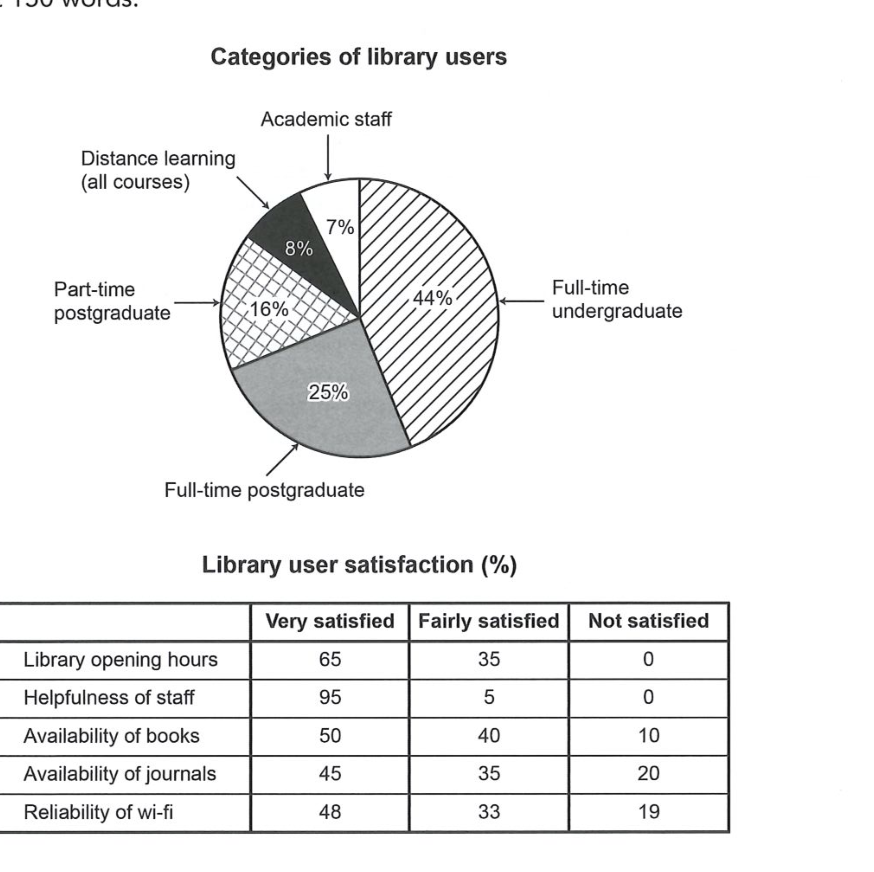
The chart illustrates the five different categories of library, users. While the table gives the information about survey results of library users.
Overall, full-time undergraduate covered the one fourth of the library users. In terms of user satisfation the majority of users satisfied with library services except some users barely satisfied with the service of availability of journals and reliability of wifi.
Regarding categories of library users the full-time undergraduate was the most considerable category with 44% of users.
Followed by 25% of full-time graduates and 16% of part-time post graduates. Meanwhile, distance learning and academic staff was recoreded 8% and 7% respectively.
On the other the larger proportion of users remarkably satisfed with the service of helpfulness of staff whereas, the rating in library opening hours and availvabily of books are quite smiliar except availability of journals and reliability of wifi these services are the least have least satisfied by users.
AI examiner evaluation
| Criterion | Band |
|---|---|
| Task Achievement / Task Response | 6.5 |
| Coherence and Cohesion | 6.0 |
| Lexical Resource | 5.5 |
| Grammatical Range and Accuracy | 5.0 |
| Overall | 6.0 |
Task Achievement / Task Response: Band 6.5
You cover both visuals and identify several important features: undergraduates are the largest user group at 44%, while academic staff are the smallest at 7%, and staff helpfulness receives the strongest satisfaction rating. This meets the task well, and the overview attempts to summarise the main patterns. However, it contains a significant misreading: undergraduates make up 44%, not “the one fourth” of users; 25% refers to full-time postgraduate users. The satisfaction overview is also imprecise: journals and Wi-Fi have the highest dissatisfaction, but most respondents were still very or fairly satisfied with both. To strengthen the response further, report the key contrasts more precisely, such as 95% very satisfied with staff helpfulness versus 20% not satisfied with journals.
Coherence and Cohesion: Band 6.0
The response has a recognisable structure: an introduction, an overview, and separate discussion of user categories and satisfaction. This gives the reader a coherent overall route through the information. Some links between ideas are awkward or incomplete, however. “Followed by 25%...” is a fragment rather than a complete sentence, and “On the other” does not clearly signal the contrast that follows. The final sentence also combines several comparisons without clearly separating them, making the relationship between opening hours, books, journals, and Wi-Fi difficult to follow. Use complete sentences and organise the satisfaction figures into a clear comparison, for example, first highlighting staff and opening hours, then contrasting books, journals, and Wi-Fi.
Lexical Resource: Band 5.5
You use relevant task vocabulary, including “categories,” “proportion,” “availability,” and “satisfied,” and you attempt more formal expressions such as “the most considerable category.” However, several word choices and collocations are inaccurate or unnatural, which reduces precision: “library users” is interrupted by an unnecessary comma, “full-time graduates” does not match the chart’s “full-time postgraduate” category, and “the least have least satisfied” is not a natural way to describe the ratings. Spelling errors such as “satisfation,” “recoreded,” and “availvabily” also affect clarity. Aim for accurate, conventional chart language rather than elaborate phrasing; terms such as “largest group,” “accounted for,” and “dissatisfied” would express the data more naturally.
Grammatical Range and Accuracy: Band 5.0
You attempt both simple and more complex sentence forms, including an overview beginning with “While” and a comparison introduced by “whereas.” However, control is inconsistent, and several errors make relationships between ideas unclear. For example, “full-time undergraduate covered the one fourth” has an incorrect subject–verb relationship and article pattern, while “the majority of users satisfied” is missing a form of “be.” The sentence beginning “On the other” also has faulty clause construction and punctuation, particularly around “whereas.” Some sentences are fragments, including “Followed by 25%...” Work on complete clauses, accurate articles and verb forms, and punctuation around linking words; these changes would make your comparisons much easier to understand.
See this exact question answered at other band scores. The same prompt compared across bands.
Browse more IELTS Writing model answers or get your own writing scored by the same AI examiner.