Band 6.5 IELTS Writing Task 1 Model Answer
Overall Band Score: 6.5 · Cambridge IELTS 21 · 2026-11-12
IELTS Writing Task 1 question
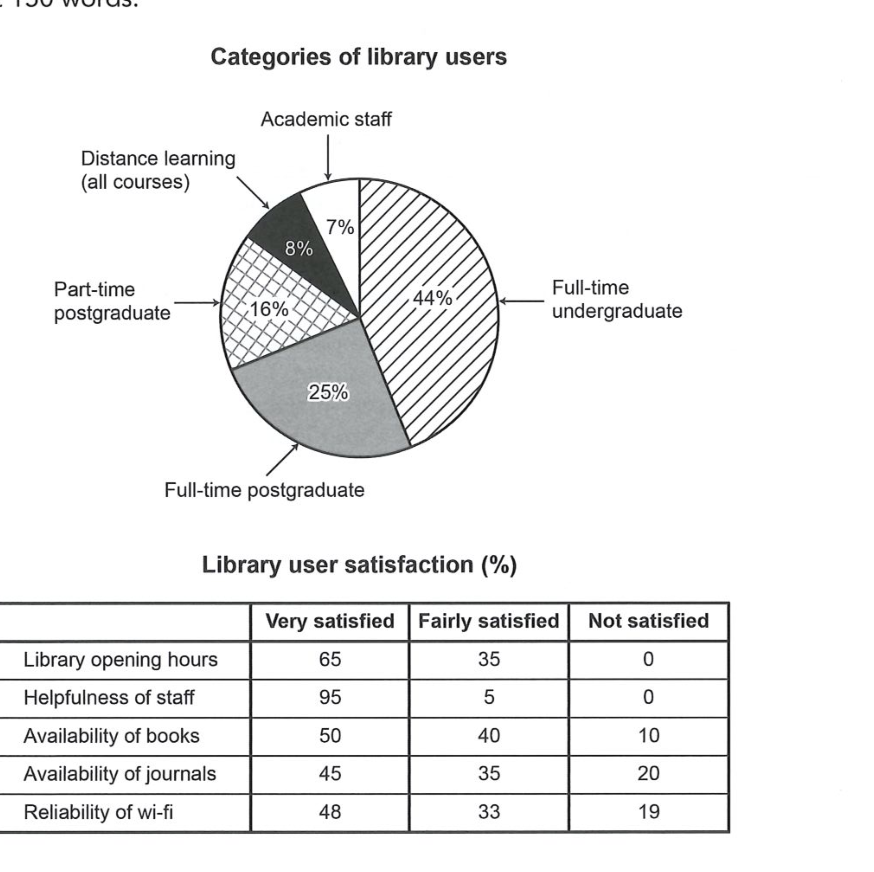
The chart and table below show the results of a survey of library users at a university.
Summarise the information by selecting and reporting the main features, and make comparisons where relevant.
Categories of library users
Student answer (Band 6.5)
The graph demonstrates the people who use library and what they do professionally and the table illustrates the satisfaction of library users about different components of the library.
Overall, most of the library users are students and among them full-time undergraduate students hold the highest position in terms of number. Besides, almost the people are very happy how the staffs behave with them.
Full-time undergraduate students are by far the largest users of librabry with 44% followed by full-time posgraduate students exactly a quarter. Part-time postgraduate students with 16% hold the third position, whereas academic staff and distance learning makes up rest of the 15%.
95% of the users are pleased with the cooperative behaviour of the library staffs. In fact, no unsatisfaction were noticed among the users about library opening hours too and 65% of them were very satisfied. But almost a quarter users were not satisfied about the wi-fi and journal availibility and only a few(10%) were unsatisfied with books availibility.
AI examiner evaluation
| Criterion | Band |
|---|---|
| Task Achievement / Task Response | 6.5 |
| Coherence and Cohesion | 7.0 |
| Lexical Resource | 5.5 |
| Grammatical Range and Accuracy | 6.0 |
| Overall | 6.5 |
Task Achievement / Task Response: Band 6.5
You identify the main user group accurately: full-time undergraduates account for 44%, followed by full-time postgraduates at 25%, and you also report the remaining user categories. The overview correctly highlights student dominance and the strong satisfaction with staff. However, the satisfaction summary is selective: the response does not report the high satisfaction with opening hours and staff alongside the more mixed ratings for books, journals and Wi-Fi in a balanced comparison. “Almost a quarter” not satisfied with Wi-Fi and journals is also imprecise: the figures are 19% and 20%, respectively. To strengthen the response, compare the satisfaction patterns more fully and distinguish clearly between very and fairly satisfied users.
Coherence and Cohesion: Band 7.0
The response has a clear overall progression: an introduction, an overview, details about user categories, and then satisfaction findings. Linking expressions such as “Overall,” “Besides,” “In fact,” and “But” help signal the relationships between points, and the reader can follow the main comparisons. Some connections are less precise, however. “Besides” does not clearly introduce a contrast or addition to the overview, while “But” joins two positive findings in a way that suggests opposition. The final sentence also groups Wi-Fi and journal dissatisfaction together without making their separate figures explicit. Use transitions that reflect the exact relationship between ideas and organise the satisfaction details into a clearer comparison.
Lexical Resource: Band 5.5
You use relevant vocabulary for describing the charts, including “largest users,” “followed by,” “third position,” and “very satisfied.” This gives you enough range to communicate the main information. However, several word choices and collocations are inaccurate or unnatural, such as “hold the highest position,” “almost the people,” and “cooperative behaviour” for staff helpfulness. There are also spelling errors in “librabry,” “posgraduate,” and “availibility,” which reduce precision. Aim for standard chart language and check spelling carefully; for example, describe a group as “accounting for” a percentage and refer to “satisfaction with” a service or facility.
Grammatical Range and Accuracy: Band 6.0
You attempt a mix of simple and complex sentences, including clauses with “whereas” and “among them,” and most of the message remains understandable. Some grammatical errors persist, particularly with articles, agreement, and sentence construction. For example, “the people who use library” needs an article, “academic staff and distance learning makes up” has a subject–verb agreement problem, and “no unsatisfaction were noticed” is not correctly formed. The phrase “almost a quarter users” also needs a determiner. Review article use, plural and singular agreement, and negative constructions. More accurate control of these patterns would make your comparisons clearer while preserving the range of sentence forms you already attempt.
See this exact question answered at other band scores. The same prompt compared across bands.
Browse more IELTS Writing model answers or get your own writing scored by the same AI examiner.