Band 6.0 IELTS Writing Task 1 Model Answer
Overall Band Score: 6.0 · Cambridge IELTS 21 · 2026-11-13
IELTS Writing Task 1 question
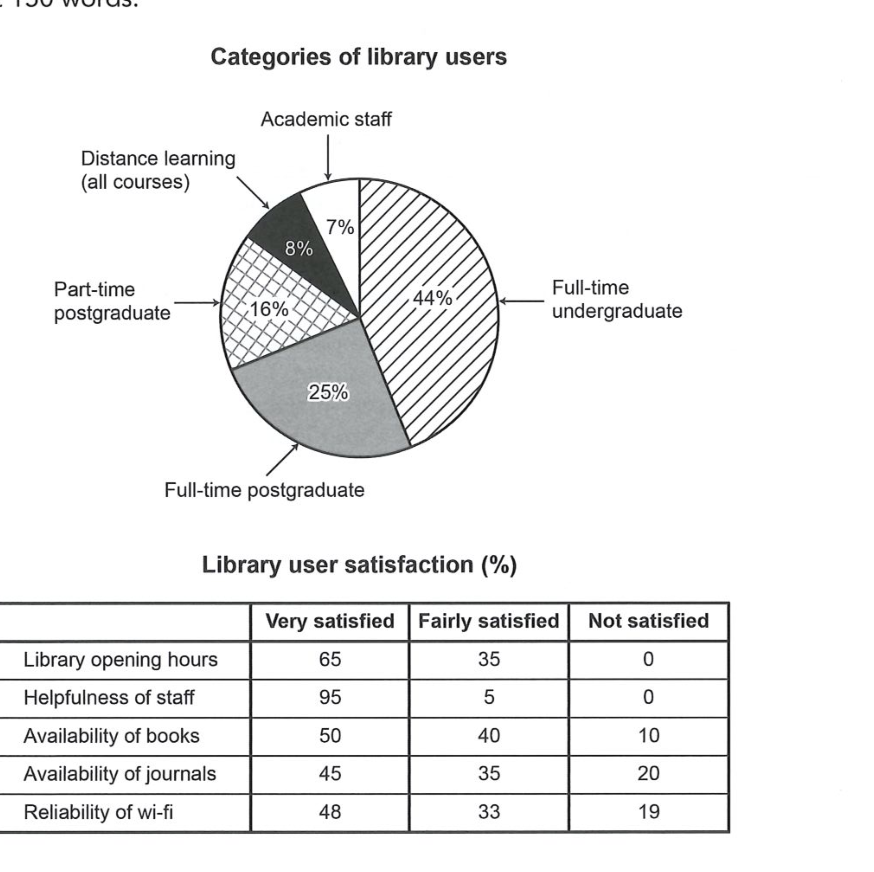
The chart and table below show the results of a survey of library users at a university.
Summarise the information by selecting and reporting the main features, and make comparisons where relevant.
Categories of library users
Student answer (Band 6.0)
The pie chart breakdown categories of library users at a university library, while table represents the satisfication level of users toward facilities in the library.
Overall, full-time undergraduate is the dominat category of library uses, while academic staff is the least users. More users are satisfied with library helpfulness of staff, whereas not satisfied with availability of journals.
Full-time undergradute has higest proportion of user, at 44% followed by full-time postgraduate and part-time postgradute at 25% and 16% respectively. Acedemic staff accounted for 7%, making it the least users category of the library.
Helpfulness of staff accounted for highest satisfication catogory at 95% of total very satisfied and 5% users are fairly satistied. The 65% of users are very satisfied with library opening hours while 35% of users are fairy satisfied. Half of users are very satisified with availability of book, while 10 % users are not statified.Availability of journals and reliability of wifil shows almost same trend. The 45% users very satisfied with availabity of journals, while 35% of them fairly satisfied. However 20%of users disappointed with journals availability, making it least satisfied catrgory. 48% of users very satisfied with realibility of wifi while 19% are not.
AI examiner evaluation
| Criterion | Band |
|---|---|
| Task Achievement / Task Response | 7.0 |
| Coherence and Cohesion | 6.5 |
| Lexical Resource | 5.5 |
| Grammatical Range and Accuracy | 5.5 |
| Overall | 6.0 |
Task Achievement / Task Response: Band 7.0
The response covers both visuals and gives a clear overview: undergraduates form the largest user group, academic staff the smallest, and staff helpfulness receives the strongest satisfaction ratings while journals attract the most dissatisfaction. The figures reported for these points are accurate, and the comparisons between user categories and facilities are relevant. This supports a well-developed account of the main features. However, the overview could be more complete by noting that no respondents were dissatisfied with either opening hours or staff helpfulness, and the distance-learning group (8%) is omitted from the detailed breakdown. The wi-fi account also leaves out the fairly satisfied figure of 33%. Selecting these details would make the coverage more consistently comprehensive.
Coherence and Cohesion: Band 6.5
The response has a recognisable structure: an introduction and overview are followed by a paragraph on user categories and one on satisfaction. Information generally progresses logically, and linking expressions such as “while,” “followed by” and “however” help show comparisons. This is a coherent overall arrangement. To make the progression more fluent, group the satisfaction results in a more systematic order and use clearer references when moving between facilities. For example, “Availability of journals and reliability of wi-fi shows almost same trend” is followed by details that do not fully compare both categories, and the final wi-fi sentence feels added on rather than integrated. More precise transitions and a clearer comparison of all three satisfaction levels would strengthen cohesion.
Lexical Resource: Band 5.5
The response uses relevant task vocabulary, including “proportion,” “accounted for,” “very satisfied” and “availability,” and it attempts to vary wording rather than repeat the chart labels throughout. However, spelling and word-choice problems are noticeable, including “satisfication,” “dominant,” “undergradute,” “catogory” and “realibility.” Some combinations are also unnatural, such as “library helpfulness of staff” and “least users category.” These errors sometimes make the reader pause, although the intended meaning is usually recoverable. Check spelling carefully and prefer accurate, natural collocations for describing proportions and satisfaction. A more controlled range of precise terms would make the report clearer and more professional.
Grammatical Range and Accuracy: Band 5.5
There are attempts at complex sentences and comparison, such as “while academic staff is the least users” and “making it the least satisfied category,” but control is inconsistent. Several sentences omit articles or use incomplete grammatical patterns: “The pie chart breakdown categories…” and “while table represents…” need clearer noun phrases and articles. Agreement and sentence construction also need attention in “Availability of journals and reliability of wifil shows,” where the compound subject requires a plural verb. Punctuation and spacing are uneven, particularly around percentages and sentence boundaries. These issues do not prevent the reader from following the main message, but they limit accuracy. Practise building complete sentences with consistent subject–verb agreement and checking articles.
See this exact question answered at other band scores. The same prompt compared across bands.
Browse more IELTS Writing model answers or get your own writing scored by the same AI examiner.