Band 7.0 IELTS Writing Task 1 Model Answer
Overall Band Score: 7.0 · Cambridge IELTS 21 · 2026-11-13
IELTS Writing Task 1 question
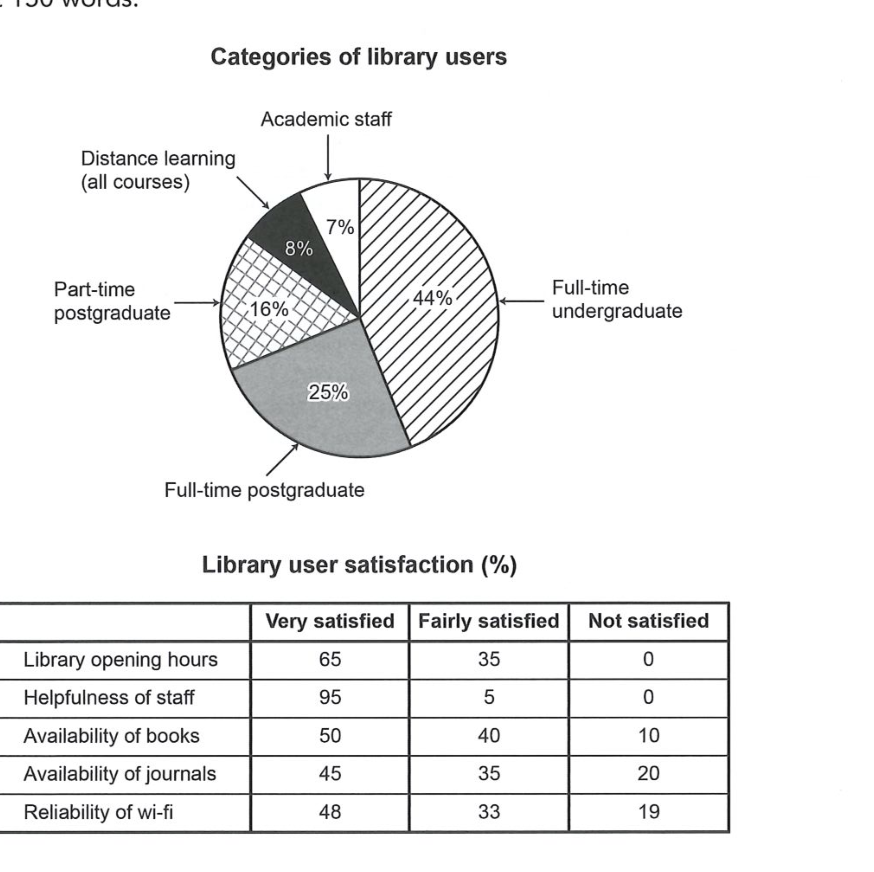
The chart and table below show the results of a survey of library users at a university.
Summarise the information by selecting and reporting the main features, and make comparisons where relevant.
Categories of library users
Student answer (Band 7.0)
The pie chart illustrates the results of a survey that was conducted on different categories of library users and the table provides information on level of satisfaction of these users on various facilities of the library.
Overall, the library seems to be occupied mostly by the full-time undergraduate students, while the least occupancy belongs to the academic staffs. Although most of the students are very satisfied with helpfulness of the staffs, many students are fairly or not satisfied with wi-fi connection and journal availability.
Full-time undergraduate students use the library most with nearly half of the total users, 44%, while full-time postgraduates occupy one-quarter of the total users. Distance learnings and academic staffs almost share the similar value with 8% and 7% respectively. The rest 16% belongs to the part-time postgraduate students, which is nearly one-fifth of the whole.
No one seems to be dissatisfied with the facilities related to library opening time and the helpfulness of the staffs. Most are happy with the availability of books too, except 10%. However, one-fifth of the users are not satisfied with the availability of journals and this is almost the same for wi-fi connection although most are either very satisfied or satisfied.
AI examiner evaluation
| Criterion | Band |
|---|---|
| Task Achievement / Task Response | 7.0 |
| Coherence and Cohesion | 7.0 |
| Lexical Resource | 6.5 |
| Grammatical Range and Accuracy | 7.0 |
| Overall | 7.0 |
Task Achievement / Task Response: Band 7.0
The response selects the main features of both visuals and gives a clear overview: undergraduates form the largest user group, academic staff the smallest, and satisfaction is strongest for staff helpfulness while journals and Wi-Fi attract more dissatisfaction. The figures for user categories are accurately reported, and the comparison that one-fifth are dissatisfied with journals matches the table. However, the overview says “most of the students” are satisfied, although the table covers library users generally, and it groups Wi-Fi and journals as “many” fairly or not satisfied without distinguishing their figures. More precise reporting would strengthen the comparisons—for example, noting that Wi-Fi dissatisfaction is 19%, close to journals at 20%, and that books receive 50% very satisfied responses. Overall, the key information is covered and supported, with some generalisation.
Coherence and Cohesion: Band 7.0
The response is organised clearly into an introduction, an overview, a paragraph on user categories and a paragraph on satisfaction. This creates a logical progression from describing the visuals to highlighting and then supporting the main patterns. Cohesive expressions such as “Overall,” “while,” “However” and “although” help connect comparisons, and the reader can follow the discussion without difficulty. Some links could be more precise: “this is almost the same for wi-fi connection” makes the comparison with journal dissatisfaction slightly vague, and “The rest 16%” is not an especially smooth transition to the remaining category. Naming the figures or categories directly in these links would make cohesion more controlled and reduce reliance on broad references.
Lexical Resource: Band 6.5
The vocabulary is adequate and varied enough to describe the charts, with useful terms such as “survey,” “categories,” “availability,” “dissatisfied” and “nearly one-fifth.” The writer also uses comparison language effectively, including “nearly half” and “one-quarter.” Some word choices and collocations are less natural or precise: “occupied mostly by” suggests physical occupancy rather than user proportions, “Distance learnings” is an awkward form, and “library opening time” is less suitable than “opening hours.” Repeated use of “students” also overlooks that the survey includes academic staff. These choices do not prevent understanding, but more accurate chart-reporting vocabulary and natural collocations would provide the greater flexibility and precision expected at the next level.
Grammatical Range and Accuracy: Band 7.0
The response uses a good mix of simple and complex structures, and many sentences are accurate. For example, the opening sentence combines the chart and table with a clear relative clause, while “Although most of the students are very satisfied…” shows an effective subordinate clause. Comparisons are also generally formed correctly. A few grammatical slips remain, including the plural “academic staffs” and “the helpfulness of the staffs,” where “staff” is normally treated as a collective noun. In “Distance learnings and academic staffs almost share the similar value,” the article is unnecessary and the singular “value” is not well matched to two categories. These errors are minor and the meaning remains clear; continued attention to articles, number and agreement would improve accuracy.
See this exact question answered at other band scores. The same prompt compared across bands.
Browse more IELTS Writing model answers or get your own writing scored by the same AI examiner.