Band 6.5 IELTS Writing Task 1 Model Answer
Overall Band Score: 6.5 · Cambridge IELTS 21 · 2026-11-13
IELTS Writing Task 1 question
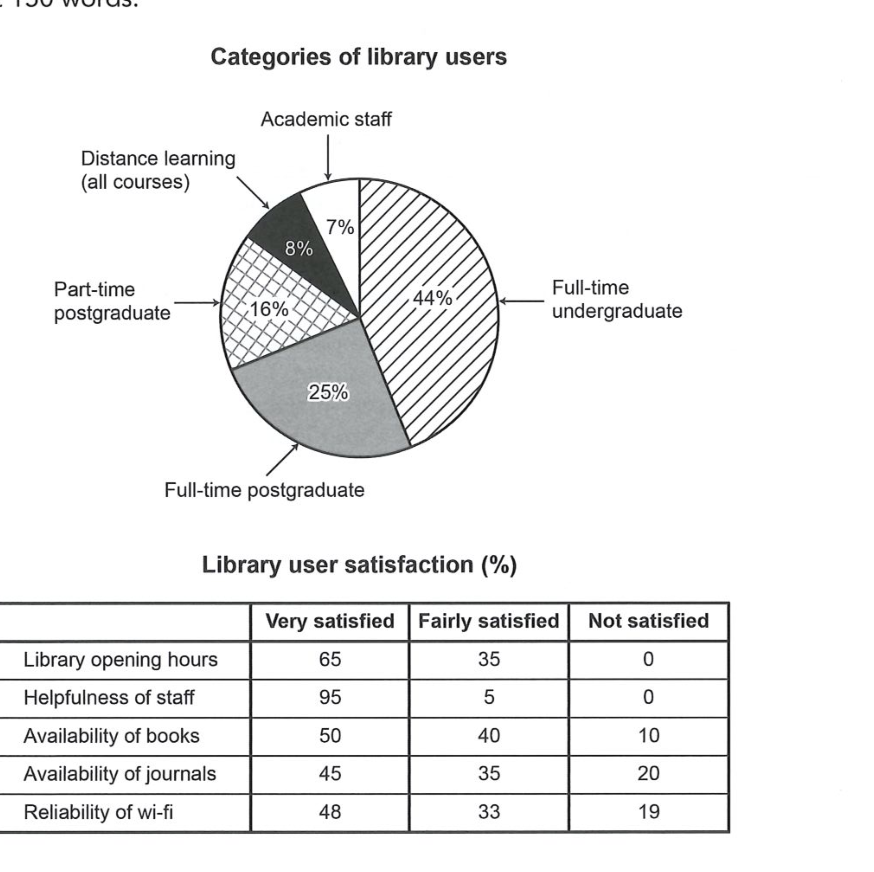
The chart and table below show the results of a survey of library users at a university.
Summarise the information by selecting and reporting the main features, and make comparisons where relevant.
Categories of library users
Student answer (Band 6.5)
The chart and table illustrate the results of a survey of categories of library users and their satisfaction at a university.
Overall, full-time undergraduate has the largest proportion among the library users while the academic staff accounted for the least amount. It is also evident that majority of the users were satisfied about the library's services.
For the categories of library users, full-time undergraduate recorded 44%, which is the highest figure. The second largest group is full-time postgraduate, for 25%. Following this, 16% of users were par-time postgraduate. For the least, it were academic staffs accounting for 7%, and all courses of distance learning for 8%.
None of the library users were not satisfied for the library opening hours and helpfulness of staff. For the availability of books, 50% of them replied as very satisfied, and 40% of them as fairly satisfied. Only 10% of them were not satisfied about it. The section with the largest proportion of being not satisfied was the availability for journals, for 20%. The 19% of users also answered they were not appreciated for the reliability of wi-fi.
AI examiner evaluation
| Criterion | Band |
|---|---|
| Task Achievement / Task Response | 6.5 |
| Coherence and Cohesion | 7.0 |
| Lexical Resource | 6.0 |
| Grammatical Range and Accuracy | 6.0 |
| Overall | 6.5 |
Task Achievement / Task Response: Band 6.5
You identify the main user group accurately (full-time undergraduates, 44%) and the smallest (academic staff, 7%), and your overview also notes that satisfaction is generally positive. The user-category figures are otherwise reported accurately, and you select relevant satisfaction details, including the 95% very satisfied with staff helpfulness and the higher dissatisfaction with journals and wi-fi. This covers both visuals and shows some comparison. However, the satisfaction overview is broad, and several important contrasts are not developed: for example, staff helpfulness has the strongest very-satisfied result, while opening hours also receive no dissatisfaction. The statement that “None of the library users were not satisfied” is unclear and could be read as contradicting the data. A more precise overview and fuller comparison across satisfaction categories would strengthen the response.
Coherence and Cohesion: Band 7.0
The response is organised into a clear introduction, overview and two detail paragraphs. It moves logically from the user profile to satisfaction results, and signposts such as “Overall,” “For the categories,” and “For the availability of books” help readers follow the information. The sequence within the user groups is also easy to understand. Some linking is less effective or repetitive, however: “Following this” and “For the least” do not create especially natural transitions, and the final paragraph lists satisfaction figures without grouping the strongest and weakest results into a clear comparison. The reference “it” in “it were academic staffs” is also unclear. More deliberate grouping of related data and smoother transitions would make the progression more cohesive.
Lexical Resource: Band 6.0
You use a suitable range of task-related vocabulary, including “largest proportion,” “accounted for,” “availability,” and “reliability,” and the meaning is generally clear. There are also attempts to vary how figures are described. However, several word choices and collocations are inaccurate or unnatural, which limits precision: “satisfied about” is better expressed as “satisfied with,” “replied as very satisfied” is awkward, and “were not appreciated” does not mean “were not satisfied.” “Par-time” is a spelling error, while “academic staffs” uses an unsuitable plural form for this category. Aim for standard reporting phrases such as “the proportion who were very satisfied” and “the least satisfied users,” and check spelling and collocation carefully.
Grammatical Range and Accuracy: Band 6.0
You use both simple statements and some more developed structures, including the overview sentence beginning “while” and the comparison “For the availability of books…”. Most sentences communicate the intended figures, but some grammatical errors remain. For example, “full-time undergraduate has the largest proportion” needs a plural subject or a clearer noun phrase, and “the second largest group is … for 25%” has an incorrect construction. The sentence “None of the library users were not satisfied” contains confusing negation and does not accurately express the intended meaning. There are also agreement and article problems in “it were academic staffs.” These errors do not usually prevent understanding, but revising sentence patterns and checking agreement, articles and negation would improve accuracy.
See this exact question answered at other band scores. The same prompt compared across bands.
Browse more IELTS Writing model answers or get your own writing scored by the same AI examiner.