Band 6.5 IELTS Writing Task 1 Model Answer
Overall Band Score: 6.5 · Cambridge IELTS 21 · 2026-11-14
IELTS Writing Task 1 question
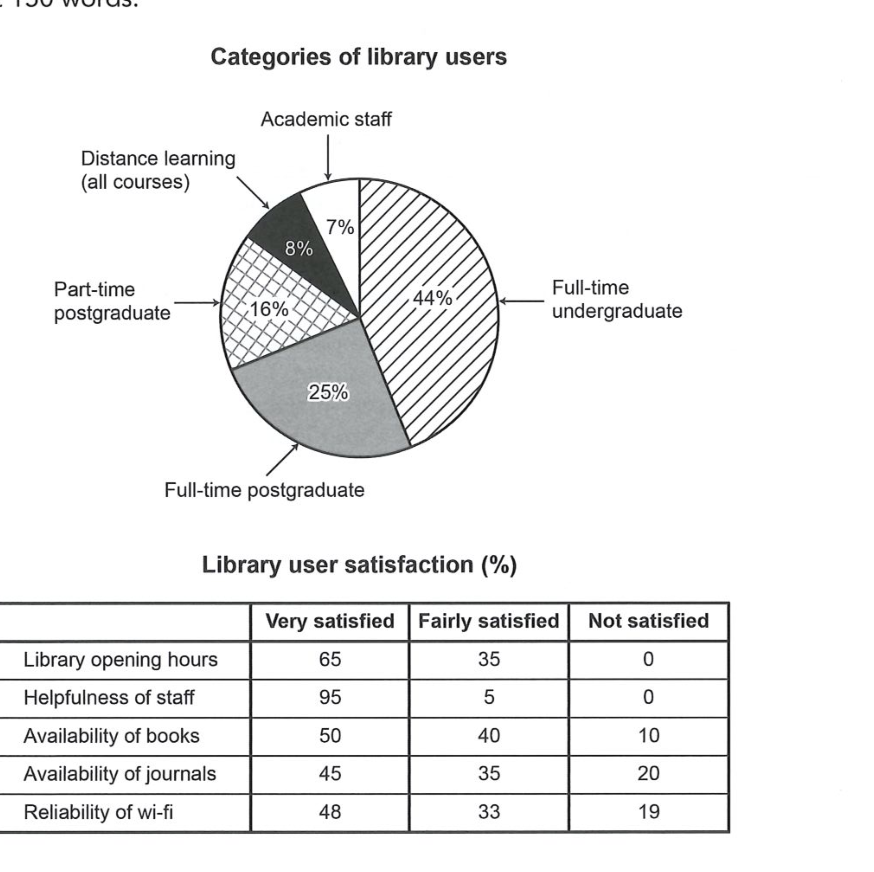
The chart and table below show the results of a survey of library users at a university.
Summarise the information by selecting and reporting the main features, and make comparisons where relevant.
Categories of library users
Student answer (Band 6.5)
The pie chart illustrates the categories of library users, while the tables summarizes the satisfaction percentage regarding library services.
Overall, full-time undergraduate students account for the highest proportion of total, meanwhile academic staffs represents the smallest group. Regarding the satisfaction, users were most satisfied with staff helpfullness, whereas opinions on journal availability and wi-fi reliability is more mixed.
Full-time undergraduates represent the largest group at 44%, followed closely by postgraduates at 41% in total of both full-time and part-time. Distance learners make up 8% and academic staff make up remaining 7%.
Regarding the satisfaction, staff helpfullness received highest rating with 95% users are very satisfied and 5% are fairly satisfied. Similarly, 65% are very satisfied with the opening hours of the library, 35% are fairly satisfied. Books availability received slightly lower ratings with, half of the users are very satisfied, 40% are fairly satisfied and 10% are dissatisfied. Meanwhile, 45% and 48% are very satisfied with journal availability and wi-fi reliability recpectively, while around 20% are dissatisfied each.
AI examiner evaluation
| Criterion | Band |
|---|---|
| Task Achievement / Task Response | 7.0 |
| Coherence and Cohesion | 6.5 |
| Lexical Resource | 6.5 |
| Grammatical Range and Accuracy | 6.0 |
| Overall | 6.5 |
Task Achievement / Task Response: Band 7.0
The response covers both visuals and gives a clear overview of the main contrasts: undergraduates form the largest user group, academic staff the smallest, and staff helpfulness receives the strongest satisfaction ratings. The figures reported for user categories and most satisfaction measures are accurate. The combined postgraduate share of 41% is a useful comparison, and the response also identifies the more mixed views of journals and wi-fi. However, the final comparison over-generalises dissatisfaction as “around 20% each”: journals have 20% not satisfied, but wi-fi has 19%, while books have 10%. The overview could also state more precisely that staff helpfulness has the highest very-satisfied share and that no one is dissatisfied with opening hours or staff helpfulness. These omissions and slight imprecision limit fuller development.
Coherence and Cohesion: Band 6.5
The response is organised into an introduction, an overview, and two detail paragraphs, with a sensible progression from user categories to satisfaction results. Linking expressions such as “Overall,” “Regarding,” “Similarly,” and “Meanwhile” help readers follow the comparisons, and the information is generally grouped appropriately. This provides a coherent overall arrangement. However, “Regarding the satisfaction” is repeated, and the final sentence combines journal and wi-fi figures in a way that makes the dissatisfaction comparison less exact. Some transitions feel formulaic rather than flexible, while the overview and detail paragraphs repeat the same broad points. More precise referencing and a clearer separation of the satisfaction comparisons would make cohesion smoother and less repetitive.
Lexical Resource: Band 6.5
The response uses an adequate range of task-relevant vocabulary, including “categories,” “proportion,” “account for,” “availability,” and “dissatisfied.” It also varies some reporting language with “represent,” “make up,” and “received.” These choices communicate the data clearly, but several collocations and forms are inaccurate or awkward, such as “highest proportion of total,” “staff helpfullness,” and “Books availability.” There are also spelling errors in “helpfullness” and “recpectively,” which reduce control. Repeated use of “satisfied” and “make up” limits flexibility. Aim for more natural chart language, such as “the largest share of users,” “staff helpfulness,” and “the availability of books,” while checking spelling carefully.
Grammatical Range and Accuracy: Band 6.0
There is a mix of simple and more complex sentence forms, including the contrast in “while the tables summarizes…” and the overview sentence beginning “Overall.” Most figures remain understandable, and the response uses present-tense reporting consistently in many places. Some errors in agreement, articles, and sentence construction remain. For example, “the tables summarizes” has a plural subject with a singular verb, while “academic staffs represents” has both an inappropriate plural form and faulty agreement. In “95% users are very satisfied,” an article or preposition is needed, and “Books availability received slightly lower ratings with, half…” contains an awkward, incorrectly punctuated structure. The final sentence also needs clearer grammatical coordination. More accurate control of these patterns would improve readability.
See this exact question answered at other band scores. The same prompt compared across bands.
Browse more IELTS Writing model answers or get your own writing scored by the same AI examiner.