Band 6.0 IELTS Writing Task 1 Model Answer
Overall Band Score: 6.0 · Cambridge IELTS 21 · 2026-11-15
IELTS Writing Task 1 question
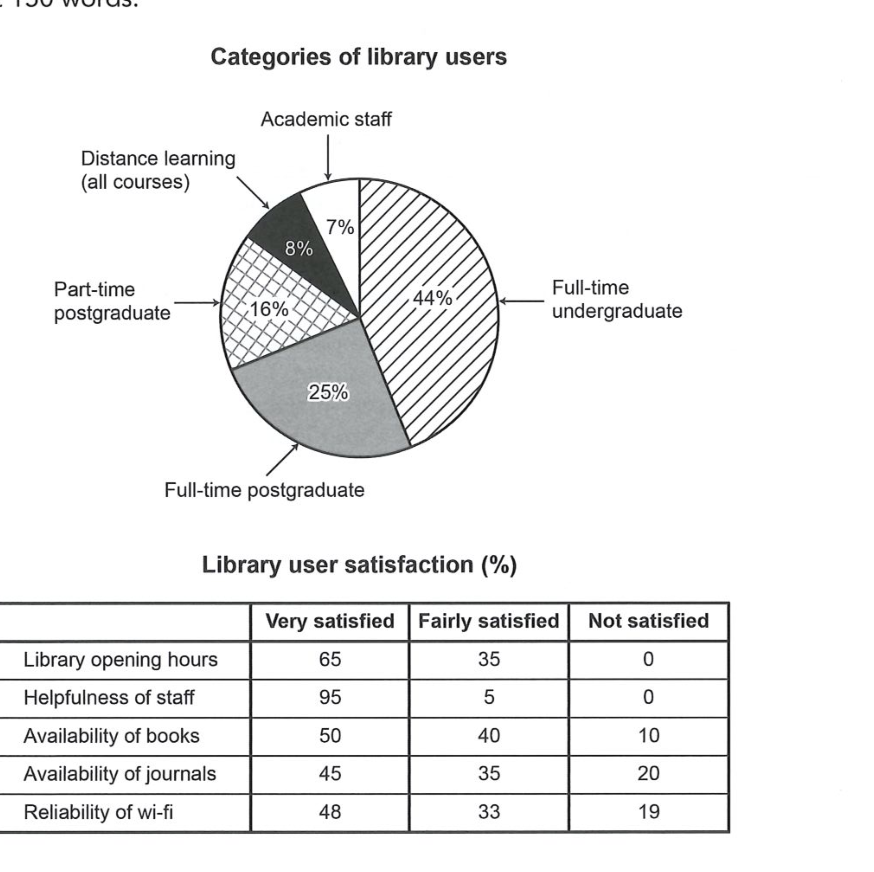
The chart and table below show the results of a survey of library users at a university.
Summarise the information by selecting and reporting the main features, and make comparisons where relevant.
Categories of library users
Student answer (Band 6.0)
The chart and table depicts information regarding the results of the survey done around the library users at a university.
The chart illustrates the proportion of library users divided into categories based on their distinctions. With full time undergraduates emerging as the major users of the library, whereas the academic staff being the lowest. The table shows the user's satisfaction with the facilities provided by the library.
The major library users are full time graduates with 44%, the full time postgraduates sits at 25% behind full-time undergraduates, the other categories such as part time postgraduates, distance learning and academic staff occupies small percentages, with academic staff being the lowest sitting at around 7%.
The table represents the library user satisfaction, the users find the staff of the library very helpful and are satisfied the most with it, furthermore it can be seen that users are satisfied with library opening hours. Availability of journals can be considered as the least satisfactory facility provided by the library as 20% are not satisfied with it.
AI examiner evaluation
| Criterion | Band |
|---|---|
| Task Achievement / Task Response | 5.5 |
| Coherence and Cohesion | 6.0 |
| Lexical Resource | 6.0 |
| Grammatical Range and Accuracy | 5.5 |
| Overall | 6.0 |
Task Achievement / Task Response: Band 5.5
You identify the main user group correctly: full-time undergraduates account for 44%, while academic staff are the smallest group at 7%. You also select relevant satisfaction findings, especially the high rating for staff helpfulness and the 20% dissatisfied with journals. However, the overview is incomplete: it does not clearly summarise the overall satisfaction pattern, such as the fact that staff helpfulness has the highest very-satisfied figure and that no one is dissatisfied with opening hours. Some details are also inaccurate or imprecise: “full time graduates” should be undergraduates, and the table’s figures are not reported to support the comparisons. Covering both visuals is a strength, but more accurate, balanced selection and development of key data are needed.
Coherence and Cohesion: Band 6.0
The response has a clear overall arrangement: it introduces the visuals, discusses user categories, and then turns to satisfaction. This makes the two parts of the task easy to distinguish. Linking expressions such as “whereas,” “furthermore,” and “as” help connect ideas, although some connections are awkward or mechanical. For example, the sentence beginning “With full time undergraduates…” is a fragment, and the next paragraph repeats the main-user comparison rather than progressing to a fuller account of the chart. The final paragraph groups several satisfaction points but does not compare them systematically. Clearer topic sentences and a more deliberate sequence—from overview to supporting figures—would improve progression and cohesion.
Lexical Resource: Band 6.0
You use an adequate range of task-related vocabulary, including “proportion,” “categories,” “satisfaction,” and “availability,” and the meaning is generally clear. There are also attempts at more formal phrasing, such as “emerging as the major users” and “least satisfactory facility.” However, some choices are imprecise or unnatural: “distinctions” does not clearly describe user groups, “major library users” is less suitable than “largest user group,” and “sits at 25% behind” is awkward. Repetition of “users” and “library” also limits flexibility. Aim for precise chart language and natural collocations, while keeping descriptions concise; this will make comparisons sound more controlled and academic.
Grammatical Range and Accuracy: Band 5.5
You attempt both simple and more complex sentence forms, and most of the intended meaning can be understood. However, some errors in sentence structure and agreement remain. “The chart and table depicts” has a plural subject and needs a plural verb; “With full time undergraduates emerging…” is an incomplete sentence; and “the full time postgraduates sits” has a subject–verb agreement error. In “the other categories … occupies small percentages,” the plural subject also requires a plural verb. Punctuation around the long final sentence makes its clauses difficult to follow. Practise building complete sentences around comparisons and checking subject–verb agreement, articles, and punctuation. More accurate control of these patterns would make your range more effective.
See this exact question answered at other band scores. The same prompt compared across bands.
Browse more IELTS Writing model answers or get your own writing scored by the same AI examiner.