Band 5.5 IELTS Writing Task 1 Model Answer
Overall Band Score: 5.5 · Cambridge IELTS 21 · 2026-11-17
IELTS Writing Task 1 question
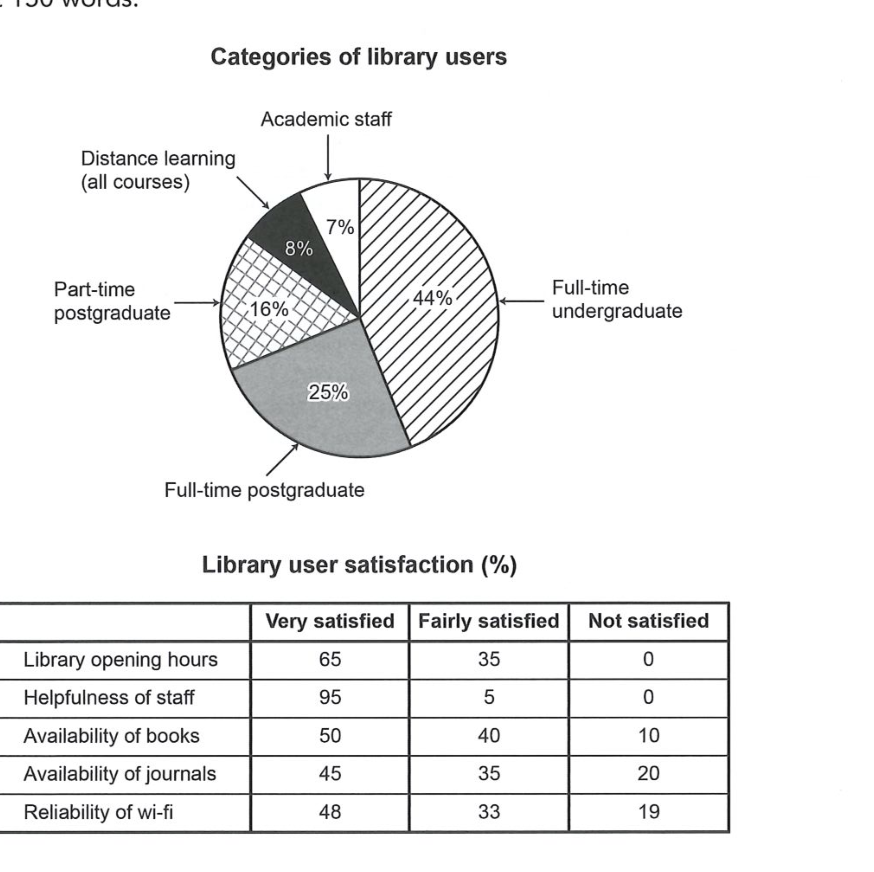
The chart and table below show the results of a survey of library users at a university.
Summarise the information by selecting and reporting the main features, and make comparisons where relevant.
Categories of library users
Student answer (Band 5.5)
The illustration gives the information about the result of survey of five different categories of library users and their satisfaction at a university.
Overall, full-time undergraduate has the most proportion from all categories of library users whereas least was academic staff. As Helpfulness of staff and library opening hours has the most highest proportion as they are "very satisfied" while, reliability of wi-fi has the ;
It is quite evident from the pie chart that full-time undergraduate has been almost doubled about 44%, whereas, full-time postgraduate is 25%. In contrast, academic staff and distance lerning has the smallest proportion of 7% and 8% respectively. while, part-time postgraduate has 16%.
Meanwhile, helpfulnesss of staff has the most percentage is 95 as they are "very satisfied", whereas 0 of them are "not satisfied". Likewise, library opening hours and availability of books has the second highest proportion about 65 and 50 however, 35% and 40% of them were "fairly satisfied". While, availability of journels and reliability of wi-fi has the smallest percentage about 45% and 48% are "very satisfied".
AI examiner evaluation
| Criterion | Band |
|---|---|
| Task Achievement / Task Response | 5.5 |
| Coherence and Cohesion | 5.5 |
| Lexical Resource | 5.5 |
| Grammatical Range and Accuracy | 5.0 |
| Overall | 5.5 |
Task Achievement / Task Response: Band 5.5
You identify the main user group correctly: full-time undergraduates account for 44%, while academic staff are the smallest group at 7%. You also report several satisfaction figures accurately, including 95% very satisfied with staff helpfulness and 65% with opening hours. However, the overview is incomplete and ends mid-sentence after “reliability of wi-fi has the”; this leaves the main satisfaction pattern unclear. Some comparisons are also imprecise: books are not the second-highest satisfaction result, and the response omits the 0% dissatisfied figures for opening hours and the 10%, 20% and 19% dissatisfied results for books, journals and wi-fi. Select the strongest contrasts and summarise them clearly.
Coherence and Cohesion: Band 5.5
The response has a recognisable structure, moving from an introduction and overview to user categories and satisfaction results. This gives the reader some organisation, and phrases such as “In contrast” and “Meanwhile” attempt to connect comparisons. However, progression is weakened by the unfinished overview sentence and by abrupt or awkward links, including “while” beginning a sentence after a full stop. The final paragraph combines several satisfaction categories without a clear order, and “second highest” does not make the comparison easy to follow. Group the satisfaction results into a clear sequence—for example, strongest ratings, then lower ratings—and use complete sentences with precise links between them.
Lexical Resource: Band 5.5
You use relevant task vocabulary such as “categories,” “proportion,” “satisfaction,” and “very satisfied,” which helps communicate the chart’s subject. There is some attempt to vary wording, but several choices are inaccurate or repetitive, making comparisons less precise. For example, “most highest proportion” is redundant, “has the most percentage” is an unnatural collocation, and “almost doubled about 44%” does not clearly express the figure. Spelling errors such as “lerning,” “helpfulnesss,” and “journels” also reduce accuracy. Aim for standard chart language such as “accounted for,” “the largest share,” and “the highest proportion,” and check spelling before submitting.
Grammatical Range and Accuracy: Band 5.0
The response attempts some longer sentences using contrast, as in “Meanwhile, helpfulness of staff has the most percentage … whereas 0 of them are ‘not satisfied’.” However, these attempts are often faulty, and sentence control is inconsistent. Subject–verb agreement errors occur in “full-time undergraduate has” and “opening hours … has”; articles are missing in “the result of survey”; and the overview ends with an incomplete clause. Punctuation and sentence boundaries are also problematic, particularly the lower-case “while” after a full stop and the comma before “whereas.” Use shorter, complete sentences first, check singular and plural subjects, and then add subordinate clauses only when their structure is secure.
See this exact question answered at other band scores. The same prompt compared across bands.
Browse more IELTS Writing model answers or get your own writing scored by the same AI examiner.