Band 6.0 IELTS Writing Task 1 Model Answer
Overall Band Score: 6.0 · Cambridge IELTS 21 · 2026-11-18
IELTS Writing Task 1 question
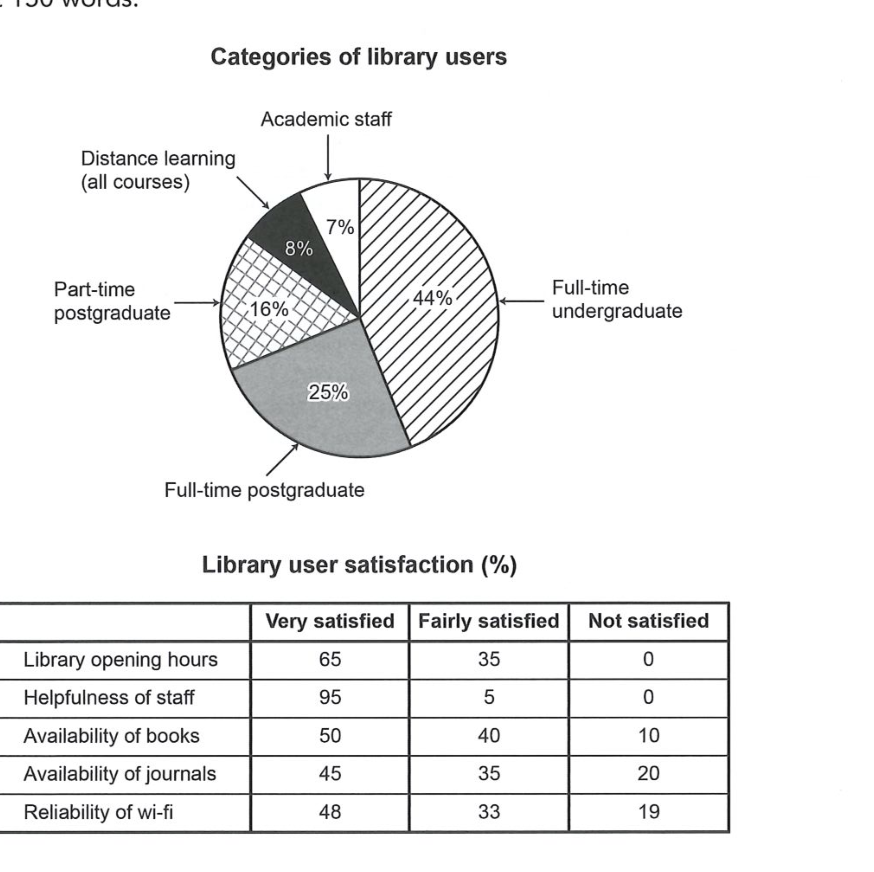
The chart and table below show the results of a survey of library users at a university.
Summarise the information by selecting and reporting the main features, and make comparisons where relevant.
Categories of library users
Student answer (Band 6.0)
The diagrams illustrate the outcome of questionnaire of people who use university's library.
Overall, it can be seen that the first graph gives an information about types of people who visits the library whereas the second graph shows the visitor's ratings. Library is mostly used by full-time undergraduate while academic workers use it the least and according to the feedbacks help of the library staff is highly appreciated while the internet connection isn't enjoyed as much.
As shown in the pie chart no less than 90 percent of the users are students, those pursuing a bachelor's degree make up the half of it followed by full-time advanced-degree learners taking up to 25%, while postgrads on a part-time basis comprise 16% and both academic staff, distance learners takes up to 13% when combined.
Those who visit the library are highly satisfied with the helpful workers, in contrast, they don't enjoy the connection of wi-fi as much.
AI examiner evaluation
| Criterion | Band |
|---|---|
| Task Achievement / Task Response | 6.0 |
| Coherence and Cohesion | 6.5 |
| Lexical Resource | 6.0 |
| Grammatical Range and Accuracy | 6.0 |
| Overall | 6.0 |
Task Achievement / Task Response: Band 6.0
You identify the main user group and the strongest satisfaction result, and your overview correctly notes that undergraduates form the largest category while academic staff are the smallest. However, some details are inaccurate or unclear: “those pursuing a bachelor's degree make up the half of it” suggests half of the student group, whereas undergraduates are 44% of all users. The combined 13% for academic staff and distance learners is correct, but the satisfaction overview is incomplete. You mention staff helpfulness and Wi-Fi, yet omit the strong ratings for opening hours and the comparatively lower results for journals. The response addresses the task, but several key features need clearer, more accurate reporting and development.
Coherence and Cohesion: Band 6.5
The response has a recognisable structure: an introduction, an overview, and a paragraph describing user categories, followed by a brief comment on satisfaction. Linking phrases such as “Overall,” “whereas,” and “in contrast” help show relationships between ideas, and the main points are generally easy to follow. However, the final paragraph repeats the overview rather than adding specific comparisons from the satisfaction table, so progression is limited. The long sentence beginning “As shown in the pie chart” also packs several figures and comparisons together, making the relationships less clear. To strengthen the organisation, group the user-category figures in one paragraph and compare the satisfaction results in another, using clear references to the relevant categories.
Lexical Resource: Band 6.0
You use a reasonable range of task-related vocabulary, including “questionnaire,” “make up,” “comprise,” “feedback,” and “highly satisfied.” These choices allow you to describe proportions and opinions, although some expressions are imprecise or unnatural for this report. For example, “the outcome of questionnaire” and “the visitor's ratings” are less natural than “survey results” and “users’ satisfaction ratings.” “The internet connection isn't enjoyed as much” is also an awkward way to describe lower satisfaction with Wi-Fi. There is some repetition of “library” and “use,” and “advanced-degree learners” is not the clearest label for postgraduate users. Aim for precise, conventional collocations and use the chart’s category names where possible.
Grammatical Range and Accuracy: Band 6.0
You attempt a mix of simple and complex sentences, including a contrast structure in “whereas the second graph shows…” and a longer sentence describing the user proportions. Meaning is generally understandable, but some grammatical errors remain. In “people who use university's library,” the possessive article is missing; “types of people who visits” has subject–verb disagreement; and “both academic staff, distance learners takes” has problems with both the plural construction and verb agreement. The phrase “no less than 90 percent” is grammatically possible but does not clearly express the intended approximate total. Review articles, agreement, and parallel structures, and divide long sentences when several comparisons are being made.
See this exact question answered at other band scores. The same prompt compared across bands.
Browse more IELTS Writing model answers or get your own writing scored by the same AI examiner.