Band 6.0 IELTS Writing Task 1 Model Answer
Overall Band Score: 6.0 · Cambridge IELTS 21 · 2026-11-18
IELTS Writing Task 1 question
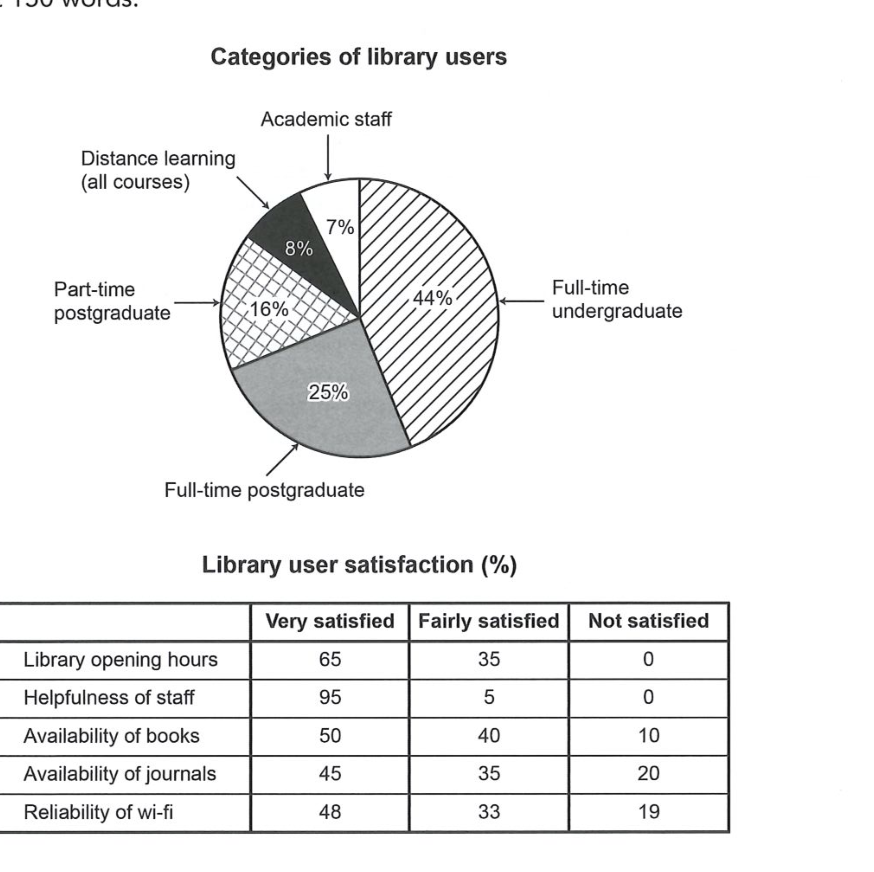
The chart and table below show the results of a survey of library users at a university.
Summarise the information by selecting and reporting the main features, and make comparisons where relevant.
Categories of library users
Student answer (Band 6.0)
The pie chart gives us the information about the outcomes of survey which show us different people who uses the library in the university.
Overall, the full time undergraduate students are the most and common users of libarary however academic staff rarely use the libarary. Moreover the libarary users are more satisfied with helpfull staff and large proportion in not statisfied category is from availabillity of journals.
If we take a look on chart the full-time undergraduate are the most common users of library which shows proportion of 44%, after that full-time postgraduate are following the trend which shares 25% of users of libarary. Moreover the part-time postgarduate share 16% of users while the distance learning and academic staff shares the more least users around 8% and 7%.
Futhermore, the 95 % users are satisifed with helping staff and 5% fairly satisified, the second most satisified category is from opening hours of library with 65% very satisified and with 35% of fairly satisfied. Morover availability of books, journals and reliable wifi have around 47 % of very satisified users with upto 36% of fairly satisfied and approximately 19.5% of users are not satisified with these services.
AI examiner evaluation
| Criterion | Band |
|---|---|
| Task Achievement / Task Response | 6.5 |
| Coherence and Cohesion | 6.5 |
| Lexical Resource | 5.5 |
| Grammatical Range and Accuracy | 5.5 |
| Overall | 6.0 |
Task Achievement / Task Response: Band 6.5
You cover both parts of the visual and give a clear overview: undergraduates form the largest user group, while academic staff are the smallest, and staff helpfulness receives the strongest satisfaction rating. These are accurate, relevant main features. You also report several key figures correctly, including 44%, 25%, 16%, 8% and 7% for user categories, and the 95% very-satisfied result for staff helpfulness. However, the final comparison groups books, journals and Wi-Fi together as having “around 47%” very satisfied and “approximately 19.5%” not satisfied, which obscures meaningful differences: journal dissatisfaction is highest at 20%, while book dissatisfaction is 10%. More precise comparisons across these services would make the report more fully developed.
Coherence and Cohesion: Band 6.5
The response has a coherent overall arrangement: an introduction is followed by an overview, then a paragraph on user categories and one on satisfaction. This gives the reader a clear route through the two visuals, and linking phrases such as “Overall,” “Moreover” and “Furthermore” help signal progression. Some connections are nevertheless mechanical or repetitive, particularly the repeated use of “Moreover,” and the opening of the third paragraph repeats the point that undergraduates are the largest group. The final sentence also combines several service ratings without clearly separating the comparisons, making the information harder to follow. Grouping the satisfaction results into clearer comparisons and using more varied referencing would strengthen cohesion.
Lexical Resource: Band 5.5
You use relevant task vocabulary, including “proportion,” “users,” “satisfied” and “availability,” and phrases such as “full-time undergraduate” identify the categories clearly. However, the range and control are limited by repeated wording and several inaccurate or awkward expressions. “The most and common users” is not a natural collocation, while “shares the more least users” makes the comparison difficult to understand. There are also noticeable spelling errors, including “libarary,” “postgarduate,” “Futhermore” and “satisifed.” These do not prevent the overall message from being understood, but they reduce precision and polish. Aim for accurate, concise reporting verbs and check spelling carefully.
Grammatical Range and Accuracy: Band 5.5
You attempt both simple and more complex sentence forms, including clauses introduced by “which” and “while,” and the main comparisons are generally understandable. Some grammatical errors remain, however. In the opening, “different people who uses” has a subject–verb agreement error; “the full-time undergraduate are” also needs a plural noun or a singular construction. Articles and sentence patterns are sometimes inaccurate, as in “the outcomes of survey” and “the second most satisfied category is from opening hours.” The long final sentence joins several figures in a way that makes the relationships unclear. Use shorter, controlled sentences for each comparison, and check agreement, articles and sentence boundaries.
See this exact question answered at other band scores. The same prompt compared across bands.
Browse more IELTS Writing model answers or get your own writing scored by the same AI examiner.