Band 4.5 IELTS Writing Task 1 Model Answer
Overall Band Score: 4.5 · Cambridge IELTS 21 · 2026-11-18
IELTS Writing Task 1 question
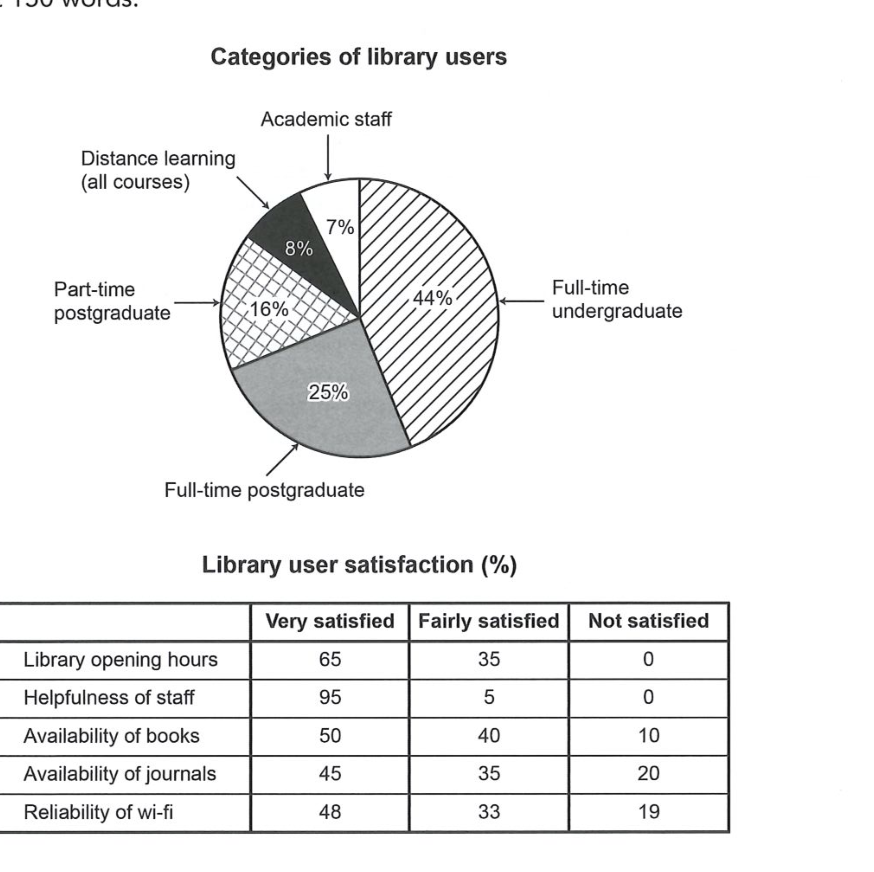
The chart and table below show the results of a survey of library users at a university.
Summarise the information by selecting and reporting the main features, and make comparisons where relevant.
Categories of library users
Student answer (Band 4.5)
The chart and table illustrate that survey on number of users have to use library at a university.
Overall, full-time undergraduates are most used and academic staff is spend less time in library according to the chart. Moreover, the most of the users are very satisfied with opening hours of library. Helpfulness of staff is least percentage with fairly satisfied in the given table.
Firstly, 44% of full-time undergraduates are used the library and coming to the full-time postgraduates they are quarterly used the library. Furthermore, the part-time postgraduates, distance learning and academic staff are used moderately 16,8 and 7 percents.
Secondly, the library user satisfaction per
AI examiner evaluation
| Criterion | Band |
|---|---|
| Task Achievement / Task Response | 4.0 |
| Coherence and Cohesion | 4.5 |
| Lexical Resource | 5.0 |
| Grammatical Range and Accuracy | 5.0 |
| Overall | 4.5 |
Task Achievement / Task Response: Band 4.0
The response identifies the largest user group, full-time undergraduates (44%), and includes the remaining category figures, so some relevant information is selected. However, it does not adequately summarise the table: the final sentence stops at “the library user satisfaction per,” and no satisfaction results are reported. The overview also misreads the data by saying academic staff “spend less time” in the library; the chart shows their share of users, not time spent. The claim that staff helpfulness has the lowest percentage of fairly satisfied users is also inaccurate: it is 5%, but opening hours are 35%, and the table’s strongest result is 95% very satisfied with staff helpfulness. The response is also 43 words below the required minimum. Cover both visuals and report the main comparisons accurately.
Coherence and Cohesion: Band 4.5
There is a basic attempt to organise the response: an opening, an overview, and paragraphs introduced by “Firstly” and “Secondly.” The user-category figures are grouped together, which gives the first body paragraph a clear focus. However, progression is incomplete because the final paragraph breaks off after “the library user satisfaction per,” leaving the table unexplained and the response without a proper ending. Some linking phrases, such as “Moreover” and “Furthermore,” connect sentences but do not establish meaningful comparisons. The overview also mixes user proportions with time spent, making the relationship between ideas unclear. Develop a complete paragraph for the satisfaction table, use comparisons to guide the reader, and ensure each paragraph has a finished purpose.
Lexical Resource: Band 5.0
The response uses some task-related vocabulary, including “full-time undergraduates,” “part-time postgraduates,” “distance learning,” and “satisfied,” and the category labels are generally recognisable. However, the range is limited and several word combinations are inaccurate or unclear, such as “most used,” “quarterly used,” and “used moderately.” “Spend less time in library” also expresses a different idea from the chart, which reports the proportion of users in each category. Repetition of “used” makes the description less precise, while “the library user satisfaction per” is unfinished and does not communicate a complete point. Use accurate reporting language such as “accounted for,” “represented,” and “the proportion of respondents,” and choose terms that describe satisfaction levels rather than frequency of library use.
Grammatical Range and Accuracy: Band 5.0
The response attempts a few longer sentence forms, including “Moreover, the most of the users are very satisfied…” and “Furthermore, the part-time postgraduates, distance learning and academic staff are used…,” but these structures are often faulty. Errors include subject–verb agreement in “full-time undergraduates are most used,” an incorrect verb construction in “are used the library,” and missing or misplaced articles in phrases such as “at a university” and “in library.” The sentence beginning “Secondly” is incomplete, so it does not form a complete grammatical statement. Most sentences rely on simple patterns, and errors sometimes make the intended meaning difficult to follow. Practise complete comparative sentences with accurate subjects and verbs, for example, “Full-time undergraduates accounted for 44% of users, compared with 25% for full-time postgraduates.”
See this exact question answered at other band scores. The same prompt compared across bands.
Browse more IELTS Writing model answers or get your own writing scored by the same AI examiner.